Can XRP Hit Four Digits Before 2030? Jake Claver Says It’s Still Possible
Digital Ascension Group CEO Jake Claver is still arguing that XRP could reach both three-digit and four-digit price territory before 2030, even if the US Digital Asset Market Clarity Act is not yet in place. In his lates...
Archive context
Older archive item. Useful for background and entity history, but not a fresh market-moving signal.

Digital Ascension Group CEO Jake Claver is still arguing that XRP could reach both three-digit and four-digit price territory before 2030, even if the US Digital Asset Market Clarity Act is not yet in place. In his latest YouTube comments, Claver framed that outcome not as a simple market cycle call, but as a function of utility, liquidity, and a potential supply shock tied to institutional adoption.
Could the Clarity Act Be The Trigger For $1,000 XRP?His central point is that XRP would need to reach a much higher price before it could be used at the scale he envisions for back-end settlement across tokenized markets. “I really think three and four digits are both possible prior to the Clarity Act,” Claver said. “I think that three digits is much more likely prior to the Clarity Act and four digits could absolutely come after the Clarity Act. And the reason for that is it really can’t start being used for back-end settlement till it’s at least three digits at scale.”
That logic sits at the heart of his thesis. Claver is not describing price appreciation as a side effect of utility arriving later. He is arguing the reverse: that XRP must first reach what he called a kind of critical mass in price and liquidity before large-scale settlement usage can begin. In his telling, a low-priced asset would not have the bandwidth required to handle settlement flows tied to markets such as equities, foreign exchange, commodities, or tokenized real-world assets.
He also argued that XRP is positioned unusually well for that transition. Claver said banks can already hold crypto to settle transactions, citing what he described as authority from the OCC, and added that XRP is “already a commodity” in the US in his view. He pointed to XRP’s listing on Bitnomial against USD and its treatment there alongside Bitcoin and Ether as part of that reasoning.
From there, the argument becomes more aggressive. Claver said a crisis moment could trigger the kind of supply shock needed to force XRP materially higher. “I think it’s in a unique position to be used in a crisis moment and we’ll have a supply shock that pushes it to at least three digits,” he said. “But four digits could happen before the Clarity Act, but I think I don’t have a certainty on that. It could be that four digits does not happen until after the Clarity Act is passed.”
In a separate video, Claver addressed whether XRP could still appreciate meaningfully by 2030 even if his broader “domino theory” for adoption never fully plays out. His answer was yes, but with limits. Without simultaneous demand from exchanges, institutions, markets, and potentially retail, he said the “big exponential move” would be hard to achieve, even if ETFs continue to consume available supply in OTC venues and dark pools.
He rejected the idea of a fixed repricing or peg, arguing that XRP would need a dynamic price that can keep rising as network volume expands. “It needs to be dynamic and fluid,” Claver said. “If it is fixed or stagnant like it would be if it was pegged, it doesn’t provide the same bandwidth over the long term.” He tied that to a much broader forecast, saying he believes 80% of global value will be tokenized by the end of 2030 and that XRP will settle that back-end activity.
To illustrate the “critical mass” concept, Claver compared XRP to ETF adoption thresholds. He said an ETF may need to reach $100 million before certain institutions can participate meaningfully, because of position limits and minimum allocation sizes. XRP, he argued, faces a similar hurdle: without enough liquidity first, meaningful institutional use does not begin; without that use, the extreme price targets many holders discuss do not materialize.
The result is a thesis that rises or falls on one key assumption: that markets will need XRP to be expensive before they can use it at scale. If that demand shock arrives, Claver sees room for a rapid repricing. If it does not, he suggested, the four-digit scenario remains out of reach.
At press time, XRP traded at $1.4067.
Why this matters
XRP is showing up inside the Institutional Adoption theme, so this story is worth tracking for follow-through rather than treating it as a one-off headline.
Original source
Read on NewsBTCRelated market context

Open USD supply on Ethereum tops $100M in its first week
OUSD's rapid growth on Ethereum highlights institutional influence in stablecoin markets, raising concerns about liquidity concent...

Ethereum (ETH) Price Prediction: ETH Eyes Recovery From $2,600 as $2,666-$2,689 Becomes Resistance
Ethereum price is holding around $2,618 as buyers attempt to preserve the latest recovery, but the market is approaching a decisiv...
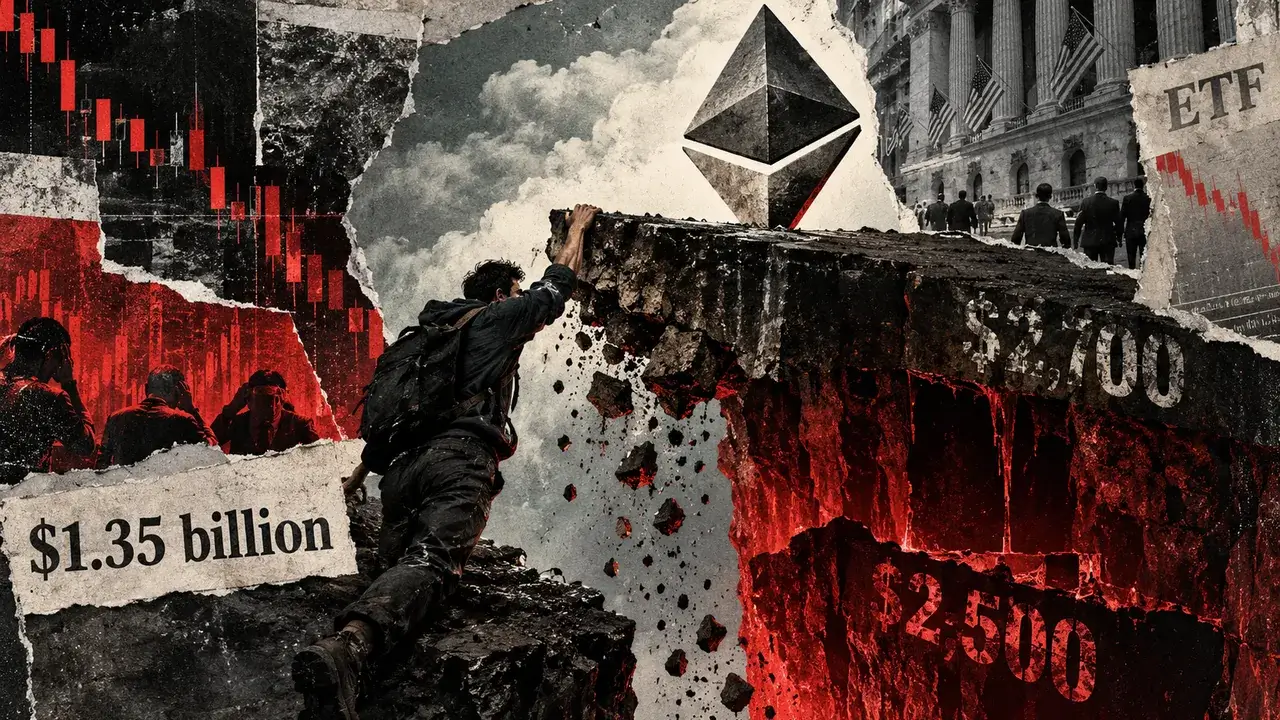
Ethereum falls 6%, leaving $1.35 billion in long bets at risk of liquidation
Ethereum’s slide toward $2,500 has put about $1.35 billion of leveraged long positions at increasing risk of liquidation. CoinMark...

XRP News: XRPL $2.2B Tokenization Depends on Energy Token
In major XRP news today, XRPL reported lead in tokenized commodities rests heavily on a single Justoken energy token: RWA.xyz list...

Sam Altman ChatGPT AI Predicts XRP Could Hit an Unbelievable Price by 2027
OpenAI’s ChatGPT AI predicts that if a monumental event lands for Ripple, XRP could surge to $50 or more. In this wildly bullish p...

Ethereum Tests 200 Million Gas Limit On Sepolia As Glamsterdam Moves Forward
TL;DR: Ethereum’s Sepolia testnet is testing a 200 million block gas limit as part of work around the Glamsterdam upgrade. The exp...