Ethereum And Solana Flash ‘W Bottoms’: Bollinger Returns With Legendary Call
John Bollinger, the inventor of Bollinger Bands and a figure whose occasional crypto market calls carry outsized weight, says Ethereum and Solana are tracing potential “W” bottoms—while Bitcoin is not. In a post on X on...
Archive context
Older archive item. Useful for background and entity history, but not a fresh market-moving signal.
John Bollinger, the inventor of Bollinger Bands and a figure whose occasional crypto market calls carry outsized weight, says Ethereum and Solana are tracing potential “W” bottoms—while Bitcoin is not. In a post on X on October 18, Bollinger wrote: “Potential ‘W’ bottoms in Bollinger Band terms in ETHUSD and SOLUSD, but not in BTCUSD. Gonna be time to pay attention soon I think.”
Potential ‘W’ bottoms in Bollinger Band terms in $ETHUSD and $SOLUSD, but not in $BTCUSD. Gonna be time to pay attention soon I think.
— John Bollinger (@bbands) October 18, 2025
Ethereum And Solana Price: What To Watch NowThe emphasis on “Bollinger Band terms” is doing heavy lifting here. In classic Bollinger taxonomy, a W bottom is a two-trough reversal with the second low holding above the first, often accompanied by a volatility signature that includes a prior band expansion, subsequent contraction, and a failure to register a lower low at the bands on the second leg.
The more robust versions see the second low forming inside the bands or with a positive divergence against the lower band, followed by a band “pinch” and a move through the middle band that transitions into an upper-band walk. Bollinger’s phrasing—“potential” and “time to pay attention”—signals that, in his framework, pattern recognition precedes confirmation, and that the validation trigger lies in subsequent price interaction with the middle and upper bands rather than in the raw shape of the price lows alone.
The rarity of Bollinger’s crypto commentary layered urgency onto the signal. As crypto trader Satoshi Flipper (@SatoshiFlipper) stressed, “John Bollinger, creator of Bollinger Bands, makes barely 1 crypto call per year and hasn’t made one for ETH in 3 years until yesterday. And each call he makes goes on to mark generational bottoms. He just told us SOL + ETH have bottomed, now imagine fading this legend.”
The same account detailed that Bollinger’s last notable Ethereum call dates to September 9, 2022, noting that ETH “went on to pump from $1,290 to $4,000.” That historical reference captures the prevailing market psychology: Bollinger’s infrequent, technically disciplined alerts are perceived by many traders as cycle-defining.
Context from earlier this year also helps frame the setup. On April 10, Bollinger publicly flagged a similar structure in Bitcoin, saying: “Classic Bollinger Band W bottom setting up in BTCUSD. Still needs confirmation.” In the exact same week, BTC carved out a bottom at $74,508 and proceeded to log seven straight green weekly candles, advancing roughly 55%. From Bollinger’s call into the first week of October, BTC rallied more than 70%.
The market nuance in Bollinger’s latest readout is the explicit exclusion of Bitcoin. If ETHUSD and SOLUSD are printing W-like structures in Bollinger terms while BTCUSD is not, it implies a temporary decoupling in volatility structure and relative strength. In practical terms, a non-confirming Bitcoin can either lag into a later confirmation, remain range-bound in a mid-band churn, or fail its own setup if lower-band interactions persist without recapture of the middle band.
For Ethereum and Solana, confirmation would typically look like sustained closes above the 20-period moving average (the Bollinger middle band), followed by a disciplined advance that converts the upper band from resistance into a guide. A healthy W bottom sequence tends not to produce immediate, vertical band overthrows; rather, it builds a stair-step profile with periodic mid-band checks that hold.
Failure would involve another lower-band excursion that undercuts the second trough or a volatility bloom that widens the bands without directional follow-through—both signatures of an incomplete base.
At press time, ETH traded at $4,037.
Why this matters
This altcoin story adds another data point to the current market tape and is useful when read alongside nearby source coverage.
Original source
Read on NewsBTCRelated market context
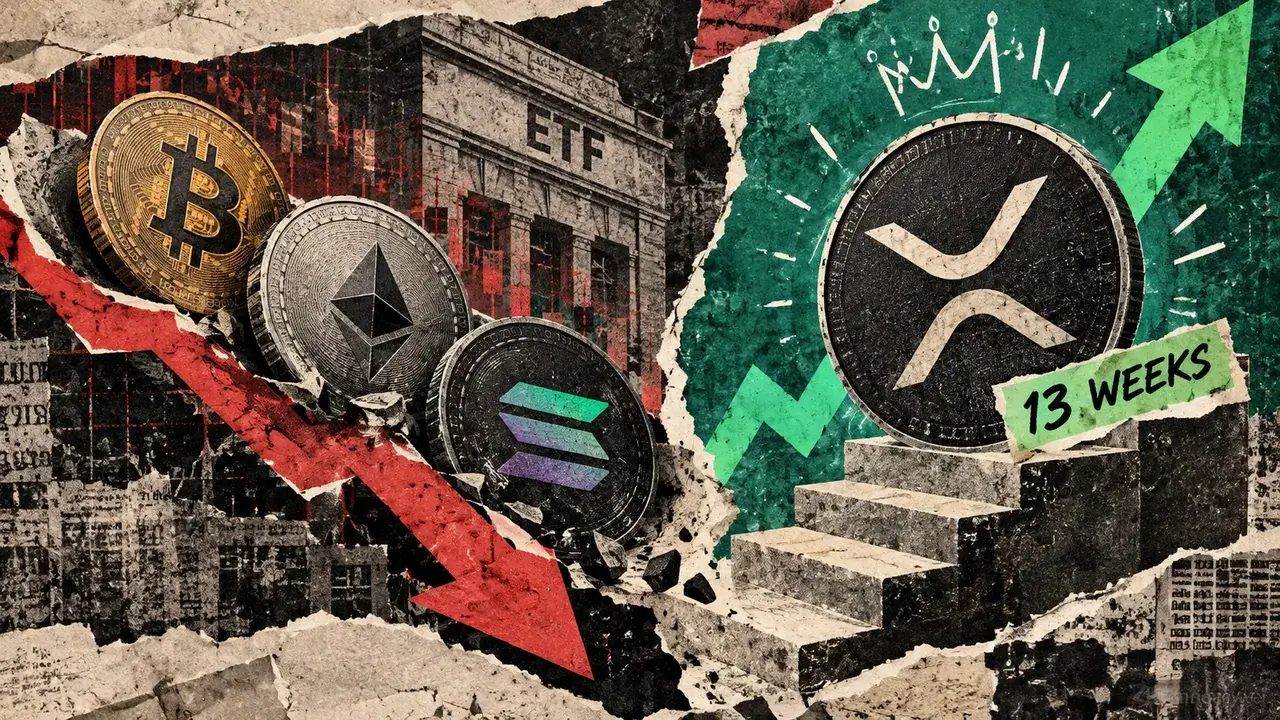
XRP ETFs extend a 13-week inflow streak as Bitcoin, Ethereum and Solana funds shed $1.25 billion
US-listed XRP ETFs extended their inflow streak to 13 weeks as Bitcoin, Ethereum and Solana funds suffered nearly $1.25 billion in...

Circle mints 250M USDC on Solana, boosting liquidity and network potential
Increased USDC supply on Solana may enhance network activity and adoption, but market caution persists regarding significant price...

Starknet considers leaving Ethereum for a quantum-resistant Layer 1
Starknet's STRK token more than doubled over seven days while developers considered leaving Ethereum to build an independent Layer...
Bitcoin, Ethereum and Solana ETFs All in the Red for October
Bitcoin ETFs have seen $386.3 million in net outflows through the first seven trading days of October, while Ethereum funds have n...

Sam Altman ChatGPT AI Predicts Bitcoin to Hit Insane All-Time High in 2026
Sam Altman’s ChatGPT AI predicts Bitcoin could reach a new all-time high in 2026, nearly doubling its October 2025 high of $126,00...

AI Could Weaken Ethereum Security as Cryptographic Risks Grow, Vitalik Buterin Warns
Buterin urged developers to prepare for potential AI vulnerabilities in both conventional and quantum-resistant cryptography, whil...