Why This Market Analyst Is Advising XRP Investors Not To Sell Their Coins
A growing part of the XRP community is paying closer attention to infrastructure changes taking shape on the XRP Ledger, especially as they relate to long-term utility and institutional adoption. That context explains wh...
Archive context
Older archive item. Useful for background and entity history, but not a fresh market-moving signal.

A growing part of the XRP community is paying closer attention to infrastructure changes taking shape on the XRP Ledger, especially as they relate to long-term utility and institutional adoption.
That context explains why crypto market commentator Brad Kimes, widely known on X as Digital Perspectives, reiterated a long-standing message that continues to resonate with many XRP holders: “Never sell your XRP.” His comment was in anticipation of the upcoming XRPL Lending Protocol.
Why You Shouldn’t Sell Your XRPThe comment from Digital Perspectives was a response to a post from Ed Hennis, a software engineer at Ripple, who recently outlined the upcoming proposal for the XRPL Lending Protocol. The proposal introduces fixed-term, fixed-rate, underwritten credit directly at the protocol level of the XRP Ledger. This approach is interesting because it moves lending away from smart-contract layers into a standardized, protocol-native system governed by validator consensus.
According to the explanation by Ed Hennis, the proposed loans on the XRPL Lending Protocol are going to be done with structured, clear terms, predictable interest, and explicit authorization, features that real-world institutions expect before committing capital. Therefore, Digital Perspectives’ “never sell” message is a reflection of a longer-term view where holders never sell their XRP and instead use them as collateral for loans.
Instead of relying on generalized liquidity pools like most lending protocols, the design of the XRPL Lending Protocol places each loan inside a segregated Single Asset Vault. This structure isolates risk to a specific credit facility and avoids the cross-contamination that has plagued many DeFi lending platforms during periods of market stress. Therefore, the XRPL Lending Protocol reduces execution risk and creates a framework that resembles traditional credit markets more closely than existing crypto lending models.
Real-World Applications Of The XRPL Lending ProtocolMost decentralized lending systems today depend on heavy overcollateralization to offset volatility and the risk of anonymity. That approach might work for traders, but it is inefficient for real businesses that operate on predictable cash flows and underwritten credit lines. Enterprises are accustomed to borrowing without locking up more capital than the value of the loan itself, and that mismatch has kept many institutions on the sidelines.
The XRPL’s approach introduces undercollateralized, institutionally underwritten lending alongside existing overcollateralized models. This expands the range of viable borrowers and aligns on-chain credit with how financing actually works in traditional markets.
As noted by Hennis, real-world use cases of XRPL’s lending protocol include market makers borrowing XRP/RLUSD for inventory and arbitrage, Payment Service Providers (PSPs) borrowing RLUSD to pre-fund instant merchant payouts, and fintech lenders accessing short-duration working capital. The feature is slated to be available for voting at the end of January 2026. From there, the voting decision is up to validators on the XRP Ledger.
Once the lending protocol goes live and XRP begins to play a direct role in institutional credit markets, selling XRP at that stage may be short-sighted.
Why this matters
This altcoin story adds another data point to the current market tape and is useful when read alongside nearby source coverage.
Original source
Read on NewsBTCRelated market context

Bitcoin holder loses 80 BTC worth $5.2 million after moving funds to reseller-bought Ledger
The incident underscores the critical importance of purchasing hardware wallets from official sources to ensure asset security. Th...

Ledger Probes Potential Theft of $87M in User Funds Tied to Crypto Wallet Reseller
Ledger asked reseller CryptoBilis to pause sales and urged recent buyers not to set up their devices, as an onchain investigator t...

XRPL’s $1.34 billion stablecoin base doesn’t tell us how much XRP users need
Tracked stablecoins on the XRP Ledger totaled $1.338 billion on Oct. 7. For XRP holders, the critical question is how much activit...

Brazil’s BRL 22T CSD BR Moves Fund Records to XRP Ledger in Live Tokenization Push
Key Takeaways: CSD BR is leveraging the XRP Ledger to reflect real-time fund holdings. Over BRL 22 trillion in registered assets i...
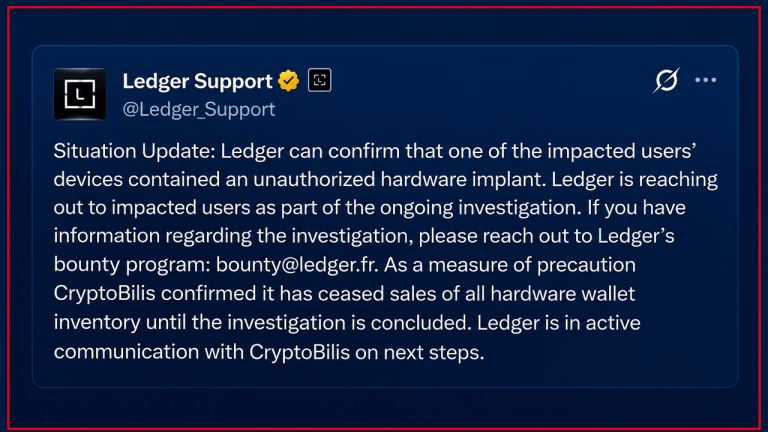
Ledger Confirms Hidden Hardware Implant in Affected User’s Wallet
Ledger confirmed Saturday, Oct. 10, 2026, that a hardware wallet belonging to one affected customer contained an unauthorized impl...
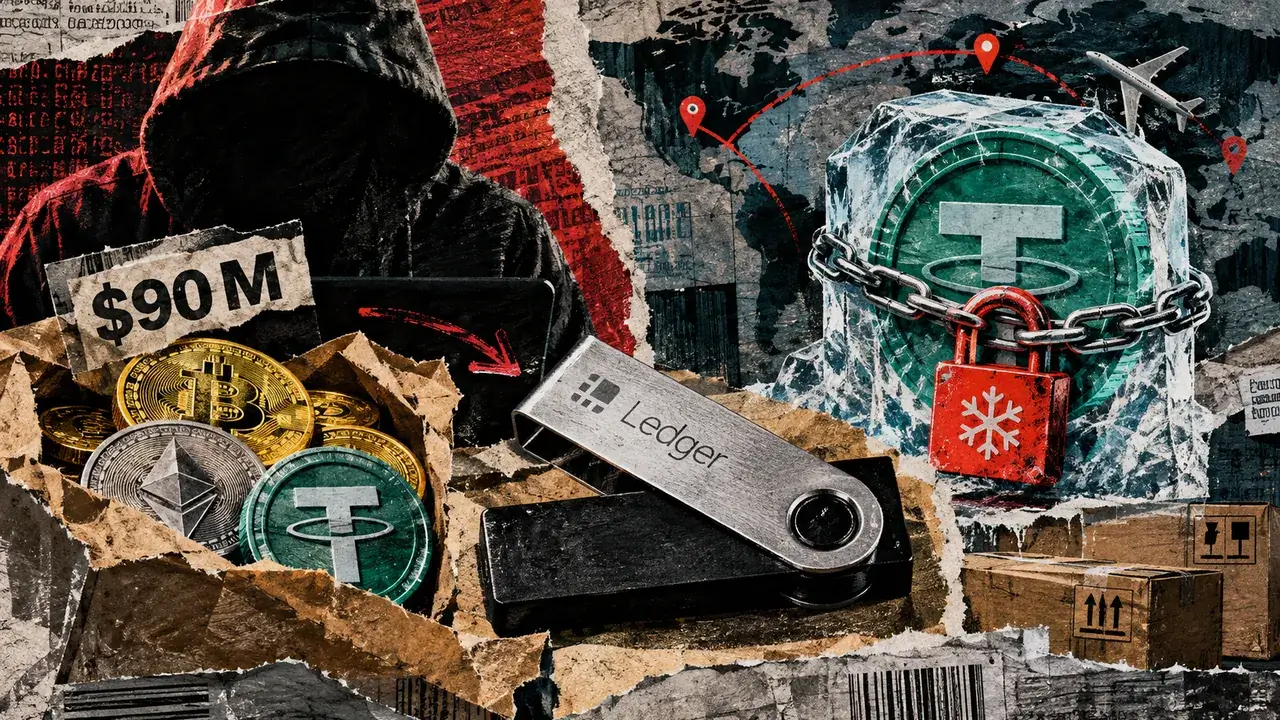
Ledger hack scare nears $90 million as Tether moves to freeze stolen USDT
Suspected Ledger wallet thefts are approaching $90 million as Tether freezes USDT stablecoin linked to the incident, according to...