Analyzing The Current Long-Term And Short-Term Bitcoin Holder Cost Bases
The current short-term and long-term bitcoin holder cost bases offer some signals about the market.The below is from a recent edition of the Deep Dive, Bitcoin Magazine's premium markets newsletter. To be among the first...
Archive context
Older archive item. Useful for background and entity history, but not a fresh market-moving signal.
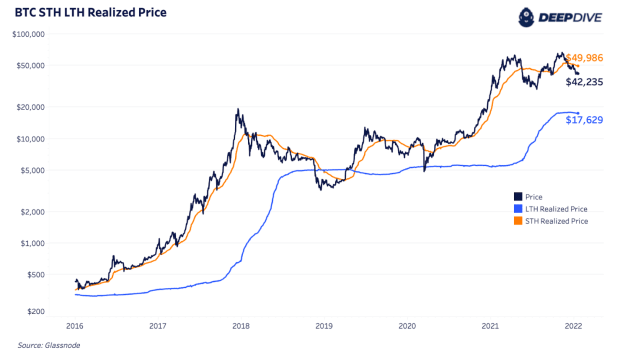
The current short-term and long-term bitcoin holder cost bases offer some signals about the market.
The below is from a recent edition of the Deep Dive, Bitcoin Magazine's premium markets newsletter. To be among the first to receive these insights and other on-chain bitcoin market analysis straight to your inbox, subscribe now.
The current short-term holder cost basis has been a key price support to watch over the last couple months as it’s dropped from nearly $53,000 to $49,986. Price below the short-term cost basis is a fairly cautious market sign as recent market buyers are down 15.5% on average. During the summer of 2021, price sustained below the short-term holder cost basis for nearly three months.
At the same time, we’re seeing little movement in the long-term holder realized price with almost no change since November. A rising long-term holder realized price is typically a bullish sign with long-term holders selling older coins with a lower cost basis.
A better way to view this relationship in tandem is using the Short-Term:Long-Term Cost Basis Ratio. We discuss the ratio more in-depth in The Daily Dive #103 - Short-Term Holder Dynamics.
As the short-term holder cost basis has fallen and the long-term holder cost basis has remained fairly neutral, the ratio is showing some signs of a potential uptrend. An upward-sloping ratio is a more bearish market sign.
Below, we highlight when the 14-day change in the ratio is accelerating or decelerating. Dark blue shows when the STH cost basis is increasing relative to the LTH cost basis. Red shows when the LTH cost basis increases relative to the STH cost basis. Historically this has been a quality signal to assess tops and bottoms.
Short-term holders account for 18.23% of outstanding circulating supply, a figure that is near five-year lows, with 93% of said short term holders currently sitting in loss.
Why this matters
This bitcoin story adds another data point to the current market tape and is useful when read alongside nearby source coverage.
Original source
Read on Bitcoin MagazineRelated market context

‘Bunker mode’ is a far greater challenge for institutions than individual crypto holders
As crypto debates whether holders should move funds before AI or quantum advances expose wallet keys, custody firms face a separat...
Citi predicts Bitcoin going back to $113,000. Here’s what the buying data shows
Citi's $113,000 Bitcoin target would require a roughly 36% rise from the Oct. 7 reference price, keeping it below its previous rec...
Bitcoin monthly inflows near $5B, but existing holders did most of the lifting
Existing holders driving Bitcoin's value increase suggests potential market vulnerability, as reliance on internal trading may lim...

Solana stablecoin holders top 14 million, setting a new record
Solana's record stablecoin holders could boost SOL demand, enhance retail and institutional adoption, and intensify competition wi...

Bitcoin’s slide below $81,000 exposes why a Fed pause may not save the crypto market
Bitcoin slid below $81,000 on Oct. 8, with an intraday low near $80,800, even as traders expect the Fed to hold in October. The Se...

Bitcoin and ether holders urged to enter ‘bunker mode’ against possible AI attacks
Ethereum researchers warned AI could break the signatures guarding bitcoin, ether and the tokens built on them "in months, not yea...