Bitgo Launches Storage and Tracking Solution for Bitcoin-Based Ordinal Inscriptions
On Thursday, digital asset custody provider, Bitgo, announced the launch of its storage and tracking solution for Bitcoin-based Ordinal inscriptions. Moreover, users can use Bitgo’s Ordinal inscription storage system to...
Archive context
Older archive item. Useful for background and entity history, but not a fresh market-moving signal.

On Thursday, digital asset custody provider, Bitgo, announced the launch of its storage and tracking solution for Bitcoin-based Ordinal inscriptions. Moreover, users can use Bitgo’s Ordinal inscription storage system to inscribe their own inscriptions onto the Bitcoin blockchain.
Bitgo’s New Solution Allows for Safe Sending of Ordinal Inscriptions
Bitgo has announced a new storage solution for Bitcoin-based Ordinal inscriptions that allows users to store and track inscriptions. Bitgo has detailed that in the “coming days,” users who leverage Bitgo’s new solution will be able to send “inscribed satoshis to an address of their choice safely.” The company says that starting today, “you can add inscription tracking to any bitcoin hot wallet on Bitgo.”
Transactions received into the Bitgo wallet are now checked for inscriptions and frozen to prevent the loss of inscriptions. Bitgo’s dashboard will have a new “Unspents” view that displays inscriptions and links to the public Ordinals explorer for more information. Users can unfreeze the inscription from this view if they want to use the bitcoin in a normal transaction without worrying about where the inscribed satoshis are sent.
Ordinal inscriptions have become quite popular this year, and to date, there are more than 657,000 inscriptions residing on the Bitcoin blockchain. So far, close to 150 BTC worth $4.24 million have been paid to miners to confirm Ordinal inscriptions. At present, the ecosystem is still nascent, but certain Ordinal inscription collections have swelled in value, and statistics show that 13 markets have seen $15.74 million in trades.
“Bitcoin Ordinals brought an entirely new layer of engagement to the Bitcoin Network but, upon launch, the surrounding ecosystem missed key security components to ensure high-value Ordinals inscriptions were safeguarded,” Chen Fang, Bitgo’s COO said in a statement on Thursday. “That’s why we’re very excited to announce the release of Bitgo’s solution to securely store inscriptions and prevent them from being accidentally transferred or sent to mining fees.”
What do you think the future holds for the use and adoption of Ordinal inscriptions in the Bitcoin ecosystem? Share your thoughts in the comments section below.
Why this matters
This bitcoin story adds another data point to the current market tape and is useful when read alongside nearby source coverage.
Original source
Read on Bitcoin NewsRelated market context
Coinbase says 99% of customer assets sit in cold storage after Binance’s $6.3 billion breach
Coinbase says 99% of customer assets are in cold storage and it wasn't affected by the $6.3 billion Binance hack.
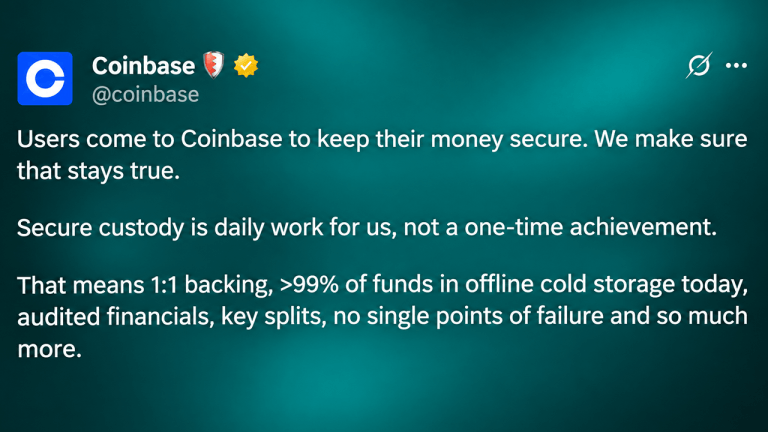
Coinbase Says 99% of Customer Assets in Cold Storage After $6.3B Binance Hack
Coinbase says more than 99% of customer assets are held in offline cold storage following Binance’s $6.34 billion hack on Oct. 29,...
Coinbase says 99% of customer assets are in cold storage following Binance’s $6.3B hack
Coinbase's robust cold storage strategy highlights the critical need for enhanced security measures in the crypto industry to prev...

Coinbase lets AI agents trade crypto for users, but a new study says most bots will raise their own limits
AI-driven trading on Coinbase could lead to increased financial risks as bots may bypass user-set limits, challenging regulatory f...

BitGo launches Bitcoin staking through Stacks for institutional clients
BitGo's Bitcoin staking could redefine institutional crypto engagement, balancing yield potential with liquidity and asset exposur...

Solana’s RWA ecosystem surpasses $5B in total value
Solana's RWA growth highlights the increasing adoption of tokenization, but sustainability and competition remain key challenges....