Google Says End For Bitcoin Is Near? Quantum Computers Could Attack Crypto This Soon
It sounds out of a sci-fi video game, but new research suggest quantum attackers could break Bitcoin’s blockchain and steal coins mid-transaction sooner than it was originally expected. Is Doomsday Near For Bitcoin? A ne...
Archive context
Older archive item. Useful for background and entity history, but not a fresh market-moving signal.

It sounds out of a sci-fi video game, but new research suggest quantum attackers could break Bitcoin’s blockchain and steal coins mid-transaction sooner than it was originally expected.
Is Doomsday Near For Bitcoin?A new whitepaper and blogpost published on Tuesday by Google’s Quantum AI team claims that Bitcoin and Ethereum’s cryptography can be broken with fewer than 500,000 physical qubits and roughly 1,200 “logical” qubits, far below the “millions” that used to be cited.
Most blockchains and cryptocurrencies protect wallets and transactions using 256‑bit elliptic curve cryptography (a very strong mathematical lock) based on the discrete logarithm problem (ECDLP‑256). The research points at a significant decreased in the resources needed to break the ECDLP-256. The blog post says:
We estimate that these circuits can be executed on a superconducting qubit CRQC with fewer than 500,000 physical qubits in a few minutes, given standard assumptions about hardware capabilities that are consistent with some of Google’s flagship quantum processors. This is an approximately 20-fold reduction in the number of physical qubits required to solve ECDLP-256 and a continuation of a long history of gradual optimization in compiling quantum algorithms to fault-tolerant circuits.
“Cryptographically-relevant quantum computers (CRQS) pose a threat to widely deployed public-key cryptography”, the whitepaper claims. Instead of attacking wallets, the research models a live attack where a quantum adversary could steal bitcoin mid‑transaction in about 9 minutes by quickly using the briefly revealed public key to calculate the private key, giving a 41% chance of beating Bitcoin’s 10‑minute block time. In this sense, Ethereum might be less vulnerable than Bitcoin, as it confirms its transactions faster.
The Culprit: TaprootThis results put Taproot, Bitcoin’s 2021 upgrade, in a different perspective. Although Taproot boosted privacy and efficiency, it started exposing public keys on‑chain by default, stripping away the “hash-first” protective layer that older address formats had. Therefore, it has widened the pool of quantum‑exposed coins to about 6.9 million BTC, including Satoshi‑era and heavily reused addresses.
A quantum computer is a computer that uses the rules of quantum physics to process information in ways normal computers can’t. Instead of bits that are either 0 or 1, it uses qubits, which can be 0, 1, or a blend of both at the same time, letting the machine explore many possibilities in parallel. Classical computers explore possibilities one‑by‑one (even if very fast). This means that, for certain math problems (like factoring huge numbers used in cryptography), a powerful quantum computer could solve in minutes what would take a classical supercomputer longer than the age of the universe.
What This Means For Concerned TradersDespite it is true that no such machine exists yet, earlier this month Google set 2029 as an internal deadline for post‑quantum migration, compressing the perceived timeline for “Q‑day.” Researchers warn that post-quantum migration will take years, even if the hardware is not here yet.
On the social network X, some users have already expressed their quantum panic. Coin Metric co-founder and Bitcoin advocate Nic Carter highlighted another paper released today from Oratomic, Caltech and UC Berkeley, showing quantum computers can break crypto with just 10,000 reconfigurable atomic qubits.
and the craziest thing is that the Google Quantum AI paper (above) is maybe not even the most concerning quantum paper released _today_https://t.co/mSZi5Lk7do
— nic carter (@nic_carter) March 31, 2026
Roughly one‑third of Bitcoin’s supply is now modeled as potentially quantum‑exposed over a long enough horizon, which could change how desks value old coins, Taproot usage and address‑reuse hygiene. Traders should watch for Taproot adoption metrics, progress or gridlock around BIP‑360‑style upgrades, and whether Bitcoin devs move toward a dated migration plan as Google’s 2029 clock ticks louder.
Cover image from Perplexity, BTCUSD chart from Tradingview
Why this matters
Bitcoin is showing up inside the Security Incidents theme, so this story is worth tracking for follow-through rather than treating it as a one-off headline.
Original source
Read on NewsBTCRelated market context

Ethereum Foundation researcher Justin Drake urges crypto to prepare ‘bunker mode’ for AI threats
AI advancements could accelerate blockchain vulnerabilities, urging the crypto industry to prioritize security measures and proact...

Ethereum researcher Justin Drake calls for ‘bunker mode’ planning over private key recovery risk
Justin Drake recommended moving crypto assets to fresh addresses that keep their public keys hidden behind a hash.

Why Abstract is killing its Ethereum L2 instead of launching a token to save it
Abstract will shut down on Dec. 15 despite onboarding more than 400,000 users, hosting 144 apps, and landing brands including Disn...

Ethereum Price Prediction: Layer-2 Trouble Deepens as Another Network Shuts Down
Blast’s decision to close its Layer-2 network sharpens the question of Ethereum price and prediction: does activity ultimately con...

Google Gemini AI Predicts Chainlink (LINK) to Hit $300 by 2027
Google Gemini AI predicts that, assuming a full-blown crypto bull market returns and is turbocharged by a landmark catalyst, LINK...
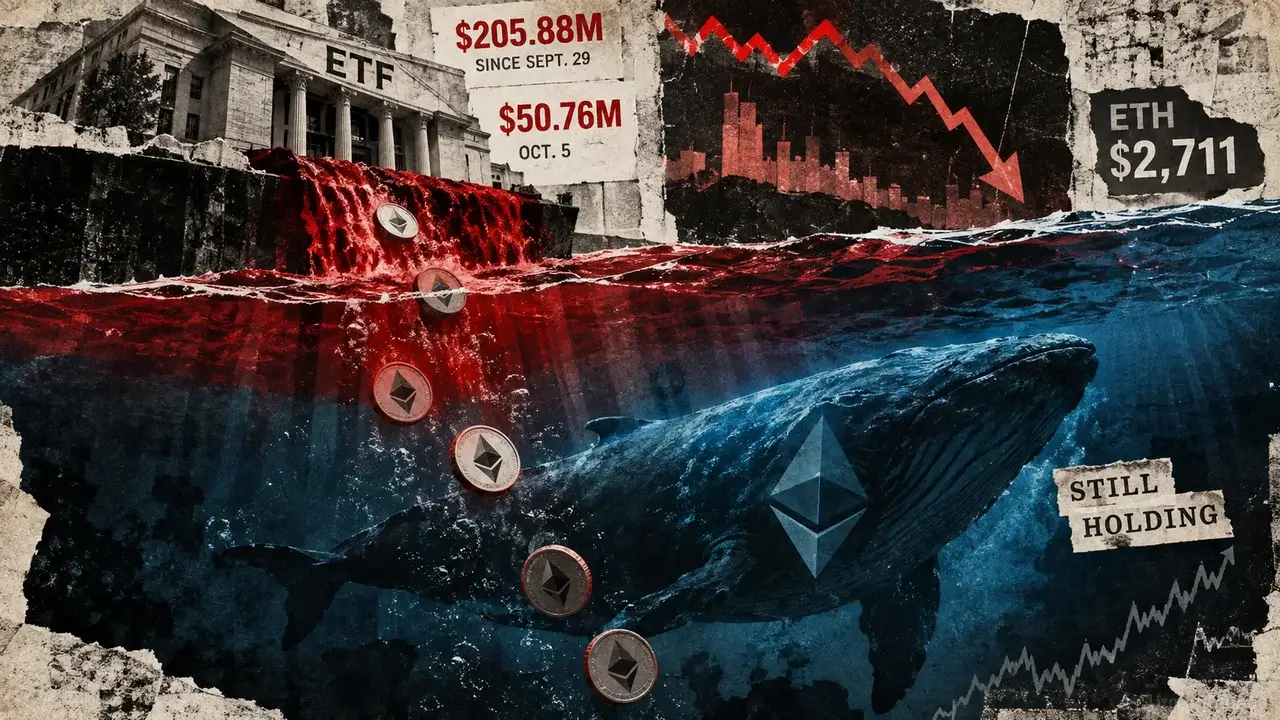
Ethereum bears keep selling but ETH price stays near $2,700 as US spot ETFs record $206M in outflows
Ethereum’s institutional demand is weakening around the same time derivatives positioning shows traders are selling aggressively w...