Riot Sells More Than 20,000 Bitcoin as AI Data-Centre Contracts Reach $38B
TL;DR: Riot Platforms says it sold 20,264 BTC in the first nine months of 2026, raising about $1.5 billion primarily for data-centre development. Its latest quarterly release puts long-term contracted data-centre revenue...
Archive context
Published within the last day. A tracked entity is involved.
TL;DR: Riot Platforms says it sold 20,264 BTC in the first nine months of 2026, raising about $1.5 billion primarily for data-centre development. Its latest quarterly release puts long-term contracted data-centre revenue at around $38 billion, underlining how far the miner’s business model is shifting.
Riot Platforms has made a striking choice with its Bitcoin holdings: sell a substantial amount of the asset it mines to finance the infrastructure it hopes will deliver future revenue. That strategy is clearer than ever in its third-quarter results, released November 4.
In its earnings filing, Riot said it sold 20,264 Bitcoin year to date for approximately $1.5 billion, mainly to fund data-centre construction. The company also announced a 15-year powered-land lease for 910 critical IT megawatts at its Corsicana campus, representing about $28 billion of contractual value over the initial term.
Mining remains substantial, but contracts tell the new storyRiot recorded $181.4 million in third-quarter revenue, barely above the comparable quarter a year earlier. Bitcoin mining contributed $116 million, down from $160.8 million, even though production increased to 1,637 BTC from 1,406 BTC. The company attributes much of the decline in mining revenue to a lower average realised Bitcoin price during the quarter.
At the same time, engineering revenue rose to $47 million and data-centre revenue was $18.4 million. Those lines make the transition visible in the income statement, although the extraordinary long-term lease figures are not the same as cash already earned. They depend on delivery milestones, counterparties, the terms of each agreement and years of operations.
Riot says it has now leased 1,151 MW of critical IT capacity, with roughly $38 billion of long-term contracted revenue. Investors should distinguish that total contract value from current profit, and consider what future capital expenditure may be required to bring the facilities online.
Why selling Bitcoin is a strategic trade-offThe Bitcoin sales create resources that can fund land, power connections, construction and specialised infrastructure. They also reduce direct exposure to future Bitcoin appreciation. It is a deliberate decision to exchange part of a liquid treasury asset for a business with potentially steadier contracted revenues, but one that carries construction and customer concentration risks.
Riot said it ended September with $950.2 million of cash and Bitcoin, including 2,418 BTC. It reported no equity raised during 2026, a detail relevant to shareholders concerned about dilution as build-outs expand.
Mining economics are still important. Riot reported an average cost to mine Bitcoin of $39,265 excluding depreciation, influenced by power-curtailment credits. Such credits are valuable, but energy arrangements and pricing can change. Our earlier look at Bitcoin miners’ growing AI commitments explored the same industry-wide tension between holding coins and building something new.
What will show whether the pivot worksThe milestones that matter most are construction progress, delivery of contracted megawatts, tenant payments and conversion of headline lease values into recurring revenue. A business can accumulate an impressive contract pipeline while facing sizeable financing, permitting or execution obstacles.
Riot’s disclosure shows that Bitcoin mining companies are not necessarily behaving like Bitcoin holding companies. One of the industry’s biggest operators is increasingly using the mined asset as a funding source for a different kind of data-centre business. That may eventually diversify earnings, but the timing and profitability have to be proven in cash flow rather than headlines.
This article was written by the News Desk and edited by Samuel Rae.
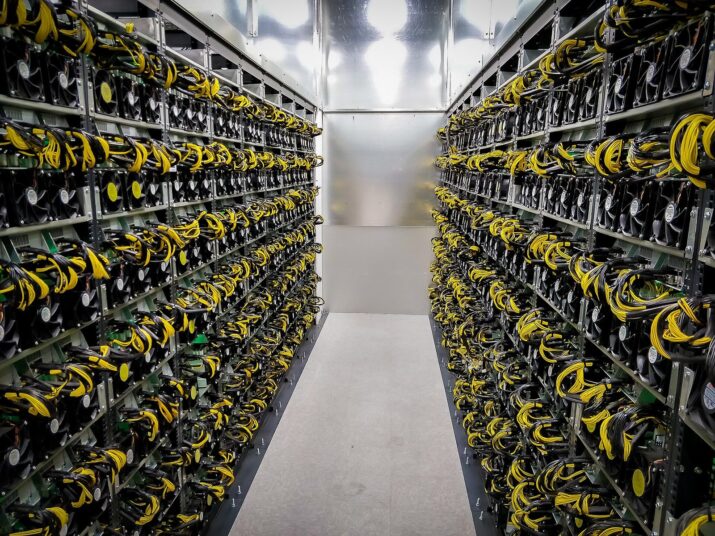
Featured image: Illustrative photograph of Bitcoin mining racks (2018 Argo Blockchain Mirabel facility; does not depict a Riot Platforms site). Photo: MikeBogosian via Wikimedia Commons, licensed under CC BY-SA 4.0.

Why this matters
Bitcoin is showing up inside the Mining theme, so this story is worth tracking for follow-through rather than treating it as a one-off headline.
Original source
Read on NewsBTCRelated market context
Core Scientific’s AI Colocation Revenue Jumps to $215M as Mining Role Shrinks
TL;DR: Core Scientific reported $215.4 million in third-quarter colocation revenue, nearly 60% above the prior quarter, while bill...
Hut 8 Expands AI Campus Commitments While Funding Buybacks With Bitcoin Sales
TL;DR: Hut 8 says it fully commercialised its Beacon Point AI campus with a second 352 MW lease, taking expected aggregate base-te...

Core Scientific projects $1.8 billion annual run-rate as it exits Bitcoin mining for AI colocation
Core Scientific's pivot to AI colocation could stabilize revenue streams, reducing reliance on volatile Bitcoin markets and enhanc...

Strive (ASST) Adds 29 Bitcoin for $2.2 Million as Weekly Buys Slow After Crossing 43,000
Bitcoin Magazine Strive (ASST) Adds 29 Bitcoin for $2.2 Million as Weekly Buys Slow After Crossing 43,000 Strive bought another 29...

Bitcoin Price Drops Below $74,000 as Nvidia Probe and Regulation Fears Spark $1 Billion in Liquidations
Bitcoin Magazine Bitcoin Price Drops Below $74,000 as Nvidia Probe and Regulation Fears Spark $1 Billion in Liquidations Bitcoin p...
Strategy (MSTR) Adds 1,036 Bitcoin for $81.9 Million as Holdings Slip Below Cost
Bitcoin Magazine Strategy (MSTR) Adds 1,036 Bitcoin for $81.9 Million as Holdings Slip Below Cost Strategy bought another 1,036 bi...