Why Bitcoin’s rally is dangerous according to new Fed data
Bitcoin’s rally and the Federal Reserve’s new financial-risk gauge describe two different time horizons. BTC reflects demand and positioning in today’s market. The Fed’s measure tracks structural weaknesses that could ma...
Archive context
Older archive item. Useful for background and entity history, but not a fresh market-moving signal.
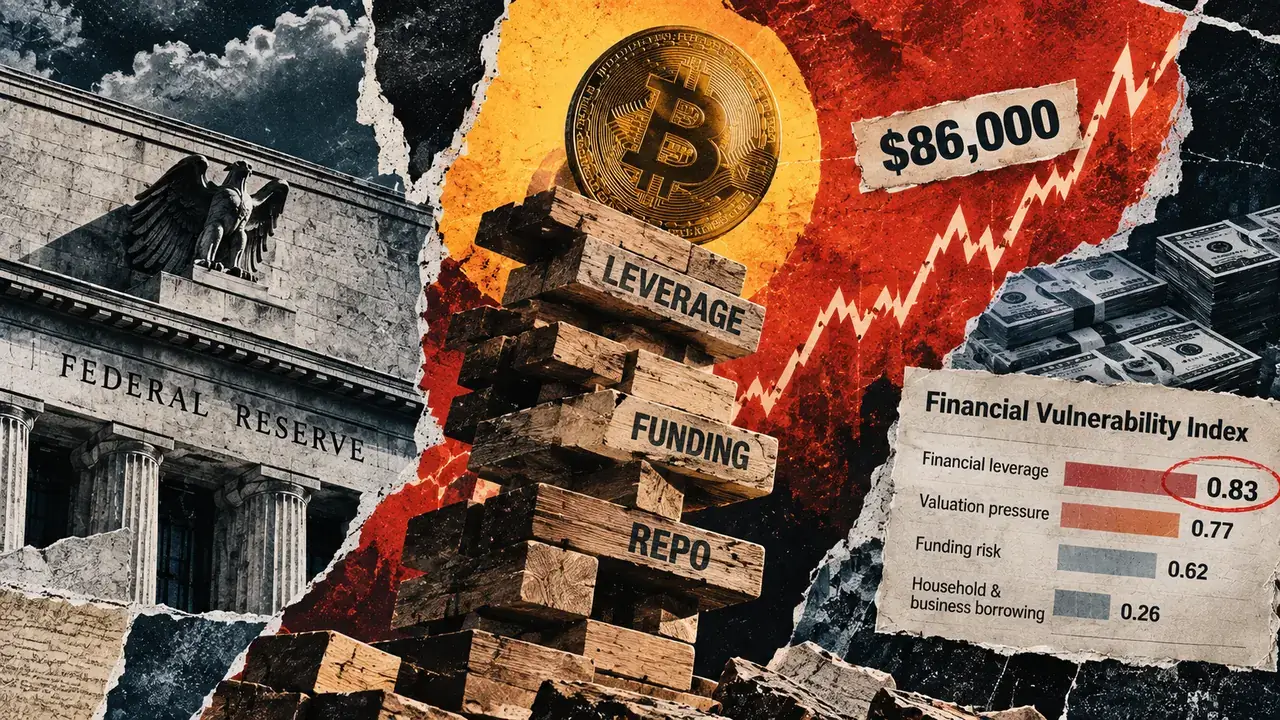
Bitcoin’s rally and the Federal Reserve’s new financial-risk gauge describe two different time horizons. BTC reflects demand and positioning in today’s market. The Fed’s measure tracks structural weaknesses that could magnify the next shock.
The Financial Vulnerability Index is built to capture slow-moving vulnerability rather than coincident market stress. In Figure 2, the final financial-leverage annotation is 0.83, inside the “elevated” band of its historical distribution. The aggregate index is labeled 0.65, valuation pressure 0.77 and funding risk 0.62, all “notable.” Household and business borrowing is lower at 0.26.
Figure 2: Heatmaps of aggregate FVI and its subindices. Red: 0.81-1 percentiles (Elevated); orange: 0.61-0.8 percentiles (Notable); yellow: 0.41-0.6 (Moderate); green: 0.21-0.4 (Low); blue: 0.01-0.2 (Extremely Subdued).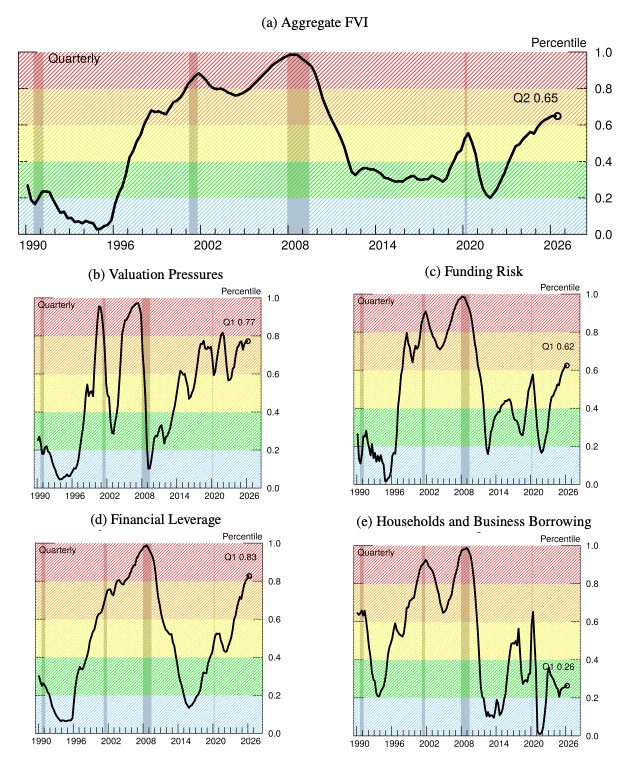
The chart labels the four components Q1 and the aggregate index Q2, with 2026 as the last axis mark. The working paper separately says its dataset and several estimation samples end in 2025:Q4, without explaining whether the endpoints are later-vintage observations, nowcasts or a labeling issue. That limits the safe description to Figure 2’s quarter labels and values, without assigning them a verified 2026 observation date.
Related Reading Bitcoin shattered $80,000 after a $148 billion US liquidity shock failed to break marketsThe distinction between vulnerability and current conditions explains the apparent split. Conventional financial-conditions indexes rise as credit tightens and visible stress emerges. The FVI can build through calmer periods as leverage and risk-taking accumulate.
Bitcoin’s current move has its own drivers. On Sept. 21 BTC touched $86,000, more than 10% above the prior Sunday close, as spot taker flow turned positive and volume rose. Short liquidations helped Monday’s leg higher. Futures open interest and funding paid by longs were above Glassnode’s high bands, options open interest was near $41 billion, and options were pricing less movement than the market delivered.
Related Reading Bitcoin hits $85,000 after $648M wipeout forces mass buying
A June analysis, “Decomposing Hedge Funds’ U.S. Treasury Exposures,” estimated that large hedge funds had $4 trillion of gross Treasury exposure and $3 trillion of repo borrowing as of September 2025. Its proxy estimates included about $830 billion in cash-futures basis trades and $305 billion in swap-spread trades.
Related Reading Why Bitcoin's rally above $80,000 isn't backed by institutional convictionThe Fed’s separate review of government bond-backed repo markets found that short-term funding, dealer intermediation, collateral reuse and low haircuts can carry stress across funding, cash and derivatives markets. Higher margin calls or tighter dealer capacity could force liquid-asset sales, weaken crypto spot demand and liquidate leveraged BTC positions. That cross-market sequence remains a scenario; the cited evidence has not observed the full chain.
The working paper’s historical model shows why the vulnerability reading matters. In high-FVI periods, the same modeled business-cycle shock produced deeper declines in consumption and long-term investment than in low-FVI periods. The index is therefore best read as an amplifier gauge: it describes the system’s capacity to turn a shock into wider damage, while Bitcoin’s immediate path remains tied to flows, liquidity and positioning.
The working paper reflects its authors’ analysis and does not indicate concurrence by the Federal Reserve Board.
The post Why Bitcoin’s rally is dangerous according to new Fed data appeared first on CryptoSlate.
Why this matters
Bitcoin is showing up inside the Security Incidents theme, so this story is worth tracking for follow-through rather than treating it as a one-off headline.
Original source
Read on CryptoSlateRelated market context
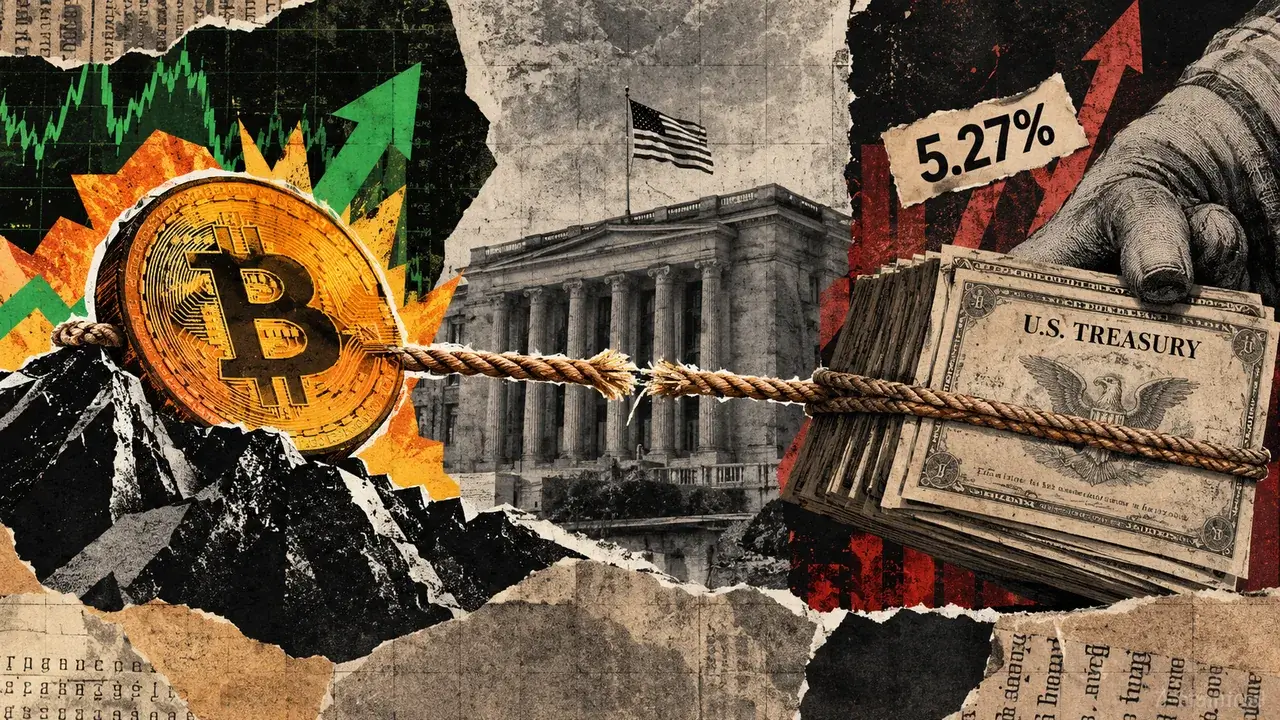
Bitcoin price has risen 84% since January 2024 while Treasury yields climbed
Bitcoin traded below $84,000 on Oct. 7 as US Treasury yields near 5.3% offered investors a competing interest-bearing alternative....

Tether Celebrates 12 Years, USD₮ Surpasses 700M Users
Key Takeaways: Tether marked the 12th anniversary of the world’s largest stablecoin by market cap, USD₮. The company claims that U...

OKX Secures Circle, Ripple and Standard Chartered Backing at $25B Valuation
Key Takeaways: OKX raised funding with Circle, Ripple, QRT, and SC Ventures with a valuation of $25B. The deal is a continuation o...

US Government Moves $103M in Seized Bitcoin and BNB to Coinbase Prime, Raising Sale Questions
The Bitcoin and BNB transactions drew attention because Coinbase Prime provides institutional custody and trading services for dig...

Elon Musk Grok AI Predicts Bitcoin Could Hit $1M by 2027
Elon Musk’s Grok AI predicts a wild price target for Bitcoin through the end of 2026, claiming that in a full-blown bull market, c...

Solana Foundation Offers Banks Open-Source Code to Settle Tokenized Trades in One Step
When a bank or fund trades a security, the rule known as delivery-versus-payment means the security and the money are exchanged to...