Congress wants to make crypto easier to use and still collect $500 million more in taxes
A House crypto tax overhaul would raise an estimated $500 million while easing taxes on stablecoin payments and small fees. The House Ways and Means Committee is scheduled to consider H.R. 10357, the Digital Asset Tax Ce...
Archive context
Older archive item. Useful for background and entity history, but not a fresh market-moving signal.
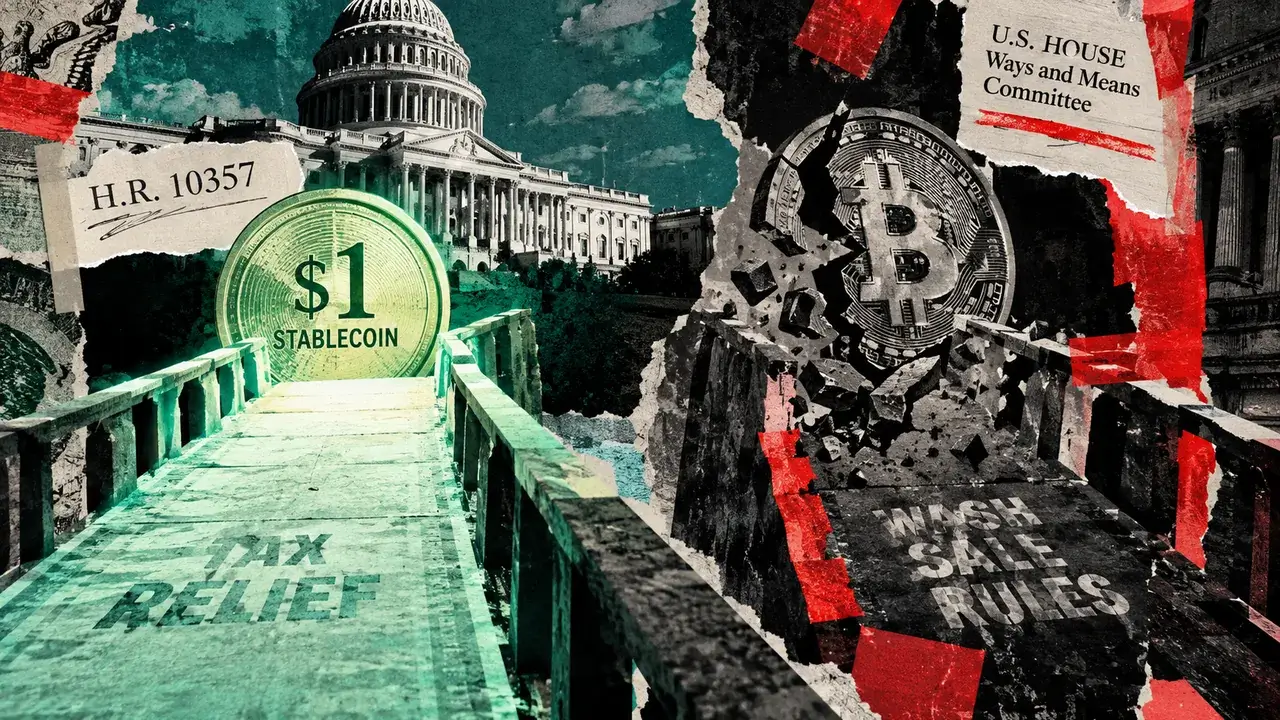
A House crypto tax overhaul would raise an estimated $500 million while easing taxes on stablecoin payments and small fees.
The House Ways and Means Committee is scheduled to consider H.R. 10357, the Digital Asset Tax Certainty Act, on Sept. 16, putting a broad rewrite of digital-asset taxation before lawmakers after months of negotiations over how closely crypto should be treated like traditional financial assets.
The Joint Committee on Taxation estimates the legislation would increase federal receipts by about $500 million net from fiscal 2027 through 2036, after accounting for provisions that both raise and reduce government revenue.
The package includes rules covering stablecoins, transaction fees, trading losses, digital-asset lending, staking and past tax violations.
That fiscal outcome reflects the bill's central trade-off. Lawmakers would remove some tax friction that makes routine crypto activity cumbersome while extending securities-style rules to traders that could generate billions of dollars in additional receipts.
Speaking on the legislation, Andrew Gordon, a crypto tax lawyer, said:
“This is a massive step forward for crypto investors who simply want rules on tax. We all pay taxes, the rules need to be clear.”
Stablecoin relief comes with a costQualifying US dollar stablecoins would receive special treatment to prevent minor movements around their $1 peg from creating gains or losses that taxpayers must calculate each time they use the tokens.
Under the proposal, redemption value would generally determine the basis and proceeds for qualifying transactions occurring within prescribed bands around the peg. Traders, brokers and dealers would be excluded, along with certain users completing more than 5,000 counted transactions and taxpayers whose functional currency is not the dollar.
The measure would also disregard gains or losses when digital assets are used to pay network or transaction fees of no more than $10, covering costs such as blockchain gas fees and certain trading or liquidity charges.
That provision would take effect for dispositions after Dec. 31, 2027, and carries one of the package's highest costs. JCT estimates the small-fee relief would reduce federal receipts by $2.365 billion through 2036.
The legislation does not establish a general $10 exemption for purchases made with Bitcoin or other cryptocurrencies. The exclusion is tied to transaction-related fees, leaving most purchases subject to the existing treatment of digital assets as property.
Lawmakers would recover revenue elsewhere by ending a tax advantage crypto investors have long held over stock traders.
The bill extends wash sale restrictions to traded digital assets other than qualifying US dollar stablecoins. Under existing rules, an investor can generally sell Bitcoin at a loss, immediately buy it back and still use the loss for tax purposes because the wash-sale regime principally covers stocks and securities.
H.R. 10357 would restrict that strategy and would also reach certain economically equivalent assets, including wrapped and tokenized versions. JCT estimates the change would increase federal receipts by $1.707 billion over the budget window.
Another provision would expand access to mark-to-market accounting for digital-asset dealers and traders whose activities qualify as a trade or business. JCT estimates those changes would raise $2.332 billion through 2036.
Together, the two trading provisions are expected to generate more than $4 billion in receipts, helping absorb tax reductions elsewhere in the legislation.
Lending and staking move closer to traditional financeThe package reaches beyond trading by extending tax treatment already available for securities lending to qualifying digital-asset loans.
That could remove uncertainty over whether temporarily transferring crypto under a lending agreement constitutes a taxable sale. Qualifying arrangements would generally avoid immediate recognition of gains or losses if they meet requirements governing the return of equivalent assets and the transaction's economics.
Investment trusts would receive another targeted change. The bill would prevent an otherwise qualifying trust from losing its tax status solely because its trustee stakes digital assets held by the vehicle, potentially removing a barrier for investment products seeking to earn staking rewards.
However, the proposal is more limited for individual miners and stakers. It classifies validation income as ordinary income and establishes sourcing rules, while leaving intact the existing timing framework that generally recognizes staking rewards when a taxpayer obtains control of them.
That means the package stops short of an industry proposal to defer taxation of newly generated mining or staking rewards until the assets are eventually sold.
Taxpayers with older reporting problems would get another route into compliance. Treasury would be directed to establish a Digital Asset Voluntary Disclosure Program that would allow eligible taxpayers to correct past filings, pay outstanding tax and interest, and potentially receive relief from certain penalties.
Related Reading Trump’s Bitcoin made in America push runs into a power problem the tax bill cannot fixWednesday's markup is the first test of whether those compromises survive the legislative process. Committee members can amend the measure before voting on whether to advance it, and approval would still leave H.R. 10357 facing a House floor vote, Senate consideration and presidential action.
Changes to the wash-sale, fee or stablecoin provisions during markup could also alter JCT's projected $500 million net revenue gain, requiring lawmakers to decide how much tax relief they are willing to provide without turning the broader package into a revenue loser.
The post Congress wants to make crypto easier to use and still collect $500 million more in taxes appeared first on CryptoSlate.
Why this matters
Bitcoin is showing up inside the Stablecoins theme, so this story is worth tracking for follow-through rather than treating it as a one-off headline.
Original source
Read on CryptoSlateRelated market context

Cardano Brings Compliance Rules On-Chain With CIP-0113 Launch
TL;DR: Cardano’s CIP-0113 programmable token standard is now live on mainnet. It gives issuers the ability to build controls such...

Hong Kong to regulate bitcoin and digital assets with new legislation this year
Hong Kong's regulatory move may bolster investor trust and align with global trends, potentially driving increased bitcoin adoptio...

Tether signs MoU with Kazakhstan’s central bank to explore tenge stablecoins and tokenized assets
Kazakhstan's collaboration with Tether could enhance its fintech landscape, potentially boosting local currency integration in dig...

Chainlink’s Sergey Nazarov discusses digital assets and AI at Sibos 2026
The shift towards tokenized deposit chains by banks signifies a move from experimentation to infrastructure ownership, necessitati...

Robinhood adds $25 million of Bitcoin to its own balance sheet
Robinhood is adding $25 million of Bitcoin to its balance sheet after executives previously debated whether corporate crypto holdi...

U.S. Government Moves $103 Million in Seized Bitcoin and BNB, Sending BTC to Coinbase Prime
Wallets linked to the U.S. government moved $103.19 million in seized and forfeited crypto on Tuesday, Onchain Lens said in an X p...