L2 protocols Connext and Nomad introduce new modular blockchain interoperability stack
Connext, a level-2 interoperability protocol for Ethereum, today announced that it has formed a new partnership with Nomad, an interoperability protocol without header verification, to accelerate the adoption of trustles...
Archive context
Older archive item. Useful for background and entity history, but not a fresh market-moving signal.
Connext, a level-2 interoperability protocol for Ethereum, today announced that it has formed a new partnership with Nomad, an interoperability protocol without header verification, to accelerate the adoption of trustless, fully generalized cross-chain communication.
This partnership enables the world’s first modular interoperability stack that provides users a fast, cheap, and trust-minimized way to bridge assets between chains.
Overview of NomadNomad is an implementation and extension of the Optics protocol short for “OPTimistic Interchain Communication.” It is a new design for cheap, fully generalized cross-chain communication that can easily be deployed to any chain or L2 that supports user-defined computations.
As part of its protocol. Nomad utilizes an optimistic pattern. Messages that pass through Nomad have a latency of 35–60 minutes, within which fraud can be proven if message relayers are dishonest.
Particularly, Nomad is an ideal protocol for more generalized cross-chain operations that are typically performed by DAOs or other organizations, rather than end-users. For example, Nomad allows for migrating USDC from Ethereum L1 to other chains with lower trust assumptions than other bridges.
Modular InteroperabilitySome of the inherent problems with building cross-chain communication systems include:
- Trust-minimized: Do not involve trusted 3rd parties.
- Extensible: Can be quickly and easily deployed to new rollups/chains.
- Generalizable: Support sending arbitrary data across chains.
“Similar to the Scalability Trilemma, the Connext team proposed that it could solve this trilemma through a modular architecture where different communication protocols are layered on top of one another. Our work with Nomad is the first live example of the modular interoperability thesis in action!”
– The Connext Team
Connext’s protocol enables trustlessly sending value and calling contracts across blockchains and L2s. However, unlike Nomad, Connext does not allow for fully generalized communication but it does have much lower latency.
Additionally, Connext doesn’t mint tokens on a destination chain — rather, it relies on liquidity minted by other bridging systems like Nomad, thus absorbing their trust/risk assumptions.
The synergies between Connext and Nomad run deep. By using madTokens (as opposed to assets created by Multichain, Celer, or other trusted systems), Connext significantly reduces the trust/risk requirements for its users on any given chain.
At the same time, Connext provides a way for Nomad users to have “fast liquidity” on a given chain, leveraging Connext’s low latency liquidity pools to allow end-users to do transfers in minutes rather than with a latency over 30 minutes.
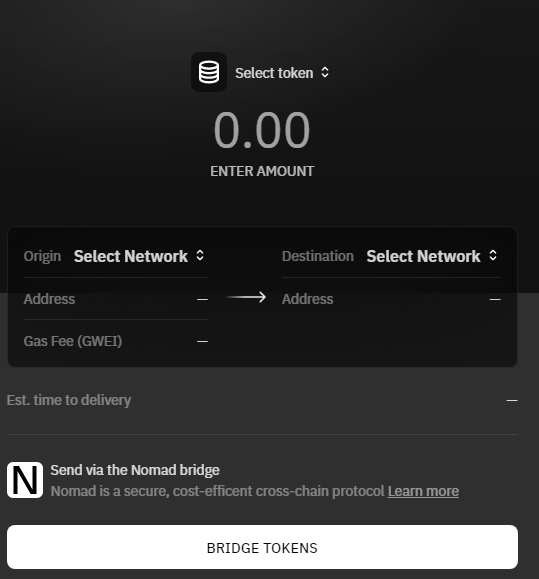
Already Live on MoonbeamUsers bridging via the Nomad app will be dynamically routed to Connext or Nomad depending on available liquidity and the size of the user’s transfer.
Nomad is a new design for cheaper cross-chain communication without header verificationFurther, Connext reports that whales and institutions will take the longer 35m Nomad bridging time, while end-users quickly trying to use Moonbeam apps will be routed via Connext. As liquidity on Connext grows, the use of Nomad can shift towards institutional capital and rebalancing Connext liquidity pools.
“The Connext ecosystem is already working on integrating Nomad into interfaces like xPollinate. We also plan to heavily advocate for and support Nomad’s growth as it rolls out to other chains and L2s. Longer term, our goal is to work closely with the Nomad team on shared offchain infrastructure and a combined onchain interface for developers. This would mean that, in a single integration, apps can leverage fast, limited Connext-style or slower, general Nomad-style communication depending a project’s context-specific needs.”
– The Connext Team
The post L2 protocols Connext and Nomad introduce new modular blockchain interoperability stack appeared first on CryptoNinjas.
Why this matters
This blockchain story adds another data point to the current market tape and is useful when read alongside nearby source coverage.
Original source
Read on CryptoNinjasRelated market context

Non-Custodial Crypto Exchanges: How Self-Custody Is Changing the Way Users Swap Digital Assets
For many users, the distinction comes down to custody. A centralized platform may hold assets on behalf of its customers, while a...

Tether Celebrates 12 Years, USD₮ Surpasses 700M Users
Key Takeaways: Tether marked the 12th anniversary of the world’s largest stablecoin by market cap, USD₮. The company claims that U...

Ethereum Price Prediction: Layer-2 Trouble Deepens as Another Network Shuts Down
Blast’s decision to close its Layer-2 network sharpens the question of Ethereum price and prediction: does activity ultimately con...
Coinbase Pro Returns With Deribit, Unlocking $30B Bitcoin Options Liquidity
Key Takeaways: Coinbase Pro returns with Spot, Futures, Perpetuals, Options, and Equities by the end of the year. Deribit is upgra...

Lido plans Morpho Blue fork ‘Lido Lend’ for new lending protocol in Q4 2026
Lido's entry into lending could enhance DeFi's appeal to passive investors, but governance and risk management will be critical ch...

Binance leads SanDisk perps liquidity, with OKX and Hyperliquid trailing
Binance's dominance in SanDisk perps highlights the growing intersection of crypto and traditional securities, raising potential r...