Saito – A Paradigm Shift in Blockchain Applications
Why you should listen Saito is a new type of layer-1 blockchain that powers peer-to-peer applications. Saito delivers a new economic model for blockchain. Saito Consensus aligns incentives for all participants, paying no...
Archive context
Older archive item. Useful for background and entity history, but not a fresh market-moving signal.

Saito is a new type of layer-1 blockchain that powers peer-to-peer applications. Saito delivers a new economic model for blockchain. Saito Consensus aligns incentives for all participants, paying nodes for scale while remaining open.
Saito is designed to create a real economy running on this network, that supports an open ecosystem of peer to peer applications, where users are sovereign and own their data, and providers that serve them best are most profitable.
Saito Consensus eliminates the sybil attacks, majoritarian attacks,and several other attack vectors common in proof-of-work and proof-of-stake consensus mechanisms by correcting the collective action problems buried in their incentive structures.
When users send transactions into the network they add cryptographic routing signatures that specify the first-hop node(s) to which they are sending their transaction(s). Receiving nodes add similar routing signatures as they forward these transactions, creating an unforgeable record within transactions of the path they have taken into the network.
These routing paths can be examined to confirm the amount of “routing work” available in a transaction. Transactions without valid routing paths contain no routing work. The amount of routing work in any other transaction is its total fee halved with each hop beyond the first that the transaction has taken into the network.
The blockchain maintains a “difficulty” for block production that is measured in routing work. Nodes produce blocks when they have enough routing work in the transactions in their mempool to meet difficulty criteria. Blocks which do not contain the required amount of routing work are invalid according to consensus rules.
While most of crypto uses a Web 2 model with token integrations or a federated model reliant on volunteer work, Saito applications operate in true, peer-to-peer Web 3 and are self-funding.
Supporting linksBitget VIP Link with BONUS 1000 USDT
If you enjoyed the show please subscribe to the Crypto Conversation and give us a 5-star rating and a positive review in whatever podcast app you are using.
ADVERTISEMENT
Advertise with BNC
Why this matters
This blockchain story adds another data point to the current market tape and is useful when read alongside nearby source coverage.
Original source
Read on Brave New CoinRelated market context

Ripple Custody Adds Canton Network Support, Bringing CC and CIP-56 Into One Vault
Key Takeaways: Ripple Custody 1.43 adds support for Canton Network, CC and CIP-56 tokens. Institutions can be given the same custo...

Liquid Network halts Bitcoin redemptions with reserves at about 86% coverage
The halted redemptions highlight the critical need for robust security and full reserve backing in maintaining trust in sidechain...

Chinese Communist Party Calls for a National Blockchain Network
The Central Committee of the Chinese Communist Party (CCP) has called for the creation of a national blockchain network to foster...
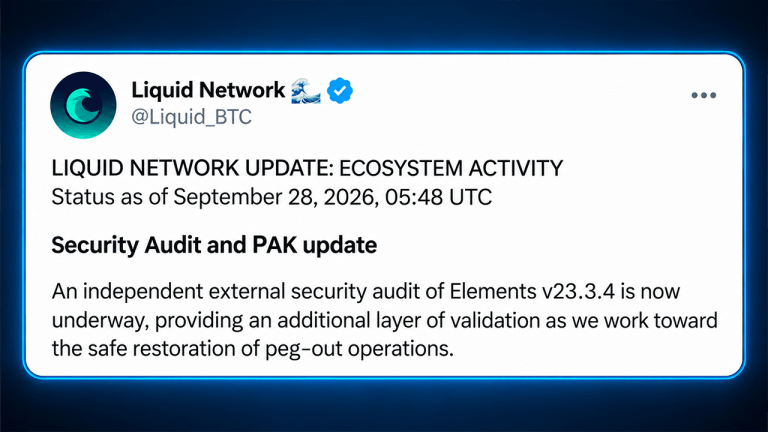
Liquid Network at 86% Backing as Bitcoin Redemption Freeze Drags On
It has been 35 days since an attacker exploited a vulnerability in the Liquid Network’s Elements software, draining nearly 4,000 B...

Circle mints 250M USDC on Solana, boosting liquidity and network potential
Increased USDC supply on Solana may enhance network activity and adoption, but market caution persists regarding significant price...

China calls for national blockchain network in new technology push
China's blockchain initiative could redefine global data markets, emphasizing state control and potentially influencing internatio...