S&P Global Targets $10B Blockchain Lending Market With New Risk Tool
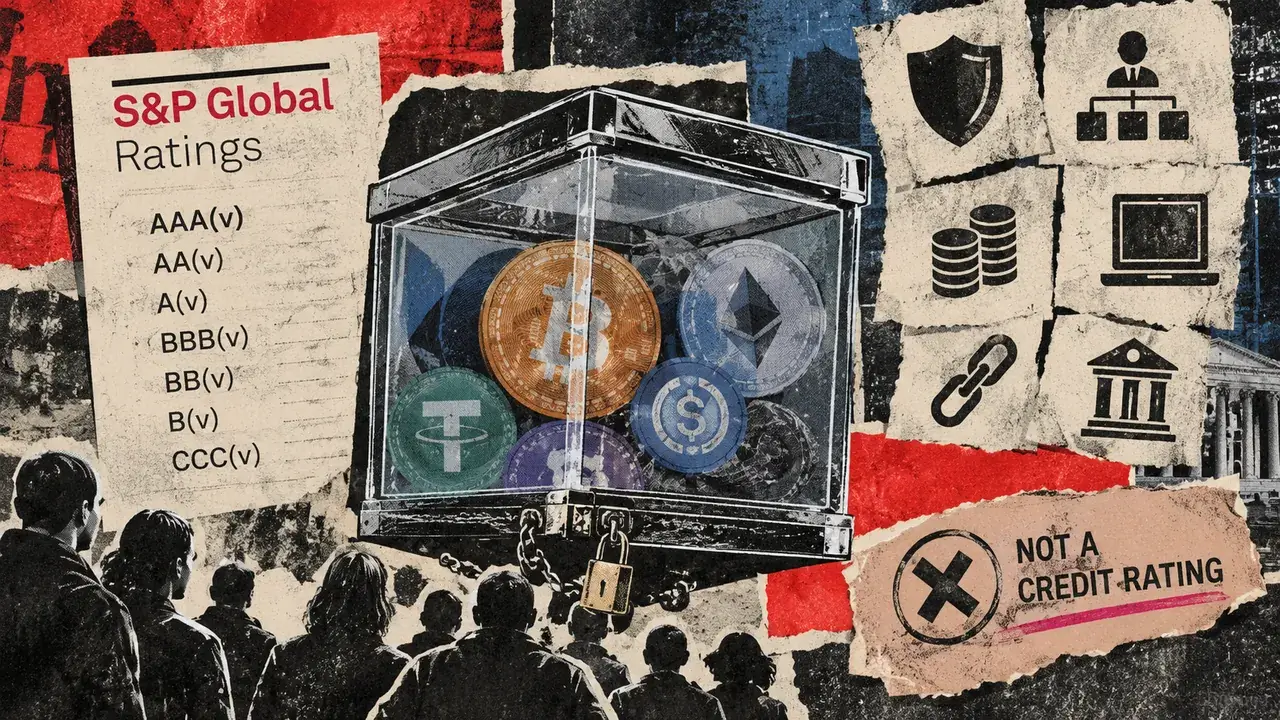
S&P Global Ratings launched its Vault Risk Assessment (VRA), offering a forward-looking assessment of six risks that could impair investors’ positions in blockchain-based lending vaults. The move comes as deposits in the...
Watchlist
Still recent enough for follow-up. Multiple named entities are involved.

S&P Global Ratings launched its Vault Risk Assessment (VRA), offering a forward-looking assessment of six risks that could impair investors’ positions in blockchain-based lending vaults. The move comes as deposits in the market reached approximately $10 billion in September 2026, up from $1.5 billion two years earlier.
The framework brings a familiar form of institutional risk analysis into a DeFi lending segment that has scaled quickly. Its scope is specific: it assesses relative impairment risk, not the attractiveness of a vault’s yield or the creditworthiness of an issuer in the conventional ratings sense.
JUST IN: S&P Global has offically launched AAA-style risk scores for DeFi, as crypto lending vaults hit $10 BILLION.
S&P Global Ratings' new "Vault Risk Assessment" will grade on-chain lending vaults, with "AAA(v)" as its lowest-risk score.
Deposits in these vaults have… pic.twitter.com/JiUVdCEtaC
Digital asset vaults pool investor deposits and deploy them on a blockchain according to defined strategies. S&P Global describes them as working much like managed fixed income funds, with strategies that may be automated through smart contracts, directed by human managers, or run through a combination of both.
The two figures in the announcement imply growth of about 6.7 times between September 2024 and September 2026, a calculation based on the reported $1.5 billion and $10 billion deposit totals. That expansion increases the amount of capital exposed to vault-specific decisions about eligible assets, liquidity, and management.
Earn $50 and Enter $300K Prize Draw on EdgeXHow S&P Global Vault Risk Assessment Works?The VRA is a forward-looking opinion on the overall relative risk of impairment to an investor’s position in a lending vault. Its six factors are portfolio credit quality, liquidity mismatch, curator risk, blockchain risk, protocol risk, and vault security and governance risk.
This matters because vault performance depends on more than the assets held at a particular moment. The framework considers the credit quality of the portfolio alongside liquidity conditions and risks associated with the people or entities curating the strategy, the underlying blockchain and protocol, and the vault’s security and governance.
Depositors receive share tokens representing their proportional claim on the vault’s assets and accrued returns. The structure can package lending exposure into an onchain investment vehicle, but tokenized ownership does not make the vault’s risk profile self-explanatory; the strategy and the conditions under which it operates remain material to an investor’s position.
S&P’s stated boundary is explicit: a VRA is not a credit rating and does not comment on yield levels.
Trade XRP on Bybit and Get a Chance to Win Our $1,000 USDT AirdropRisk Transparency Vs. PerformanceThe firm says the assessment moves beyond transaction transparency toward risk transparency, with the aim of helping institutions strengthen investment governance and vault selection.
S&P Global Ratings President Yann Le Pallec said the company sees demand for independent risk assessments that connect traditional finance with decentralized markets as digital assets institutionalize. This positioning makes the VRA relevant to institutional crypto investors assessing onchain lending exposure.
The distinction is important for market participants comparing vaults with familiar fund structures. A risk label can offer a standardized lens across several factors; it does not turn the underlying exposure into a conventional fixed income product or make yield and risk interchangeable measures.
S&P said it will publish initial Vault Risk Assessments in future announcements. Its Oct. 4 release provided no publication date, list of vaults to be assessed, or eligibility schedule, so the launch establishes the analytical framework.
Discover: The Best Token Presales
The post S&P Global Targets $10B Blockchain Lending Market With New Risk Tool appeared first on Cryptonews.
Why this matters
Tether is showing up inside the Institutional Adoption theme, so this story is worth tracking for follow-through rather than treating it as a one-off headline.
Original source
Read on CryptonewsRelated market context
S&P brings ratings-style scrutiny to $10 billion crypto vault market as $6 million Base incident exposes risks
S&P Global is bringing ratings-style risk assessments to crypto lending vaults as the fast-growing market confronts fresh security...

Plume Opens Onchain Access to Fidelity’s $28B Bond ETF Through New nBND Vault
Key Takeaways: Plume has introduced nBND, a tokenized vault with a primary asset of Fidelity Total Bond ETF (FBND). FBND is managi...

Spark Savings USDT vault nearly doubles to $600 million in two weeks
The rapid growth of Spark Savings USDT vault highlights increasing demand for decentralized finance solutions, though yield compre...

Lido plans Morpho Blue fork ‘Lido Lend’ for new lending protocol in Q4 2026
Lido's entry into lending could enhance DeFi's appeal to passive investors, but governance and risk management will be critical ch...

Tether Celebrates 12 Years, USD₮ Surpasses 700M Users
Key Takeaways: Tether marked the 12th anniversary of the world’s largest stablecoin by market cap, USD₮. The company claims that U...
Crypto trading giant GSR's new vault business is a $100M bet on onchain credit
The firm is putting its own capital into stablecoin and tokenized gold vaults as institutional finance moves further onchain.