Why DeFi giant Aave is pulling the plug on six hyped blockchains making less than $5,000 a quarter
In a July 29 forum-stage proposal, Aave risk service provider LlamaRisk recommended winding down the decentralized lender’s V3 deployments on Sonic, Scroll, zkSync, Metis, Soneium, and Aptos. The plan would put $4.1 mill...
Archive context
Older archive item. Useful for background and entity history, but not a fresh market-moving signal.
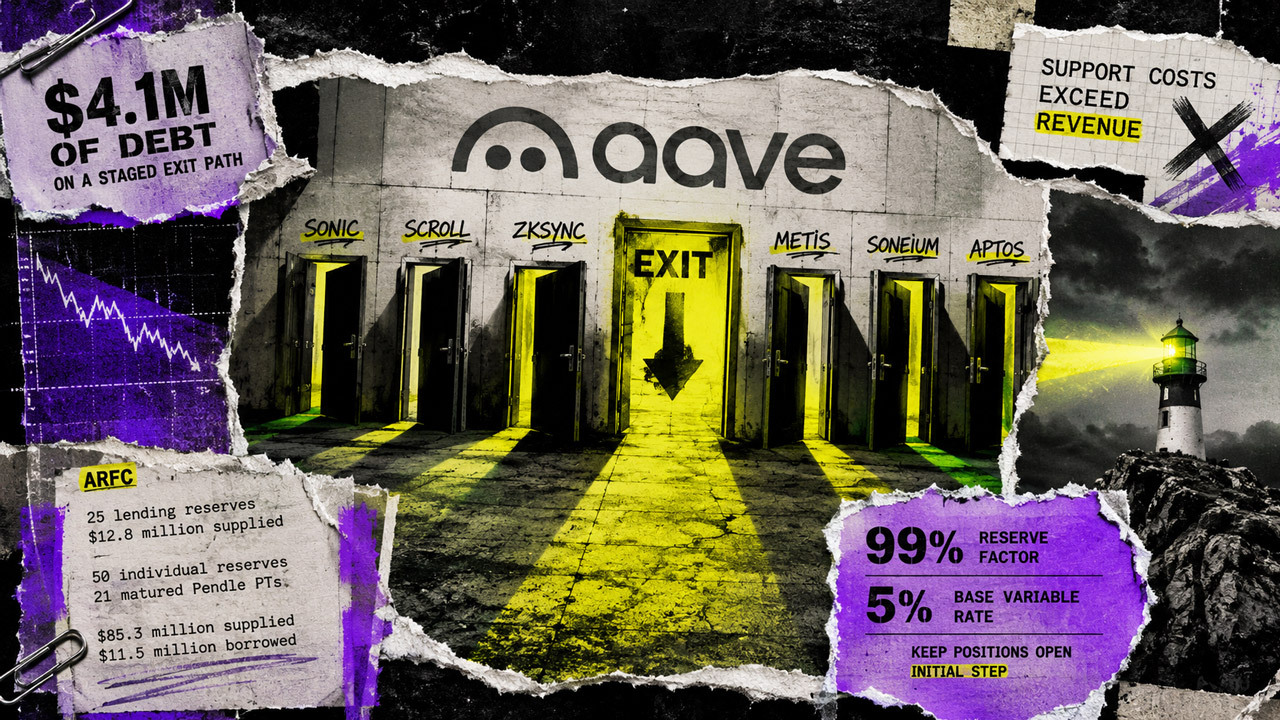
In a July 29 forum-stage proposal, Aave risk service provider LlamaRisk recommended winding down the decentralized lender’s V3 deployments on Sonic, Scroll, zkSync, Metis, Soneium, and Aptos. The plan would put $4.1 million of debt on a staged exit path that keeps existing positions open during the initial step.
The Aave Request for Final Comments, or ARFC, covers 25 lending reserves with $12.8 million supplied, based on LlamaRisk data dated July 28. The forum thread still showed the request under discussion on July 31. Aave’s proposal lifecycle places an ARFC before a community Snapshot and any executable on-chain Aave Improvement Proposal.
Related Reading Aave’s $25B lending lead faces a real test after key contributor exits Aave still leads DeFi lending, but contributor exits have turned scale into an execution test. Apr 7, 2026 · Gino MatosLlamaRisk’s economic case rests on support costs exceeding revenue. It said Sonic, Scroll, and zkSync each generate less than $5,000 in quarterly protocol revenue at current balances, while Metis, Soneium, and Aptos each generate less than $1,000. The proposal cites oracle, monitoring, and operational support costs but does not quantify the shortfall.
The same ARFC separately targets 50 individual reserves and 21 matured Pendle principal tokens across 11 deployments, with $85.3 million supplied and $11.5 million borrowed. Those balances sit outside the six-market totals.
Related Reading Aave rally makes DeFi lending look more like a bank to investors AAVE's rally, reported strategic interest, and a TradFi bull case all point to the same test: whether DAO-owned lending rails can look investable while keeping economics outside a normal company structure. Jun 29, 2026 · Liam 'Akiba' Wright How the six-market exit would workFor the six full-market exits, every reserve would be frozen and its supply and borrow caps cut to 1. Reserves carrying debt would receive a 99% reserve factor and a 5% interest rate model base variable rate; unborrowed reserves would not receive those two changes.
The two settings act on different sides of the market. The 5% figure is the base-rate component applied to borrowing. The 99% reserve factor determines how interest revenue is divided, directing nearly all interest paid by borrowers to the Aave treasury and leaving little for supplier yield. LlamaRisk expects lower yield to encourage withdrawals, which raises utilization and gives borrowers a stronger incentive to repay.
A freeze stops new supply, new borrowing, and use as fresh collateral. Positions already open would remain open, and the proposal says any additional unwind would be considered case by case. The starting point also varies: every listed Sonic and Aptos reserve was active in the July 28 tables, while every listed reserve on Scroll, zkSync, Metis, and Soneium was already frozen.
Related Reading Aave reduces Scroll exposure amid turmoil in governance model Scroll’s governance halt prompts Aave to recalibrate risk management for continued protocol stability. Sep 12, 2025 · Oluwapelumi Adejumo What users could face nextThe staged approach is designed to minimize immediate liquidation risk while preserving stronger levers if balances remain. LlamaRisk said later steps could raise interest rate curves or gradually reduce liquidation thresholds for selected collateral. After positions unwind further, deployment oracles could be replaced with fixed-price adapters under the method described in a companion oracle proposal.
Users remaining after the first step would therefore face possible rate, collateral, and oracle changes as the wind-down progresses, while the initial freeze itself leaves their positions open.
The post Why DeFi giant Aave is pulling the plug on six hyped blockchains making less than $5,000 a quarter appeared first on CryptoSlate.
Why this matters
Aave is showing up inside the Institutional Adoption theme, so this story is worth tracking for follow-through rather than treating it as a one-off headline.
Original source
Read on CryptoSlateRelated market context
Robinhood adopts Ripple’s RLUSD stablecoin, boosting institutional operations
Robinhood's adoption of RLUSD may drive institutional interest, potentially boosting Ripple's ecosystem and influencing future mar...

Franklin Templeton pitches BENJI as an onchain rate in Pendle discussion
Franklin Templeton's BENJI could redefine institutional cash management and collateral use, signaling a shift towards blockchain i...

Chainlink Targets $700B Custody Market With CustodySync and Anchorage DeFi Access
Key Takeaways: Chainlink introduced CustodySync, a new solution that connects loan markets in DeFi and qualified custody. The laun...

Hong Kong Gold Exchange-backed XGZ token integrates Chainlink CCIP
The integration of Chainlink CCIP with XGZ token could significantly enhance cross-chain asset liquidity, boosting institutional a...

Aave vs. Bitso USDC Prime: What Lenders Hold and What Limits Exits
A direct Aave deposit earns through one reserve; Bitso’s Morpho vault delegates allocations to a curator. Neither balance guarante...

OpenAI ChatGPT AI Predicts a Monumental Event for BTC by 2027
Sam Altman’s ChatGPT AI predicts that Bitcoin’s most extreme bullish case may not come from another halving event, the approval of...