After MiCA deadline, majority of Binance users sent funds to self-custody not other compliant exchanges
Binance says users in the European Union sent up to 70% of the funds they withdrew after July 1 to wallets they controlled themselves. Only about 30% went to platforms regulated under the Markets in Crypto-Assets framewo...
Archive context
Older archive item. Useful for background and entity history, but not a fresh market-moving signal.
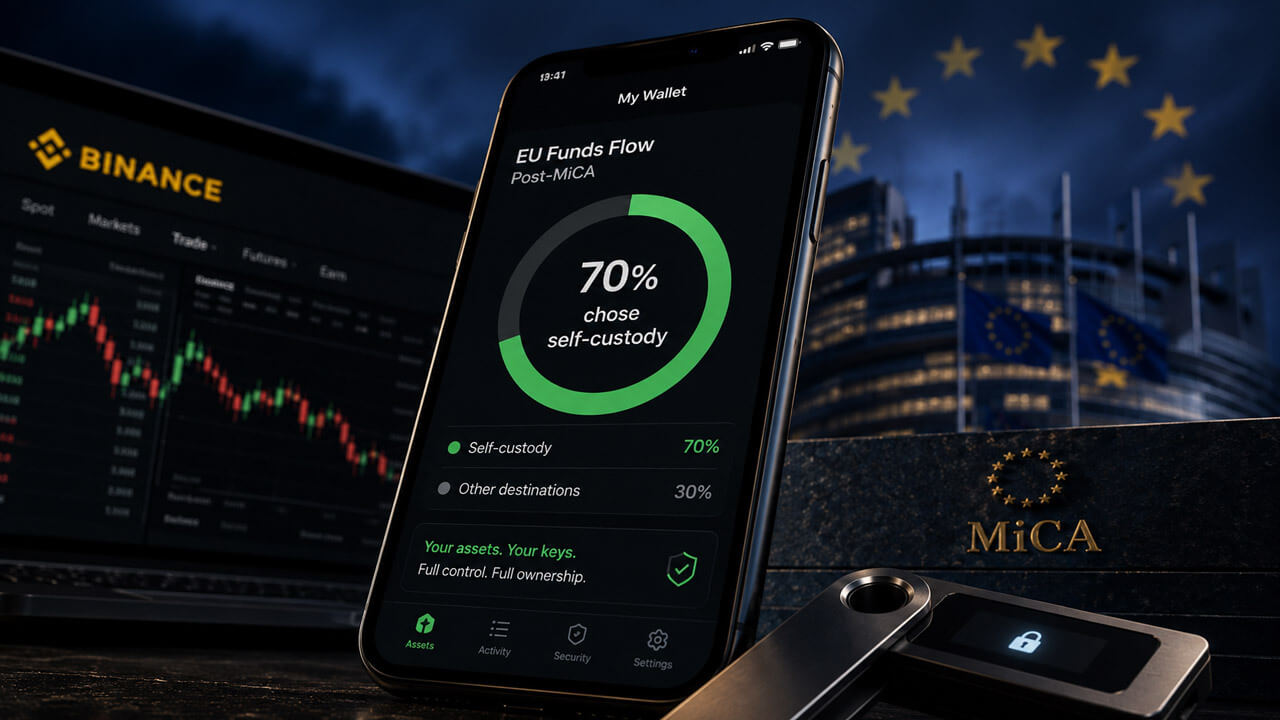
Binance says users in the European Union sent up to 70% of the funds they withdrew after July 1 to wallets they controlled themselves.
Only about 30% went to platforms regulated under the Markets in Crypto-Assets framework, according to Binance co-CEO Richard Teng.
The split was reported by the company, has not been independently audited, and came without the asset value, user count, measurement window, or tracking method needed to test it.
MiCA may not have backfired, but Binance’s figures point to an awkward outcome. Most departing funds appear to have bypassed regulated rivals and gone straight into users’ own wallets.
Related Reading Binance will be cut off from Europe on July 1 – Removes the “best liquidity in the world” says CZ The July 1 deadline will show whether licensed venues can absorb users without weakening execution or stablecoin access. Jun 26, 2026 · Liam 'Akiba' Wright MiCA anticipated the self-custody routeThe European Securities and Markets Authority told firms without authorization to execute wind-down plans when the transition ended July 1. Its guidance identified both a transfer to an authorized crypto-asset service provider and a self-hosted wallet as acceptable destinations.
MiCA can stop an unauthorized intermediary from serving EU clients, but it cannot require users to choose another custodian over holding their own keys. The cutoff pushed Binance out of the immediate custody relationship for those withdrawn assets while leaving users free to leave the regulated exchange layer altogether.
Binance is still pursuing an EU authorization route, Teng said after withdrawing its Greek application. A later approval could alter future flows, but it would not change where users sent funds during the cutoff.
Self-custody removes the exchange as a point of failure and gives users direct control. It also places key security, recovery and transaction responsibility on the user.
Related Reading How MiCA brings banks closer to controlling Europe’s stablecoin access The EU’s post-transition crypto regime is deciding who controls the compliant rails for stablecoins, wallets and retail access. Jul 6, 2026 · Liam 'Akiba' WrightTeng argued that the shift can mean less customer support, fewer recovery options and less visibility for authorities than a large supervised platform provides.
Moving funds to a self-hosted wallet also does not make public-blockchain activity invisible. Authorities lose the ability to step in at the account level once funds leave a custodian, though they can still trace activity on-chain and run checks when those assets return to regulated services.
MiCA-authorized exchanges had offered incentives to attract customers leaving platforms that could no longer serve the bloc, as CryptoSlate reported before the cutoff. Binance's reported 30% share for regulated destinations suggests authorization alone was not enough to win most of those balances.
Related Reading European crypto users are being paid to move before MiCA closes the door OKX, Coinbase, Kraken and SwissBorg are using incentives to capture deposits from platforms facing MiCA restrictions. Jun 27, 2026 · Oluwapelumi AdejumoRivals may now need to compete on transfer simplicity, liquidity, product continuity and trust. Regulators have a different gap to close: the only outcome data in this case came from the departing company.
Standardized wind-down reports could show how much money reaches authorized platforms, self-hosted wallets or other destinations.
Without that evidence, the user-migration test can show that custody moved, but not whether MiCA reduced total risk or merely redistributed it.
The post After MiCA deadline, majority of Binance users sent funds to self-custody not other compliant exchanges appeared first on CryptoSlate.
Why this matters
Binance is showing up inside the Stablecoins theme, so this story is worth tracking for follow-through rather than treating it as a one-off headline.
Original source
Read on CryptoSlateRelated market context

Securitize Teams With Korea’s LG CNS to Explore Tokenized Funds and Stablecoins
Securitize and Korean technology company LG CNS announced a strategic partnership, set out in a memorandum of understanding, aimed...

US Government Moves $103M in Seized Bitcoin and BNB to Coinbase Prime, Raising Sale Questions
The Bitcoin and BNB transactions drew attention because Coinbase Prime provides institutional custody and trading services for dig...

Cardano News: CIP-0113 Upgrade Could Change ADA Future
Good news coming from The Cardano Foundation as it launched CIP-0113 on mainnet, giving issuers of regulated stablecoins, funds, a...

Tether Celebrates 12 Years, USD₮ Surpasses 700M Users
Key Takeaways: Tether marked the 12th anniversary of the world’s largest stablecoin by market cap, USD₮. The company claims that U...
Coinbase Pro Returns With Deribit, Unlocking $30B Bitcoin Options Liquidity
Key Takeaways: Coinbase Pro returns with Spot, Futures, Perpetuals, Options, and Equities by the end of the year. Deribit is upgra...
U.S. Government Moves $103 Million in Seized Bitcoin and BNB, Sending BTC to Coinbase Prime
Wallets linked to the U.S. government moved $103.19 million in seized and forfeited crypto on Tuesday, Onchain Lens said in an X p...