Bretton Woods institutions must reorient, US Treasury secretary says
United States Treasury Secretary Scott Bessent recently called for “Bretton Woods institutions,” such as the International Monetary Fund (IMF), to reorient themselves, a signal that the global monetary order could be shi...
Archive context
Older archive item. Useful for background and entity history, but not a fresh market-moving signal.

United States Treasury Secretary Scott Bessent recently called for “Bretton Woods institutions,” such as the International Monetary Fund (IMF), to reorient themselves, a signal that the global monetary order could be shifting.
Speaking at the Institute of International Finance (IIF) on April 23, Bessent called on the IMF and the World Bank to correct trade imbalances and protect the value of fiat currencies against exchange rate risk.
"The Bretton Woods institutions must step back from their sprawling and unfocused agendas," Bessent said. He added:
"The IMF's mission is to promote international monetary cooperation, facilitate the balanced growth of international trade, encourage economic growth, and discourage harmful policies like competitive exchange rate depreciation."Bessent's call for the IMF to correct trade imbalances between countries, specifically the US and China, coincides with a decline in the US dollar to three-year lows, $36 trillion in US government debt, and stiff economic competition from China.
The Dollar Currency Index (DXY), a measure of the US dollar’s strength relative to other major fiat currencies, plunges to three-year lows. Source: TradingViewInvestor and hedge fund manager Ray Dalio argues that the world is experiencing a global macroeconomic shift that will upend the post-WWII financial order and eventually replace the US dollar as the global reserve currency, potentially with a digital form of money.
Related: Trump tariffs reignite idea that Bitcoin could outlast US dollar
The Bretton Woods AgreementThe Bretton Woods Agreement was signed in 1944 and pegged the currencies of 44 countries to the value of the US dollar, which, at that point, was pegged to the value of gold at $35 per ounce.
Eliminating complex foreign exchange risks between freely floating currencies to make global trade more efficient was the primary goal of the agreement.
US President Richard Nixon delivers the infamous “Nixon shock” speech in August 1971, suspending the dollar’s convertibility to gold. Source: Richard Nixon Presidential LibraryIn August 1971, US President Richard Nixon announced the end of the dollar's convertibility to gold — formally ending the Bretton Woods agreement in a move that was supposed to be temporary.
“Your dollar will be worth just as much tomorrow as it does today,” Nixon incorrectly told Americans during his now-infamous address.
The IMF and the World Bank, which were spawned from the Bretton Woods agreement, continue operating in an attempt to curb the effects of free-floating fiat currencies on the foreign exchange market.
Bessent eyes stablecoins to protect the US dollar, BTC advocates have another ideaSpeaking at the White House Digital Asset Summit on March 7, Bessent said stablecoins could drive international demand for US dollars and US government debt instruments.
Bessent added that the Trump administration will use stablecoins to protect the US dollar and its status as the global reserve currency.
Bitcoin maximalist Max Keiser argued against this plan, predicting that gold-backed stablecoins would outcompete dollar-pegged tokens due to the desire for low-volatility, inflation-resistant money.
The US dollar’s purchasing power has declined by over 90% since the year 1900. Source: Visual CapitalistIn March this year, BlackRock CEO Larry Fink wrote that the $36 trillion US national debt could drive investors to Bitcoin (BTC) as market participants start to see BTC as a better store of value than the US dollar.
Bitwise executive Jeff Park voiced a similar prediction in February, focused on the effects of US President Donald Trump's trade tariffs.
The analyst wrote that the tumult from the ongoing trade war would cause worldwide inflation, which would cause individuals to seek alternative stores of value like Bitcoin, driving its price much higher in the long term.
Magazine: Bitcoin payments are being undermined by centralized stablecoins
Why this matters
This cryptocurrency story adds another data point to the current market tape and is useful when read alongside nearby source coverage.
Original source
Read on CointelegraphRelated market context

Chainalysis: USDC-led stablecoins take 44% of Canadian dollar crypto volume
The rise in stablecoin use in Canada highlights a shift towards utility-driven crypto demand, potentially impacting domestic finan...

Morgan Stanley Builds Crypto Lab to Test Stablecoins, Tokenization and DeFi at Scale
Key Takeaways: Morgan Stanley has opened a Digital Asset Lab dedicated to blockchain technologies. The test is to be applied to th...

MARA Selling Bitcoin? Exchange Deposits Put 1,000 BTC Under Watch
Is MARA Selling Bitcoin? Wallets linked to MARA Holdings sent 1,000 BTC, worth about $82.8 million, to Binance and Gate over five...
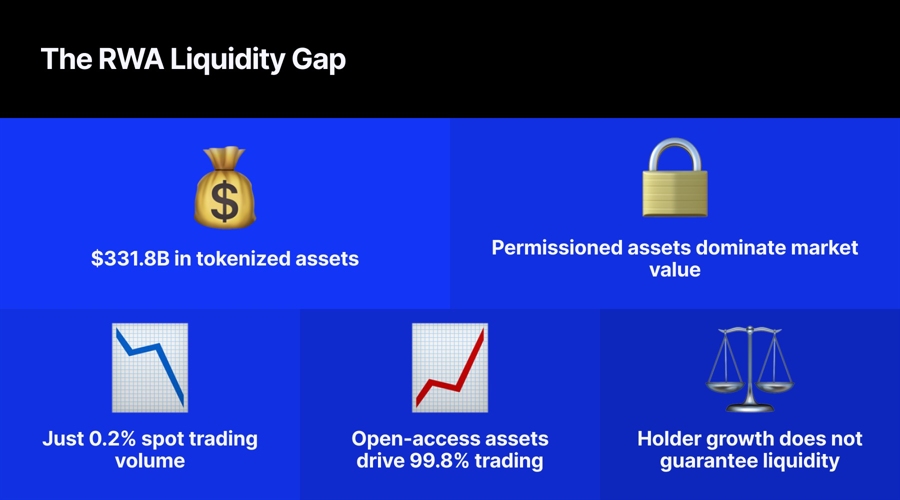
More Holders, Little Trading: The RWA Liquidity Problem Is Worse Than You Think
Let me ask you something straight. Does real-world asset trading on crypto exchanges feel like a genuine revolution, or does it fe...

BTCC Exchange Wraps TOKEN2049 Singapore, Bringing its Zero-Barrier Theme From Platform to Show Floor
GEORGE TOWN, Cayman Islands, October 19, 2026 – BTCC, the world’s longest-serving cryptocurrency exchange, has wrapped its partici...

Bitmine’s Holdings Value Falls to $15.1 Billion Even as Its Ether Stash Keeps Growing
Bitmine Immersion Technologies (NYSE: BMNR) added 12,535 ETH in the past week, lifting its ether stash to 6,041,481 ETH, even as t...