China Just Put A Two-Year Expiry Date On Crypto Access For 1.4 Billion People
China’s securities regulator, the China Securities Regulatory Commission, announced on May 25 that it will penalize three major offshore brokerages for their ties to crypto — Tiger Brokers, Futu Securities, and Longbridg...
Archive context
Older archive item. Useful for background and entity history, but not a fresh market-moving signal.

China’s securities regulator, the China Securities Regulatory Commission, announced on May 25 that it will penalize three major offshore brokerages for their ties to crypto — Tiger Brokers, Futu Securities, and Longbridge Securities — for illegal cross-border financial operations targeting mainland investors, as part of a sweeping nine-agency implementation plan that sets a two-year deadline to eliminate all unauthorized cross-border securities, futures, and fund management activity from China’s financial landscape.
The announcement, made public via the State Council Information Office and covered by China’s official Xinhua News Agency, represents the most coordinated regulatory enforcement action Beijing has taken against offshore financial platforms since the 2021 crypto mining ban. The CSRC stated it will confiscate all illegal gains from domestic and overseas entities associated with Tiger, Futu, and Longbridge, and impose severe penalties in accordance with Chinese law, per the official Xinhua report.
Under the implementation plan, the three brokerages have been given a two-year phase-out window — during which they are strictly prohibited from facilitating new buy orders or accepting capital inflows from mainland investors. Only sell orders and capital withdrawals will be permitted. Upon expiration, affected institutions must completely shut down their mainland-targeted websites, trading applications, and supporting servers, per the SCIO announcement.
Why This Matters For CryptoThe enforcement action is not nominally directed at crypto — it targets offshore securities and futures brokerages. The crypto implications, however, are structural and direct. The primary channels through which Chinese traders access crypto markets — over-the-counter desks, peer-to-peer exchanges, and USDT on-ramps — operate in the same regulatory gray zone that Beijing has now formally committed to eliminating across all cross-border financial activity, per analysis by BeInCrypto published May 22.
The February 2026 crackdown, in which the People’s Bank of China and seven other agencies jointly expanded China’s existing crypto ban to explicitly cover stablecoins, RWA tokenization, and offshore yuan-pegged stablecoin issuance, established the policy framework.
The May 25 action represents its enforcement arm — a signal that the two-year rectification timeline applies broadly to any unauthorized cross-border financial channel, not only to licensed brokerages, per the CSRC’s implementation plan language as reported by Xinhua.
Market reaction was swift. US-listed shares of Tiger Brokers’ parent company fell more than 10% in premarket trading. Futu Holdings dropped more than 5%, with some session reports showing declines reaching 35%, per Wu Blockchain’s coverage of the announcement on May 22.
The Broader PatternBeijing’s 2026 enforcement posture reflects a deliberate sequencing: the February policy notice established the expanded legal perimeter covering stablecoins and tokenization; the May brokerage action demonstrates the state’s willingness to impose material financial penalties on large, publicly listed companies operating in breach of that perimeter.
For the nascent sector’s participants who have continued to access crypto through informal Chinese channels, the trajectory of enforcement points in one direction — and the two-year rectification deadline gives Beijing a concrete timeline against which to measure compliance.
This development marks a critical juncture for crypto’s relationship with Chinese capital. Whether the crackdown accelerates OTC crypto demand as mainland investors seek alternative stores of value — as has historically occurred during prior Chinese enforcement waves — or succeeds in materially reducing cross-border digital asset flows, will determine whether Beijing’s tightening ultimately strengthens or simply redirects China’s crypto participation.
Cover image from Grok, BTCUSD on Tradingview
Why this matters
Tether is showing up inside the Stablecoins theme, so this story is worth tracking for follow-through rather than treating it as a one-off headline.
Original source
Read on NewsBTCRelated market context

Securitize Teams With Korea’s LG CNS to Explore Tokenized Funds and Stablecoins
Securitize and Korean technology company LG CNS announced a strategic partnership, set out in a memorandum of understanding, aimed...
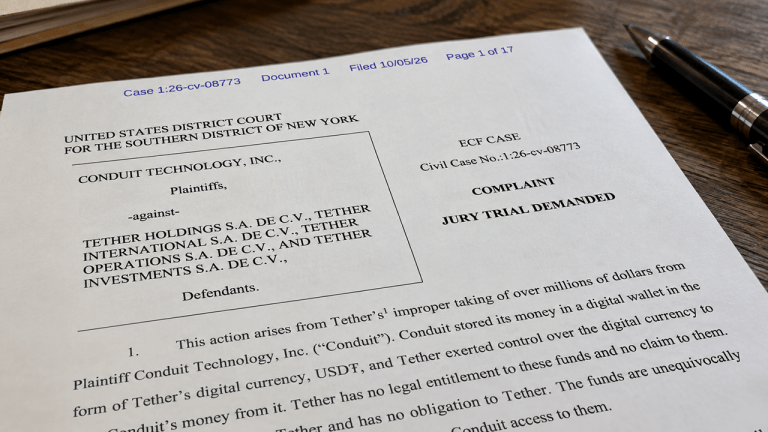
Conduit Sues Tether Over a $2.76M USDT Wallet Frozen for a Year
Conduit Technology has sued Tether after the stablecoin issuer froze $2.76 million in the company’s USDT and allegedly kept it loc...

Tether Celebrates 12 Years, USD₮ Surpasses 700M Users
Key Takeaways: Tether marked the 12th anniversary of the world’s largest stablecoin by market cap, USD₮. The company claims that U...

Tether signs MoU with Kazakhstan’s central bank to explore tenge stablecoins and tokenized assets
Kazakhstan's collaboration with Tether could enhance its fintech landscape, potentially boosting local currency integration in dig...

Tether tapped by Kazakhstan’s central bank to explore stablecoin and tokenization
The National Bank of Kazakhstan said it will study a local currency-linked stablecoin and tokenized real-world assets with Tether.

XRP News: XRPL $2.2B Tokenization Depends on Energy Token
In major XRP news today, XRPL reported lead in tokenized commodities rests heavily on a single Justoken energy token: RWA.xyz list...