Crypto Guru Arthur Hayes Is ‘Short-Term Bearish’: Here’s Why
In a recent essay titled “Boom Times … Delayed,” Arthur Hayes, co-founder and former CEO of BitMEX, delves into why impending Federal Reserve rate cuts may not initially rejuvenate the crypto markets as many investors ho...
Archive context
Older archive item. Useful for background and entity history, but not a fresh market-moving signal.

In a recent essay titled “Boom Times … Delayed,” Arthur Hayes, co-founder and former CEO of BitMEX, delves into why impending Federal Reserve rate cuts may not initially rejuvenate the crypto markets as many investors hope. Published on Substack, Hayes presents a detailed analysis interwoven with his perspective on broader economic policies and their implications on asset prices, including Bitcoin and cryptocurrencies.
A New ParadigmHayes starts by challenging the typical investor crypto reflex to “buy the fucking dip” (BTFD) in response to rate cuts—a behavior ingrained from past experiences during periods of subdued inflation in the US. He recalls times when the US Federal Reserve aggressively counteracted deflation threats with massive liquidity injections, benefiting asset holders significantly. However, Hayes argues that the current economic climate, shaped heavily by post-COVID fiscal policies and resulting inflation, alters the effectiveness of such monetary interventions.
“The effects of global fiscal policies to fight the COVID pandemic ended an era of deflation and ushered in an era of inflation,” Hayes states, emphasizing the delayed recognition of these inflationary impacts by central banks, which led to reactionary rather than preventative measures.
Focusing on the US Treasury market, Hayes points out its pivotal role due to the dollar’s status as the global reserve currency. He notes that even with the Fed’s aggressive rate hikes, the bond market has shown a belief in the central bank’s commitment to controlling inflation, as evidenced by the containment of the 10-year US Treasury yield below 4% during significant inflationary periods.
However, a turning point came during the Federal Reserve’s August meeting at Jackson Hole, where Chair Jerome Powell hinted at a rate cut, introducing uncertainty into the markets. Hayes critiques the continued high government spending, which he views as a political strategy rather than fiscal prudence, influencing inflation and consequently the Fed’s policy decisions.
“The primary driver of inflation that the Fed sought to quell, government spending, was left unchecked, leading the market to do the Fed’s job for it,” Hayes explains, referencing the swift rise in the 10-year Treasury yield following Powell’s announcement. This reaction underscores his argument that while the Fed may cut rates, the bond market will continue to react dynamically to underlying economic factors.
Bitcoin And Crypto Are Short-Term BearishHayes points out Bitcoin’s extreme sensitivity to dollar liquidity conditions. “I believe Bitcoin is the most sensitive instrument that tracks dollar fiat liquidity conditions. As soon as the RRP started rising to the tune of ~$120bn, Bitcoin swooned. A rising RRP sterilizes money as it sits inert on the Fed’s balance sheet, unable to be re-leveraged within the global financial system,” Hayes notes.
He suggests a direct correlation between Federal Reserve policies, dollar liquidity conditions, and the Bitcoin price. He further predicts that if the Fed doesn’t cut rates before their September meeting, the rising balances in the Fed’s Reverse Repo Program (RRP) could see the Bitcoin price either stabilize or potentially decline further towards $50,000.
“Assuming the Fed doesn’t cut rates before the September meeting, I expect T-bill yields to stay firmly below those of the RRP. As such, RRP balances should continue to rise, and Bitcoin, at best, will chop around these levels and, at worst, slowly leak lower towards $50,000. Let’s see how the cookie crumbles. My shift in opinion keeps my hand hovering over the Buy button. I am not selling crypto because I am short-term bearish,” Hayes explains.
Despite this, Hayes remains optimistic about the long-term prospects of Bitcoin and cryptocurrencies, particularly in response to policy shifts that might stimulate liquidity. Hayes speculates that US Treasury Secretary Janet Yellen will stimulate financial markets ahead of the US presidential election.
He states, “Obviously, Bad Gurl Yellen will only stop once she has done everything possible to ensure Kamala Harris is elected as the US President.” Hayes predicts that Yellen might deplete the Treasury General Account (TGA) to prompt a favorable market reaction and instruct Federal Reserve chair Jerome Powell to cease quantitative tightening (QT) and restart quantitative easing (QE).
“All these monetary machinations are positive for risk assets, especially Bitcoin. The magnitude of the money supply injections must be large enough to counteract the rising RRP balance, assuming the Fed continues cutting rates. If this scenario occurs, I expect intervention to begin in late September. Between now and then, Bitcoin will, at best, continue to chop, and altcoins could dive deeper into the gutter,” Hayes predicts.
He concludes his analysis noting a shift in his expectations for a bull market. Originally anticipating a resurgence in September, he now foresees a more turbulent period for Bitcoin and cryptocurrencies but remains steadfast in his long-term strategy. “I’m still long as fuck in an unlevered fashion. The only additions to my portfolio will be increasing position sizes in solid shitcoin projects at deeper and deeper discounts to my perception of fair value,” he declares.
At press time, BTC traded at $56,615.
Why this matters
This cryptocurrency story adds another data point to the current market tape and is useful when read alongside nearby source coverage.
Original source
Read on NewsBTCRelated market context
Bitcoin’s Fed Week Starts With A Fresh Rise In US Inflation Expectations
TL;DR: US household inflation expectations rose in October while consumer sentiment barely changed. The readings add context ahead...

Swell Freezes swETH and rswETH Withdrawals Until It Corrects Their Exchange Rates
Holders of Swell‘s swETH and rswETH cannot deposit or withdraw through the protocol after the team said at 2:39 a.m. ET Friday it...

Austin Griffith Demonstrates How Fast Bots Can Drain Weak Ethereum Keys
Austin Griffith of the Ethereum Foundation put about $1 in an Ethereum wallet whose private key was the number 6969, and bots went...
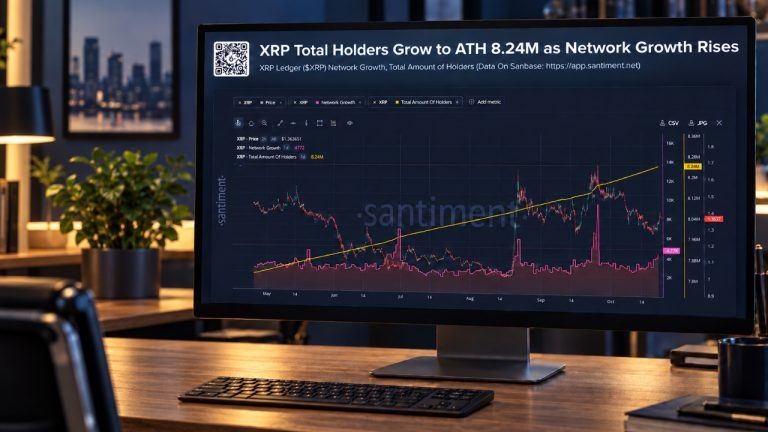
XRP Wallets Hit Record 8.24 Million as Network Growth Accelerates
XRP Ledger’s wallet count has reached 8.24 million, extending its climb through months of price volatility. Santiment paired the m...
Aave Opens Its First Externally Curated V4 Markets With Sentora
Aave’s first externally curated V4 markets are live on Ethereum, according to Sentora’s October 22 launch explanation. The curator...

Ethereum staking yield is losing to cash rates, so why are investors still lining up?
Put €10,000 into Ethereum staking at a 2.2% annual return and, if ETH's price stays unchanged, you'll earn about €220 over a year....