Don’t Forget the Importance of Censorship Resistance
Since people are once again talking about self-custody as one of crypto’s unique strengths, I would like to remind everyone about an equally important fundamental value proposition of crypto that, in the early days, was...
Archive context
Older archive item. Useful for background and entity history, but not a fresh market-moving signal.

Since people are once again talking about self-custody as one of crypto’s unique strengths, I would like to remind everyone about an equally important fundamental value proposition of crypto that, in the early days, was touted as the killer feature. I’m talking about censorship resistance.
The following opinion editorial was written by Bitcoin.com CEO Dennis Jarvis.
In the financial context, censorship resistance is the ability to carry out financial actions despite the wishes of any third party.
In crypto, the three pillars of censorship resistance are:
- The freedom to transact. This means third parties cannot prevent you from sending or receiving assets.
- The freedom from confiscation. Third parties cannot take away or freeze your assets.
- The immutability of transactions. It is impossible for third parties to change or revert transactions after the fact.
Troubling actions increasingly taken by centralized entities in the public and private sector demonstrate the importance of censorship resistance. Let’s look at some examples:
Governments have shown an increased willingness to exert control of financial institutions while also ratcheting up their crypto regulatory efforts. Earlier in the year, Trudeau’s Canadian government took the unprecedented step of invoking emergency powers to freeze or suspend the bank accounts of Canadian citizens without court orders. Their crime? Donating funds to fellow citizens participating in the Freedom Convoy protests.
The U.S. Treasury Department’s watchdog the Office of Foreign Asset Control (OFAC) made headlines this summer by banning and sanctioning addresses that used Tornado Cash, a decentralized application that improved privacy for users by “mixing” ETH.
The U.S. Securities and Exchange Commission (SEC) increased crypto regulatory actions, best exemplified by this quote from SEC Chairman Gary Gensler who said, “…the SEC will serve as the cop on the beat. As with seat belts in cars, we need to ensure that investor protections come standard in the crypto market.” This isn’t merely empty rhetoric, the SEC nearly doubled the size of the Division of Enforcement’s Crypto Assets and Cyber Unit in 2022.
Post-merge, a majority of Ethereum’s blocks are compliant with OFAC. This is a potential problem because OFAC-compliant relays will not include any transactions that interact with the Tornado Cash smart contract or other sanctioned wallet addresses as designated by OFAC. Not all blocks built by OFAC compliant relays are censoring, however, all blocks built by OFAC compliant relays will censor when non-compliant transactions are broadcast to the network. As Martin Köppelmann, the co-founder of Gnosis, noted about the state of OFAC compliant relays, “[t]his means if the censoring validators would now stop attesting to non-censoring blocks they would eventually form the canonical, 100% censoring chain.”
Centralized stablecoin companies Tether (USDT) and Circle (USDC) have a history of cooperating with law enforcement requests to freeze assets. Circle complied with OFAC’s Tornado Cash sanctions by banning “tainted” USDC. So far Tether has decided to not comply, but that can change (and probably will, given sufficient pressure) in the future.
Outside of crypto, Paypal made international news when it released an updated policy that let Paypal fine users $2,500 for spreading ‘misinformation.’ Paypal quickly retracted the policy in public, though much of the language remains. This includes $2,500 fines that have existed since September 2021 for the very vague “promotion of hate, violence, racial or other forms of intolerance that is discriminatory…”
While Paypal was almost universally condemned, its actions are consistent with a growing number of web2 companies, such as Twitter, Youtube, and Facebook, who are using their platforms to punish behavior they deem “bad” through levers like demonetization, suspensions, and bans.
Censorship resistance is one of the main value propositions of decentralized finance in general and Bitcoin specifically because it fundamentally separates the technology from any traditional financial tools. In fact, censorship resistance is so strong in Bitcoin as to render it an economic freedom enhancing technology. This dramatization powerfully demonstrates why:
The silver lining to the concerning increase in authoritarian actions from both the public and private sector is that they are helping refocus attention on censorship resistance.
Bitcoin, once the embodiment of crypto, had become ridiculed as worse than boring — antiquated. It’s nice to see this begin to shift back as people inside and out of crypto reacquaint themselves with its deceptively simple power.
Within the crypto industry, more people are paying attention to the slow creep of web2-like features of speed and cheap transactions that are coming at the cost of censorship resistance. For example, prominent developers like the aforementioned Martin Köppelmann are sounding the alarms that the percentage of OFAC compliant blocks needs to be fixed. It’s also nice to see debates about censorship resistance begin to take up more oxygen within the broader crypto community. I particularly enjoyed Erik Voorhees’ piece on the empowering nature of defi.
This is not to say that all crypto projects need to be censorship resistant; indeed censorship resistance itself exists on a spectrum. Yet it is vital that some crypto projects remain robustly censorship resistant. At Bitcoin.com, we are proud to offer tools like the Bitcoin.com Wallet, that anyone can use to self-custody their Bitcoin and other cryptocurrencies. As an industry, let’s take the events of the last year to remember how important censorship resistance is. Let’s not sacrifice this industry-defining attribute for short sighted gains.
What are your thoughts on this story? Let us know in the comments section below.
Why this matters
This cryptocurrency story adds another data point to the current market tape and is useful when read alongside nearby source coverage.
Original source
Read on Bitcoin NewsRelated market context

Ethereum mainnet averages record 2.16M daily transactions in 2026
Ethereum's increased transaction volume highlights its role as a key infrastructure for digital finance, but raises concerns about...
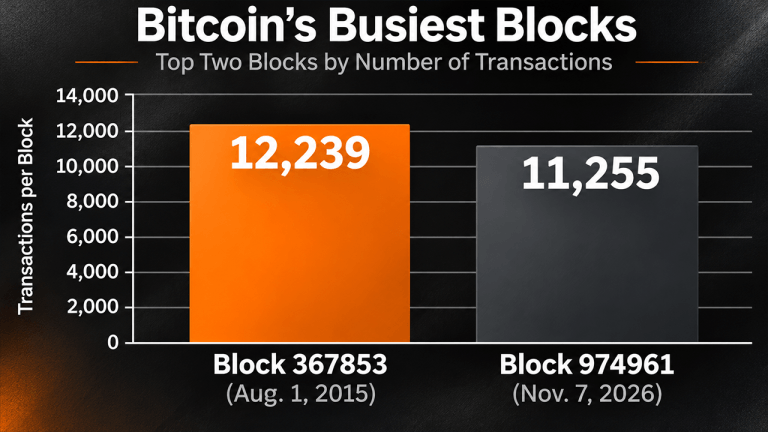
Bitcoin Packs 11,255 Transactions Into a Single Block, Nears Record
Bitcoin’s blockchain came within striking distance of an 11-year-old transaction record on Saturday, Nov. 7, 2026, when a single b...

Vitalik Buterin Says Maximizing ETH’s Fee Burn Would Cost Ethereum Its Decentralization
Ethereum co-founder Vitalik Buterin wants ETH holders to judge the token by how well it holds value, not by how much of it the net...
OKX Warns Users Off MEXC Transfers as US Moves to Cut Off the Exchange
OKX founder Star Xu told customers on Saturday to stop sending funds directly from MEXC after the US moved to cut the crypto excha...
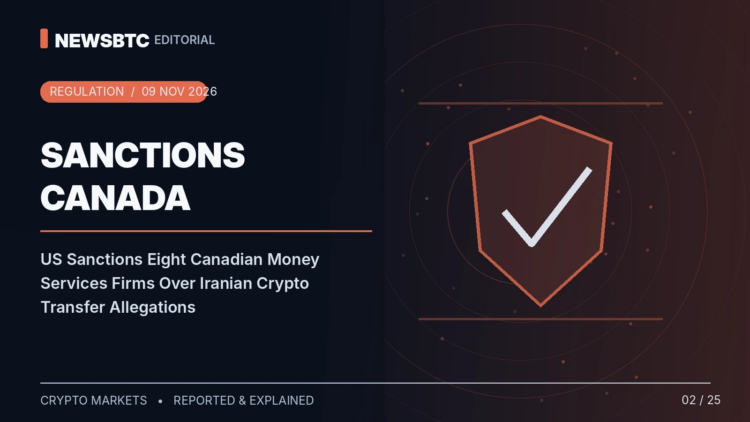
US Sanctions Eight Canadian Money Services Firms Over Iranian Crypto Transfer Allegations
TL;DR: The US Treasury has added eight Canada-based money services businesses to its sanctions list, alleging that they helped mov...

Crypto News Today: Saylor Hints at Bitcoin Buy as Buterin Questions Ethereum Burn Thesis, and Schwartz Downplays XRP Price Influence
Michael Saylor has revived expectations of another Bitcoin acquisition by Strategy after sharing its long-term accumulation chart....