Eight South Korean Banks Join to Establish Won-Backed Stablecoin, Plan Two Key Models
Eight major commercial South Korean banks have formed a consortium to establish a won-linked stablecoin venture. The collaboration involves participation from the Open Blockchain and DID Association, and the Financial Su...
Archive context
Older archive item. Useful for background and entity history, but not a fresh market-moving signal.

Eight major commercial South Korean banks have formed a consortium to establish a won-linked stablecoin venture. The collaboration involves participation from the Open Blockchain and DID Association, and the Financial Supervisory Service.
Announced on Wednesday by the country’s financial sector, the joint venture marks the first time commercial banks have entered into the digital asset business in the form of a consortium.
The group of eight banks includes KB Kookmin, Shinhan, Woori, Nonghyup, Industrial Bank of Korea, Suhyup, Citibank Korea, and SC First Bank.
The announcement arrives in line with the central bank’s advocacy for a phased rollout of a won-backed stablecoin.
The Bank of Korea’s (BOK) senior deputy governor Ryoo Sang-dai said Tuesday at a press conference that it was desirable to initially allow commercial banks to introduce won-denominated stablecoins at a gradual pace.
Commercial banks’ involvement in stablecoin is a signal that the private sector is starting to respond to crypto in earnest. Particularly, when the US has established its first federal framework for dollar-pegged stablecoins – the GENIUS Act, several nations like South Korea and industry giants like Amazon are moving toward embracing this asset class.
Banks Rollout Two Initial Won-Linked Stablecoin ModelsPer the local report, discussions on joint infrastructure between banks are currently in progress. Further, the establishment of the cooperation would come to light this year or early next year.
The banks have rolled out an initial plan comprising two methods of issuing the won-backed stablecoin – trust-based and deposit-linked.
In the trust model, coins are issued after separately entrusting customer funds, while in the deposit-linked model, coins are issued by linking 1:1 with bank deposits.
“There is a shared sense of crisis that if things continue this way, foreign dollar coins could dominate the domestic market,” a banking official noted. “It is time to secure both the independence and competitiveness of the domestic financial system through a won-based digital currency.”
Stablecoin Regulations and President’s PromisesThe current trend of banks’ involvement is in line with the Digital Asset Act that was recently proposed by South Korea’s National Assembly. The legislation explicitly notes the introduction of a stablecoin authorization system.
However, the Bank of Korea is still skeptical of proposals to launch a won stablecoin. Meanwhile, the newly elected President Lee Jae-myung has pledged to launch a KRW-pegged coin for use in business and international trade.
Presidential candidate Lee Jae-myung proposes a won-backed stablecoin to stop $40.8B in crypto capital flight.#Korea #Stablecoin #LeeJaemyunghttps://t.co/qR1jwd7tXB
— Cryptonews.com (@cryptonews) May 20, 2025His administration is quickly moving to implement campaign pledges aimed at modernizing South Korea’s regulatory framework for digital assets.
The joint venture of banks is a private sector-led model, differing from the CBDC being prepared by the Bank of Korea. Though further discussions on its technological linkages with the central bank are needed, there are talks in the market that it can be expanded into various applications such as cross-border remittance and domestic payments.
The post Eight South Korean Banks Join to Establish Won-Backed Stablecoin, Plan Two Key Models appeared first on Cryptonews.
Why this matters
This cryptocurrency story adds another data point to the current market tape and is useful when read alongside nearby source coverage.
Original source
Read on CryptonewsRelated market context

Coinbase and Gennius plan ONED USD stablecoin access through Latin American banks
Coinbase's partnership with Gennius could reshape Latin American banking by integrating stablecoins, enhancing financial inclusion...

Coinbase and Gennius Plan ONED Stablecoin Access Through Latin American Banks
The Argentina-first initiative would let customers convert eligible deposits into ONED USD, transfer it around the clock and spend...

Stealing $1.5B in crypto is easy, cashing out is the trap
North Korean hackers stole around $1.5 billion from Bybit in February 2025. While the hack itself has been widely covered and anal...

Bank of England says it will be ‘the banker to the stablecoin’
The Bank of England's support for stablecoins could enhance financial stability and innovation, influencing global regulatory appr...
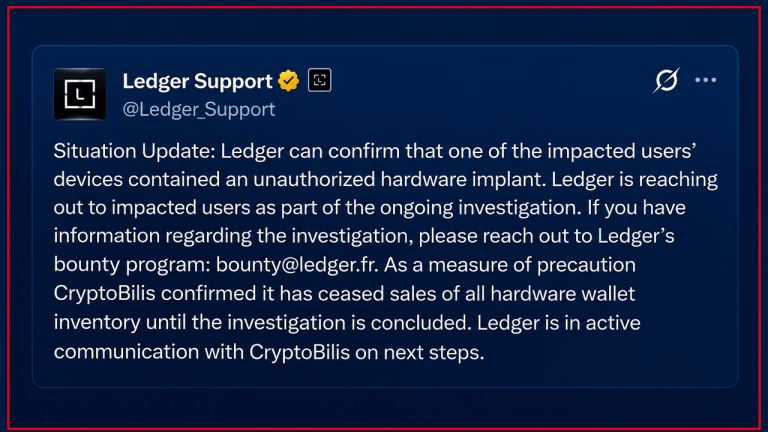
Ledger Confirms Hidden Hardware Implant in Affected User’s Wallet
Ledger confirmed Saturday, Oct. 10, 2026, that a hardware wallet belonging to one affected customer contained an unauthorized impl...

TRON captures 23% of stablecoin card volume in Q3 2026
TRON's significant share in stablecoin card volume highlights its growing influence in digital payments, but competition remains f...