Financial Superintendence of Colombia Presents Project to Regulate Crypto Service Providers
The Financial Superintendence of Colombia presented a project that seeks to bring clarity to how links between banks and virtual asset service providers (VASPs) will be handled in the future. The document defines certain...
Archive context
Older archive item. Useful for background and entity history, but not a fresh market-moving signal.
The Financial Superintendence of Colombia presented a project that seeks to bring clarity to how links between banks and virtual asset service providers (VASPs) will be handled in the future. The document defines certain key concepts and determines a set of prerequisites that banks need to verify before accepting virtual asset service providers as customers.
Virtual Asset Service Providers to Be Regulated in ColombiaRegulation is becoming a key goal for countries in Latam, where cryptocurrency adoption is growing at significant rates. Now, the Financial Superintendence of Colombia has presented a document that seeks to establish norms regarding the requirements cryptocurrency exchanges and custody providers must meet to be serviced as customers by banks. The project defines key concepts such as virtual asset service providers (VASPs), and virtual assets in the scope of the regulation.
In the same way, it establishes that virtual asset service providers will have to be connected to the UIAF, the financial intelligence office of Colombia, and have a plan of action to deal with money laundering and terrorism financing attempts that might potentially be made using their platform.
The project also makes an indirect reference to compliance with the travel rule promoted by the Financial Action Task Force (FATF). It states banks must verify these VASPs have:
The technological and operational capacity to monitor transactions with virtual assets, as well as to obtain, preserve and transmit the information of the originator and the beneficiary of each transaction.
More RequirementsThe proposal establishes that the VASPs will have to be able to present clear information to their customers about the services they offer and the risks associated with these services, the costs associated with these services, and the virtual assets present on their platforms.
VASPs will also have a plan to deal with operational and cybersecurity-related risks to handle possible hacks or platform problems that might affect how their services are delivered to their customers. Also, banks will have the obligation to separate their responsibilities from those of VASPs, telling customers that only they and these platforms are responsible for VASP-related problems.
The proposal also establishes restrictions regarding investments. It states:
The supervised entities authorized to capture resources through deposit products or funds must ensure that the operations of deposit and withdrawal of resources in financial products of deposit or funds in the name of a VASP are carried out only through non-face-to-face channels.
The proposal is still in the discussion stages, and the Financial Superintendence will receive suggestions about it until August 12.
What do you think about the VASP regulation proposal in Colombia? Tell us in the comments section below.
Why this matters
This cryptocurrency story adds another data point to the current market tape and is useful when read alongside nearby source coverage.
Original source
Read on Bitcoin NewsRelated market context

AI Tops Fed Survey of Financial Risks—Why Crypto Investors Should Pay Attention
AI has become the most frequently cited financial-stability risk in a survey published with the Federal Reserve’s latest report, b...

Kraken Parent Payward Breaks Trading Reliance as Services and Custody Drive Q3 Margin
Kraken parent Payward is decoupling its profitability from the crypto trading cycle. In the third quarter, client assets and enter...

Bitcoin Holiday? Thailand Opens the Door to Nationwide Crypto Payments for Tourists
Thailand is giving crypto holders another reason to book a holiday. Foreign tourists can now convert their digital assets into Tha...

Court Order Lets DOJ Lock Up $1.2 Billion of North Korea’s Stolen Binance Crypto
The U.S. Department of Justice (DOJ) has court authorization to seize or restrain more than $1.2 billion of the crypto North Korea...

Thailand SEC Proposes Stablecoin Rules With 5M Baht Daily Caps for Crypto Transfers
Key Takeaways: Thailand suggests that daily deposits and withdrawals for stablecoins should be capped at 5 million baht. Only veri...
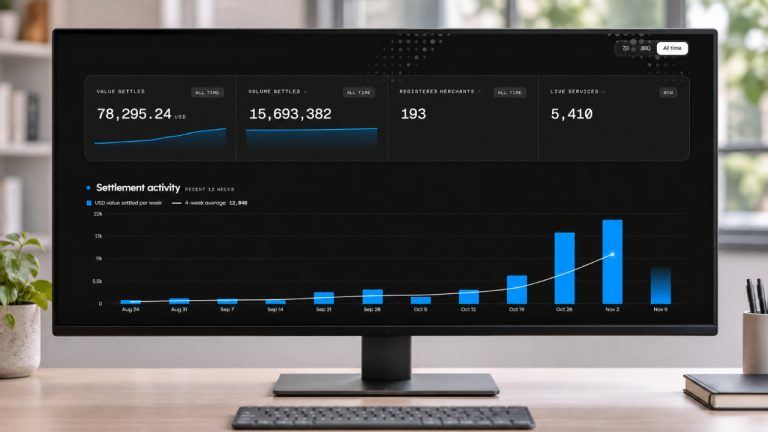
XRP Ledger AI Services Exceed 5,400 Across More Than 190 Merchants
AI agents can now purchase more than 5,400 services on the XRP Ledger, according to t54. Its expanding directory connects automate...