How FBI turned Hamas’ crypto fundraising pipeline into a law-enforcement trap
The US Federal Bureau of Investigation (FBI) seized Hamas-linked fundraising infrastructure and used it to intercept cryptocurrency donations intended for the group. Earlier this week, the Justice Department said the ope...
Archive context
Older archive item. Useful for background and entity history, but not a fresh market-moving signal.

The US Federal Bureau of Investigation (FBI) seized Hamas-linked fundraising infrastructure and used it to intercept cryptocurrency donations intended for the group.
Earlier this week, the Justice Department said the operation followed earlier court-authorized seizures that traced and recovered more than $560,000 in digital assets tied to Hamas fundraising.
Those seizures came through warrants issued in March, June and October 2025 after investigators followed rotating donation addresses distributed through encrypted chats and fundraising websites.
The June warrant showed how that process worked. Tether was ordered to burn targeted USDT and reissue an equivalent amount to a US law-enforcement-controlled address, while Binance was directed to transfer specified account balances into FBI-controlled wallets.
That approach allowed investigators to recover crypto after identifying where it had moved.
Special Agent in Charge Justin A. Garris of the FBI Albuquerque Field Office said:
“Reducing the capabilities of foreign terrorist organization's ability to receive donations and creating distrust in communications to their donors was the primary focus of this latest operation. This continued success demonstrates the unwavering commitment and determination of the FBI in fighting terrorism.”
FBI moved from tracing funds to intercepting themInvestigators targeted domains and servers linked to AlQassam.ps, a website the DOJ tied to the Al Qassam Brigades, Hamas’ military wing.
Affidavits filed in July and August said authenticated responses from [email protected] were routed through host.alaqsaflood.org, helping investigators connect fundraising communications to related infrastructure.
The FBI’s Albuquerque Field Office then worked with human sources to identify and seize domains and servers associated with the operation.
Control of that infrastructure changed the scope of the investigation. DOJ said agents were able to intercept crypto donations intended for Hamas and obtain additional information about people attempting to contribute.
That turned the case from a retrospective tracing effort into an active disruption operation.
DOJ said the broader investigation produced information about thousands of people who contacted Hamas online seeking to donate through cryptocurrency or traditional payment methods. The department did not specify how much of that information came directly from the seized servers.
Related Reading Tether freezes 134 wallets as stablecoins now sit inside the sanctions machineThe disclosure also does not establish that every person identified completed a donation or committed an offense.
However, this shows how several enforcement tools converged: blockchain tracing identified the money, court orders moved assets through centralized crypto providers, and infrastructure seizures gave investigators control over the fundraising channels themselves.
The post How FBI turned Hamas’ crypto fundraising pipeline into a law-enforcement trap appeared first on CryptoSlate.
Why this matters
Tether is showing up inside the Stablecoins theme, so this story is worth tracking for follow-through rather than treating it as a one-off headline.
Original source
Read on CryptoSlateRelated market context

Cardano Brings Compliance Rules On-Chain With CIP-0113 Launch
TL;DR: Cardano’s CIP-0113 programmable token standard is now live on mainnet. It gives issuers the ability to build controls such...

Tether Celebrates 12 Years, USD₮ Surpasses 700M Users
Key Takeaways: Tether marked the 12th anniversary of the world’s largest stablecoin by market cap, USD₮. The company claims that U...

Tether signs MoU with Kazakhstan’s central bank to explore tenge stablecoins and tokenized assets
Kazakhstan's collaboration with Tether could enhance its fintech landscape, potentially boosting local currency integration in dig...

Securitize Teams With Korea’s LG CNS to Explore Tokenized Funds and Stablecoins
Securitize and Korean technology company LG CNS announced a strategic partnership, set out in a memorandum of understanding, aimed...

Payments Firm Says Tether Froze $2.76 Million Brazilian Police Didn’t Flag, Forcing Layoffs
Tether froze $2.76 million of a payments company’s working capital though the Brazilian police investigation behind the freeze nev...
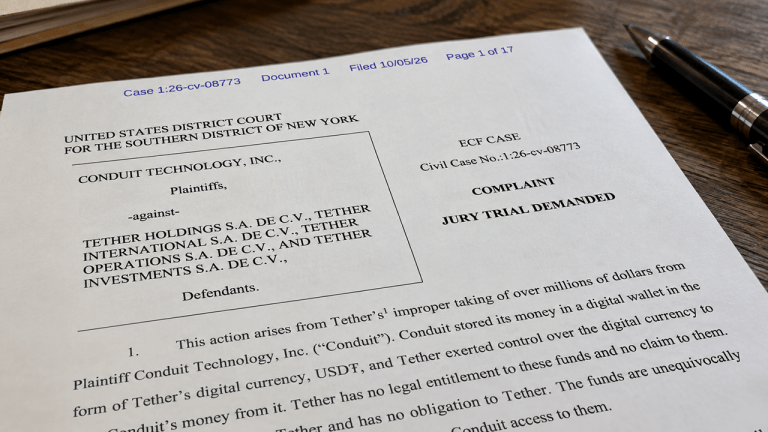
Conduit Sues Tether Over a $2.76M USDT Wallet Frozen for a Year
Conduit Technology has sued Tether after the stablecoin issuer froze $2.76 million in the company’s USDT and allegedly kept it loc...