How Orange Bikes are Changing Africa
After a steep contraction resulting from the COVID-19 pandemic, sub-Saharan economies are expanding, leading to a boom in the logistics sector as the need for transportation rises. However, more than half of active vehic...
Archive context
Older archive item. Useful for background and entity history, but not a fresh market-moving signal.

After a steep contraction resulting from the COVID-19 pandemic, sub-Saharan economies are expanding, leading to a boom in the logistics sector as the need for transportation rises. However, more than half of active vehicles in the region are inefficient 2-stroke petrol-powered motorcycles, primarily used in taxi and delivery services that drive hundreds of kilometers per day. The fuel they burn is costly for drivers and produces large quantities of toxic CO2 and fine particulate emissions.
Recognizing the need for cheaper and more efficient transportation solutions, Bob Eco Ltd., a rapidly-growing electric vehicle and clean energy company, entered the African markets with a line of orange-clad electric two and three-wheelers designed for the needs of taxi and delivery drivers. Since the first one hit the road in October of 2020, Bob Eco’s bikes create a total of 2.6 jobs per bike and save 5 tons of CO2 emissions from being released into the atmosphere every year.
Able to save on fuel costs, drivers who switch to one of Bob Eco’s vehicles nearly quadruple their take-home pay on average – enabling them to support their families and equip their homes with basic necessities like running water. Further, Bob Eco provides its bikes on a lease-to-own basis, giving drivers the chance to accumulate wealth once they pay off their rides.
Being the clear choice for both drivers and the environment, Bob Eco has attracted the attention of African governments, leading to several state-level partnerships, including an order for 232,000 vehicles from the Senegalese government.
Bob Eco signed a 200-million-dollar production deal with manufacturing juggernaut Jincheng Suzuki for annual volumes reaching 200,000 units to keep up with demand. Bob Eco has also recently opened a manufacturing facility focused on producing tricycles and Tuk Tuks, popularly used for comfortably transporting voluminous goods and larger groups of people. This facility has an annual production capacity of 1,500,000. The electric vehicles produced by this facility alone can save over 1,500,000 tons of CO2 emissions by 2024.
Using the UN Environment eMob calculator, scenario calculations show that 11 billion tons of emissions could be saved by 2050 with a global shift to 90% battery-electric motorcycles. Given the rapid growth of two and three-wheelers in Africa, Bob Eco is focused on areas where it can make the most significant impact.
However, Bob Eco is not fighting only for the environment. Bob Eco also runs several social programs in Africa serving people in need. These programs include feeding hungry children nutritious meals via planting fruit trees and rearing animals, building new water sources for local communities, providing schools with scholarships and resources, and providing shelter solutions for those without any.
To do good in more places, Bob Eco launched its BobCoin (BOBC) STO on the primary market in March of 2021. As Bob Eco sold 24% of all Bobcoins for tens of millions of dollars to investors in over 40 countries, the STO can be considered a massive success. Bob Eco’s drift to expand has led Bob Ultee (CEO of Bob Eco) to announce that Bob Eco is “going public” in March with an ICO-WA. Bob Eco will sell BOBC on the primary market in this second round of funding, which is already accessible to retail investors via presale on the reputable www.Knaken.eu crypto platform. The expected listing valuation is $1.45 billion to $1.5 billion.
Why this matters
This cryptocurrency story adds another data point to the current market tape and is useful when read alongside nearby source coverage.
Original source
Read on NewsBTCRelated market context
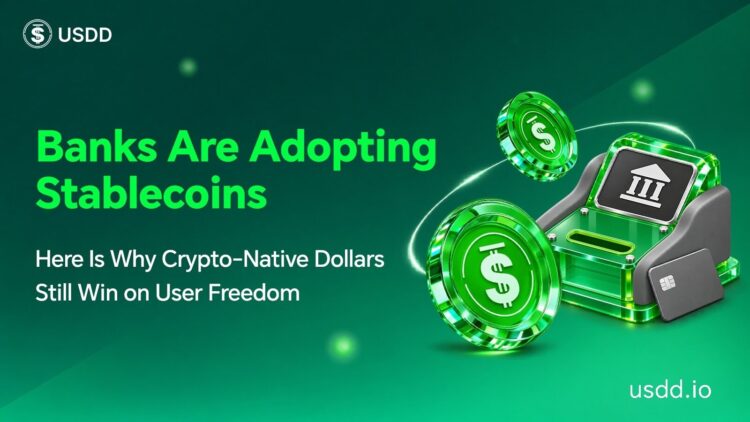
As traditional giants rush into digital dollars, USDD’s Yvonne Chia explains why 24/7 access, self-custody, and transparent yield give decentralized stablecoins an edge banks can’t replicate. 20 November – Road Town, Totorla, British Virgin Islands – Decentralized stablecoin protocol USDD is accelerating its multichain utility across TRON, Ethereum, and BNB Chain—combining automated sUSDD yield via its Smart Allocator with GasFree zero-TRX transfers—as traditional financial giants race to build competing stablecoin rails. In a recent industry interview with instant exchange partner ChangeNOW, USDD Head of Communications Yvonne Chia outlined why self-custody, 24/7 settlement, and transparent onchain reserves give decentralized digital dollars a structural advantage over bank-issued alternatives. 1. Permissionless Access vs. Gatekept Accounts For billions of people globally, opening and maintaining a traditional bank account still involves paperwork, minimum balance requirements, geographic restrictions, and approval delays. Even when banks integrate stablecoin rails behind the scenes, those services remain gated behind legacy compliance walls and intermediary control. Crypto-native stablecoins flip that model on its head. As Yvonne Chia highlighted during the interview: “Compare this to a stablecoin like USDD, where all you need is a phone, a working internet connection, you can immediately start a wallet and you have access to your funds right away.” With USDD, users can access and manage their digital dollars directly through their own wallets, without depending on traditional financial intermediaries. This represents a fundamental shift in financial access: users are no longer limited to the services, operating hours, or account structures of a single institution. Instead, they have the freedom to hold, manage, and transfer their assets on their own terms. Self-custody also gives users greater autonomy over their financial decisions. They can choose which wallets to use, where to transfer their assets, and which supported decentralized applications to interact with, without needing to route every transaction through a centralized financial institution. With USDD, users’ digital dollars can move with them across an open blockchain ecosystem, rather than remaining tied to a particular bank or service provider. 2. 24/7 Global Settlement vs. “Banking Hours” Legacy payment networks still operate on decades-old schedules: weekend cutoffs, bank holidays, and multi-day cross-border settlement delays accompanied by hefty wire fees. Blockchain networks never close. Whether it is a Sunday night or a public holiday, USDD moves globally without depending on traditional banking operating hours or settlement windows. “We are able to have transfers 24/7 and we’re not limited to any traditional banking hours. So I think that in some ways, stablecoins are not just becoming banks, but exceeding what traditional banks can offer to users.” To make everyday transfers even smoother than fintech apps, USDD introduced GasFree integration on TRON, allowing users on supported wallets to pay network fees directly in USDD without needing to hold TRX. This removes another practical barrier to stablecoin adoption: having to acquire and maintain a separate gas token just to transfer digital dollars. With GasFree, eligible users can pay approximately 0.5 USDD per transaction, compared with around 1.5 USDT for a standard USDT transfer under the referenced fee conditions. These improvements matter because the usefulness of a stablecoin is not determined by its peg alone. Low-cost transfers, straightforward wallet experiences, and around-the-clock availability are what make digital dollars practical for everyday payments and global value transfers. 3. Passing Yield Back to Users vs. Bank Spreads Perhaps the sharpest contrast between banks and decentralized stablecoins lies in how yield is distributed. In traditional banking, institutions take customer deposits, deploy them into yield-generating markets, and retain a significant portion of the returns. Everyday depositors may receive relatively low interest rates, while higher-yielding products often come with eligibility requirements, minimum deposits, or fixed maturity periods. Stablecoins introduce another way to participate in digital-dollar opportunities. Rather than keeping capital entirely within a traditional deposit account, users can access onchain yield opportunities through decentralized protocols and transparent investment mechanisms. USDD was built to return that value directly to holders. Through USDD Earn, users can deposit USDD to receive sUSDD, earning automated, competitive yield powered by our Smart Allocator system, with no fixed lock-up periods restricting access to their capital. For users, the distinction is important: USDD Earn provides access to a productive stablecoin while maintaining flexibility, rather than requiring users to commit their capital to a conventional fixed-term product. 4. Onchain Verification vs. Institutional Trust Traditional banks ask customers to trust closed-door balance sheets and periodic regulatory filings—until a crisis proves otherwise. USDD takes a different approach through its “Don’t trust, verify” ethos, emphasizing publicly accessible onchain information and independent verification. Onchain Transparency: Smart contract addresses, collateral reserves, and Smart Allocator deployments are publicly viewable, allowing users to examine relevant information directly on the blockchain. Structured Disclosures: Quarterly Treasury Reports provide additional information about reserve positions, financial performance, and operational developments. Independent Security Reviews: USDD undergoes third-party security audits to assess its smart contracts and identify potential vulnerabilities. Transparency does not eliminate financial or technical risks, but it changes how users can evaluate them. Instead of relying exclusively on an institution’s assurances, users have access to information that can be independently examined and verified. 5. Beyond a Single Network: An Open, Multichain Financial Ecosystem Financial freedom is not just about holding digital dollars. It is also about being able to use them wherever opportunities and applications exist. A stablecoin confined to a single network or limited use case cannot fully realize the potential of open blockchain finance. Following its January 2025 protocol upgrade, USDD expanded natively from TRON onto Ethereum and BNB Chain, extending its reach across multiple blockchain ecosystems. This multichain presence allows USDD to connect with different communities, liquidity environments, and decentralized applications. Its sUSDD product has also expanded into DeFi integrations, including Pendle and Morpho, giving users additional ways to access yield strategies across supported ecosystems. The bigger picture is an interconnected financial ecosystem in which users can move between holding, transferring, exchanging, and deploying their stablecoins according to their own needs. These are not isolated functions. Together, they make stablecoins more useful as everyday financial infrastructure. The Future: Interconnected, Open, and Multichain Banks will undoubtedly continue using stablecoin rails to modernize their back-end settlement. However, true financial freedom comes from open networks where assets flow freely across protocols without intermediaries. For USDD, the opportunity goes beyond offering a dollar-pegged asset. It is about making digital dollars accessible, transferable, and productive across an interconnected financial ecosystem. From self-custody and 24/7 transfers to flexible yield opportunities and multichain DeFi access, these capabilities give users more ways to put their money to work. Banks may be bringing stablecoins into traditional finance. Crypto-native protocols are showing what stablecoins can make possible beyond it.
As traditional giants rush into digital dollars, USDD’s Yvonne Chia explains why 24/7 access, self-custody, and transparent yield...

LIVE – Bitcoin ETF Bleeds: Anthropic’s Record-Breaking IPO Fails to Save the Market
Bitcoin ETF outflows accelerated as Wall Street extended its losing streak, with Asia’s semiconductor markets suffering their wors...

Stablecoin Market Loses Billions: Where Is Crypto’s Liquidity Going?
Crypto’s stablecoin market has shed $16 billion in a month, marking its sharpest contraction since the 2022 bear market. The retre...

Institutions Holding ETH, SOL or HYPE Can Now Borrow Up to Five Years at a $4 Billion Lender
Institutional lender Two Prime will now take seven assets besides bitcoin as loan collateral, the firm announced on Wednesday, Nov...
Binance hack: $2.82 billion frozen, only $32 million recovered
The Binance hack underscores the challenges of asset recovery in crypto, highlighting vulnerabilities in exchange security and leg...

Strategy reports $35 billion net reserve with all Bitcoin unencumbered
Strategy's unencumbered Bitcoin and cash reserves enhance its financial stability, reducing risk during market downturns and prote...