Investors Predict Fed to Hike Rates This Week — Reactions From Crypto, Stocks, Gold Market Expected
The U.S. central bank is expected to raise its target fed funds rate on Wednesday for the first time since the onset of the pandemic. Analysts and economists are hyper-focused on this key event, as the Russia-Ukraine con...
Archive context
Older archive item. Useful for background and entity history, but not a fresh market-moving signal.

The U.S. central bank is expected to raise its target fed funds rate on Wednesday for the first time since the onset of the pandemic. Analysts and economists are hyper-focused on this key event, as the Russia-Ukraine conflict continues in Europe. If the Federal Reserve decides to increase the rate by a quarter percentage point from zero, investors wonder how stock markets, crypto prices, and investments like precious metals will react to the news.
A 25 Basis Point Increase Is Expected — Anxiety Revolves Around the Fed’s Next Moves
Last week, the world watched as financial sanctions were used against Russia and the price of gold soared to an all-time high reaching $2,060 per ounce. Energy stocks, oil, and a myriad of commodities also jumped considerably in value during the last seven days. Cryptocurrency markets last week were lackluster, volume is down, and action remained flat after a brief price jump on March 9, 2022.
Stocks on the other hand suffered a great deal and indexes like the NYSE, Dow Jones, S&P 500, and Nasdaq all closed the day in red on Friday afternoon (EST). Making matters worse, data stemming from the U.S. Labor Department’s Consumer Price Index (CPI) report shows consumer prices tapped a 40-year high at 7.9% in February.
A key event this week for all of the aforementioned markets will be on Wednesday. That’s when the U.S. Federal Reserve is expected to increase the benchmark bank rate for the first time since the Covid-19 pandemic. The increase is anticipated to be a mere quarter-point hike, but investors will also be wondering if the Fed reveals a series of rate hikes for the rest of the year.
During a panel discussion on March 11, Oxbow Advisors managing partner, Ted Oakley, said he expects a 25 basis point increase this Wednesday.
“I want to look at what we might see happen with the Fed. Obviously, next week, we’re expecting a 25 basis point increase there,” Oakley said. “A lot of concern that we saw the markets still didn’t seem to be that settled about what the Fed might do next. How do you plan around this? How do you position your portfolio when you’re not really sure how aggressive the Fed will be?”
CME’s Fed Watch Tool is also expecting the U.S. central bank to raise rates by 0.25 percentage points. A Bloomberg report published on Sunday further details that after the first rate hike, the Fed could get more “aggressive.”
“Futures markets show around 165 basis points of tightening this year, or the equivalent of at least six quarter-point increases,” Bloomberg’s Craig Torres and Olivia Rockeman explain. At the House Financial Services Committee meeting on Tuesday, Moody’s Analytics chief economist Mark Zandi said he thinks it’s a good idea to move forward normalizing rates. At the meeting, Zandi stated:
To ensure that the economy continues to expand and avoid recession, I do think that it’s important to normalize interest rates.
On Sunday afternoon, the price of one ounce of gold is lower than the $2,060 high it saw last week. An ounce of gold is currently exchanging hands for $1,980 per ounce of .999 fine gold. At the time of writing, the global crypto market capitalization is hovering around $1.78 trillion down 2.6% during the last 24-hours.
Crypto markets remain lusterless with only a few tokens gathering single-digit gains on Sunday. Digital currency supporters will be watching the Fed’s move on Wednesday to see if it affects crypto markets negatively. As far as most reports are concerned, there’s not much of a chance that the central bank won’t raise its target fed funds rate this month.
Just like the futures markets and CME’s Fed Watch Tool, most analysts and economists agree that Fed chair Jerome Powell’s and the U.S. central bank’s monetary easing tactics are coming to an end.
“[Jerome] Powell can’t really afford to be dovish at this point, it would be inconsistent with what sound policy is and where policy needs to be heading,” Derek Tang, an economist at Monetary Policy Analytics in Washington said on Sunday.
What are your thoughts on this story? Tell us what you think in the comments section below.
Why this matters
This cryptocurrency story adds another data point to the current market tape and is useful when read alongside nearby source coverage.
Original source
Read on Bitcoin NewsRelated market context
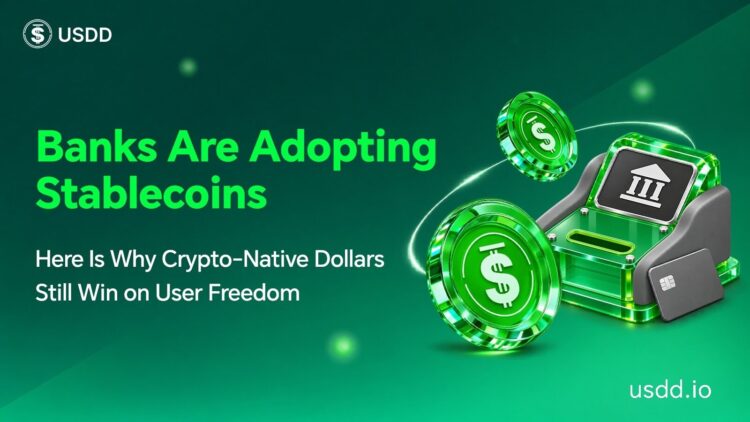
As traditional giants rush into digital dollars, USDD’s Yvonne Chia explains why 24/7 access, self-custody, and transparent yield give decentralized stablecoins an edge banks can’t replicate. 20 November – Road Town, Totorla, British Virgin Islands – Decentralized stablecoin protocol USDD is accelerating its multichain utility across TRON, Ethereum, and BNB Chain—combining automated sUSDD yield via its Smart Allocator with GasFree zero-TRX transfers—as traditional financial giants race to build competing stablecoin rails. In a recent industry interview with instant exchange partner ChangeNOW, USDD Head of Communications Yvonne Chia outlined why self-custody, 24/7 settlement, and transparent onchain reserves give decentralized digital dollars a structural advantage over bank-issued alternatives. 1. Permissionless Access vs. Gatekept Accounts For billions of people globally, opening and maintaining a traditional bank account still involves paperwork, minimum balance requirements, geographic restrictions, and approval delays. Even when banks integrate stablecoin rails behind the scenes, those services remain gated behind legacy compliance walls and intermediary control. Crypto-native stablecoins flip that model on its head. As Yvonne Chia highlighted during the interview: “Compare this to a stablecoin like USDD, where all you need is a phone, a working internet connection, you can immediately start a wallet and you have access to your funds right away.” With USDD, users can access and manage their digital dollars directly through their own wallets, without depending on traditional financial intermediaries. This represents a fundamental shift in financial access: users are no longer limited to the services, operating hours, or account structures of a single institution. Instead, they have the freedom to hold, manage, and transfer their assets on their own terms. Self-custody also gives users greater autonomy over their financial decisions. They can choose which wallets to use, where to transfer their assets, and which supported decentralized applications to interact with, without needing to route every transaction through a centralized financial institution. With USDD, users’ digital dollars can move with them across an open blockchain ecosystem, rather than remaining tied to a particular bank or service provider. 2. 24/7 Global Settlement vs. “Banking Hours” Legacy payment networks still operate on decades-old schedules: weekend cutoffs, bank holidays, and multi-day cross-border settlement delays accompanied by hefty wire fees. Blockchain networks never close. Whether it is a Sunday night or a public holiday, USDD moves globally without depending on traditional banking operating hours or settlement windows. “We are able to have transfers 24/7 and we’re not limited to any traditional banking hours. So I think that in some ways, stablecoins are not just becoming banks, but exceeding what traditional banks can offer to users.” To make everyday transfers even smoother than fintech apps, USDD introduced GasFree integration on TRON, allowing users on supported wallets to pay network fees directly in USDD without needing to hold TRX. This removes another practical barrier to stablecoin adoption: having to acquire and maintain a separate gas token just to transfer digital dollars. With GasFree, eligible users can pay approximately 0.5 USDD per transaction, compared with around 1.5 USDT for a standard USDT transfer under the referenced fee conditions. These improvements matter because the usefulness of a stablecoin is not determined by its peg alone. Low-cost transfers, straightforward wallet experiences, and around-the-clock availability are what make digital dollars practical for everyday payments and global value transfers. 3. Passing Yield Back to Users vs. Bank Spreads Perhaps the sharpest contrast between banks and decentralized stablecoins lies in how yield is distributed. In traditional banking, institutions take customer deposits, deploy them into yield-generating markets, and retain a significant portion of the returns. Everyday depositors may receive relatively low interest rates, while higher-yielding products often come with eligibility requirements, minimum deposits, or fixed maturity periods. Stablecoins introduce another way to participate in digital-dollar opportunities. Rather than keeping capital entirely within a traditional deposit account, users can access onchain yield opportunities through decentralized protocols and transparent investment mechanisms. USDD was built to return that value directly to holders. Through USDD Earn, users can deposit USDD to receive sUSDD, earning automated, competitive yield powered by our Smart Allocator system, with no fixed lock-up periods restricting access to their capital. For users, the distinction is important: USDD Earn provides access to a productive stablecoin while maintaining flexibility, rather than requiring users to commit their capital to a conventional fixed-term product. 4. Onchain Verification vs. Institutional Trust Traditional banks ask customers to trust closed-door balance sheets and periodic regulatory filings—until a crisis proves otherwise. USDD takes a different approach through its “Don’t trust, verify” ethos, emphasizing publicly accessible onchain information and independent verification. Onchain Transparency: Smart contract addresses, collateral reserves, and Smart Allocator deployments are publicly viewable, allowing users to examine relevant information directly on the blockchain. Structured Disclosures: Quarterly Treasury Reports provide additional information about reserve positions, financial performance, and operational developments. Independent Security Reviews: USDD undergoes third-party security audits to assess its smart contracts and identify potential vulnerabilities. Transparency does not eliminate financial or technical risks, but it changes how users can evaluate them. Instead of relying exclusively on an institution’s assurances, users have access to information that can be independently examined and verified. 5. Beyond a Single Network: An Open, Multichain Financial Ecosystem Financial freedom is not just about holding digital dollars. It is also about being able to use them wherever opportunities and applications exist. A stablecoin confined to a single network or limited use case cannot fully realize the potential of open blockchain finance. Following its January 2025 protocol upgrade, USDD expanded natively from TRON onto Ethereum and BNB Chain, extending its reach across multiple blockchain ecosystems. This multichain presence allows USDD to connect with different communities, liquidity environments, and decentralized applications. Its sUSDD product has also expanded into DeFi integrations, including Pendle and Morpho, giving users additional ways to access yield strategies across supported ecosystems. The bigger picture is an interconnected financial ecosystem in which users can move between holding, transferring, exchanging, and deploying their stablecoins according to their own needs. These are not isolated functions. Together, they make stablecoins more useful as everyday financial infrastructure. The Future: Interconnected, Open, and Multichain Banks will undoubtedly continue using stablecoin rails to modernize their back-end settlement. However, true financial freedom comes from open networks where assets flow freely across protocols without intermediaries. For USDD, the opportunity goes beyond offering a dollar-pegged asset. It is about making digital dollars accessible, transferable, and productive across an interconnected financial ecosystem. From self-custody and 24/7 transfers to flexible yield opportunities and multichain DeFi access, these capabilities give users more ways to put their money to work. Banks may be bringing stablecoins into traditional finance. Crypto-native protocols are showing what stablecoins can make possible beyond it.
As traditional giants rush into digital dollars, USDD’s Yvonne Chia explains why 24/7 access, self-custody, and transparent yield...
Bitcoin Hovers Just Above Average Holder’s Cost Basis as Price Keeps Dipping
Bitcoin Magazine Bitcoin Hovers Just Above Average Holder’s Cost Basis as Price Keeps Dipping Bitcoin is trading just above its re...

Ethereum Devs Lean Toward Shipping Glamsterdam as Is, Push Hoodi Testnet Decision to Next Week
Ethereum’s core developers leaned toward shipping Glamsterdam, the network’s next hard fork, with its contested gas repricing unch...

Binance hack laundering accelerates as $149M in Bitcoin passes through coinjoins, Elliptic says
The accelerated laundering of stolen funds via coinjoins highlights ongoing challenges in tracking and recovering illicit cryptocu...

Bitcoin Price Crashes Below $62K: What Should You Do?
Bitcoin price has fallen below $62,000 for the first time since early July, extending a brutal November selloff as institutional i...

Jesse Pollak Says Tokenized Stocks on Base Have Crossed $1 Billion in Weekly Volume
Tokenized stocks on Base, the Ethereum layer 2 network built by Coinbase, have “just crossed $1 billion of weekly volume” less tha...