Kalshi’s $40 billion growth story hits tough questions about its trading volume
Kalshi is ending a trader-volume incentive program nearly a year early as scrutiny of activity in its crypto markets intensifies. The prediction-market operator told the Commodity Futures Trading Commission (CFTC) that i...
Archive context
Older archive item. Useful for background and entity history, but not a fresh market-moving signal.
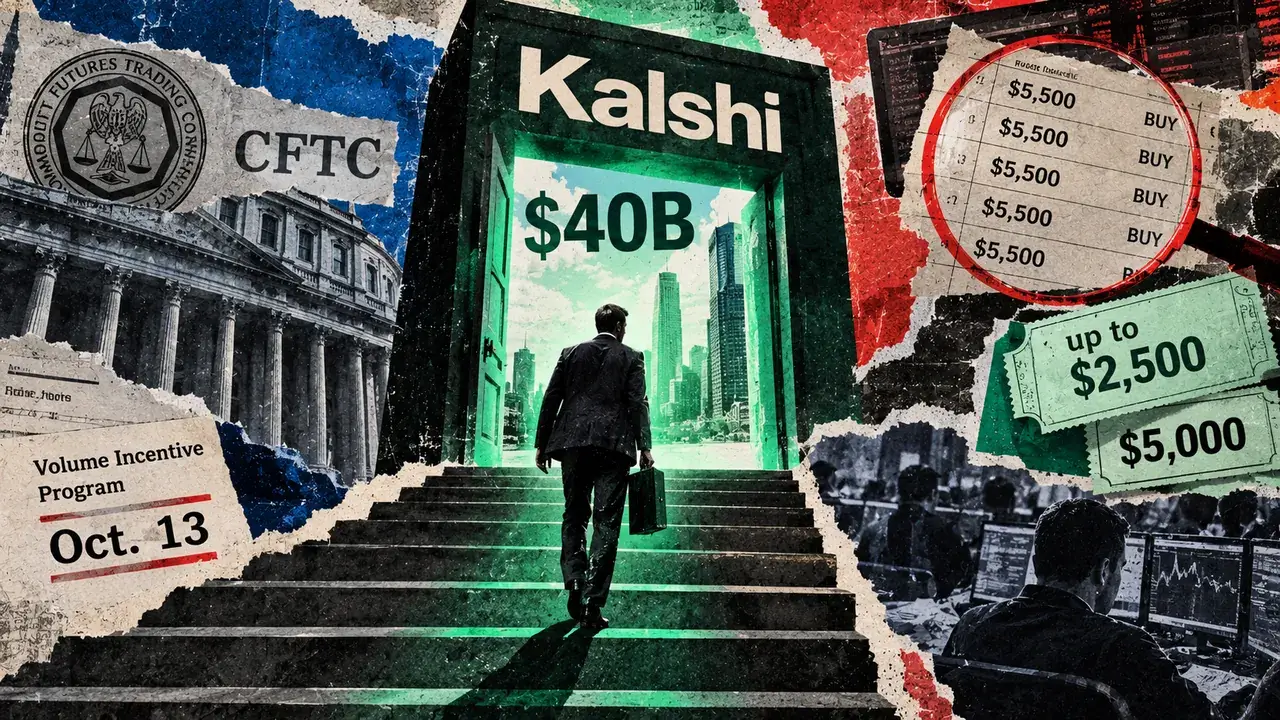
Kalshi is ending a trader-volume incentive program nearly a year early as scrutiny of activity in its crypto markets intensifies.
The prediction-market operator told the Commodity Futures Trading Commission (CFTC) that its Volume Incentive Program will terminate no earlier than Oct. 13, according to a Sept. 28 filing. The program had previously been scheduled to run until Oct. 1, 2027, making the change a significant acceleration of its planned end date.
The decision comes as Kalshi faces questions over trading patterns in its perpetual futures markets. The CFTC has reportedly examined activity after researchers identified repetitive trades around fixed dollar amounts, including roughly $5,500 in Ethereum perpetuals.
Kalshi has said it is not under investigation and has rejected allegations of wash trading, attributing the repeated transactions to market makers placing fixed-size quotes that other traders repeatedly hit.
The filing does not link the program's termination to those concerns or explain why Kalshi ended it early. Under its terms, the exchange could terminate the program at its discretion.
Launched to increase activity on Kalshi's central limit order book, the program allowed the exchange to designate eligible markets and establish fixed reward pools. Traders received a share based on their proportion of eligible volume, with event-contract rewards capped at half a cent per contract for each participant. Perpetual futures were also eligible and were exempt from the program's normal 3-cent to 97-cent qualifying price range.
That incentive structure is now giving way to a broader framework that gives Kalshi far more flexibility in how it spends money to attract and retain traders.
Kalshi shifts toward targeted trader rewardsDays before filing to terminate the volume program, Kalshi submitted a new Deposit and Trading Reward Incentive Program to the CFTC. The regulator's docket lists a modified version as received Sept. 25, with the filing setting Sept. 28 as the earliest effective date.
The two programs are not formally described as replacements and can overlap before the older program ends. Still, the new framework changes how Kalshi can deploy incentives.
Rather than distributing a fixed pool according to each trader's share of market volume, Kalshi can offer time-limited promotions tied to deposits, trading activity, or both. Promotions can run from three to 90 days and target groups based on criteria including account age, whether an account is funded, previous trading activity, inactivity, geography, and prior participation in particular contract categories.
Individual promotions can pay up to $2,500 per participant, while total rewards are capped at $5,000 per person over the program's planned two-year life. Kalshi can use percentage matches or fixed-value incentives across categories including crypto, sports, economics, financials, politics, weather and entertainment.
The filing also adds more detail on abusive trading. Transactions under inquiry for potential self-matching, wash trading, prearranged trading or other prohibited practices would be excluded from promotional rewards.
Kalshi said its surveillance staff would apply heightened monitoring to participants receiving incentives and could terminate eligibility or pursue disciplinary action.
That gives Kalshi a more targeted customer-acquisition tool at a time when the economics and quality of trading activity on prediction platforms are receiving increased attention.
Record trading supports a $40 billion pitchThe incentive overhaul comes despite little evidence that Kalshi is struggling to generate headline volume.
The exchange has repeatedly broken trading records during September. Data compiled by DeFiRate shows Kalshi handled a record $3.24 billion on Sept. 27, while weekly volume reached $15.66 billion in the seven days through that date. Its share of tracked prediction-market volume stood near 80%, up substantially from levels seen a year earlier.
That growth is increasingly being reflected in what investors are willing to pay for the company.
Kalshi is in advanced discussions to raise about $1 billion at a valuation of roughly $40 billion, Reuters reported, citing people familiar with the talks. Sequoia Capital and Wellington Management are discussing leading the round, with Tiger Global and Dragoneer Investment Group also considering investments.
A deal at that price would almost double the $22 billion valuation Kalshi secured in a $1 billion fundraising round in May. Reuters said the company is also exploring expansion beyond prediction markets into additional asset classes and has held preliminary discussions about a future initial public offering.
That makes the incentive transition consequential beyond the rewards themselves. As Kalshi seeks a valuation closer to established financial-market operators, investors will increasingly have to judge how much of its rapidly rising activity reflects durable customer demand and how much still depends on the economics the exchange creates to stimulate trading.
The post Kalshi’s $40 billion growth story hits tough questions about its trading volume appeared first on CryptoSlate.
Why this matters
Kalshi is showing up inside the Regulation theme, so this story is worth tracking for follow-through rather than treating it as a one-off headline.
Original source
Read on CryptoSlateRelated market context

Ethereum (ETH) Price Prediction: ETH Eyes Recovery From $2,600 as $2,666-$2,689 Becomes Resistance
Ethereum price is holding around $2,618 as buyers attempt to preserve the latest recovery, but the market is approaching a decisiv...

Ethereum Price Prediction: Layer-2 Trouble Deepens as Another Network Shuts Down
Blast’s decision to close its Layer-2 network sharpens the question of Ethereum price and prediction: does activity ultimately con...

Why Abstract is killing its Ethereum L2 instead of launching a token to save it
Abstract will shut down on Dec. 15 despite onboarding more than 400,000 users, hosting 144 apps, and landing brands including Disn...

Bitcoin rally delivers $4.1 billion tax windfall for Strategy
Strategy estimated a $4.1 billion income-tax benefit after Bitcoin's fair value rose above cost as of Sept. 30, according to its O...

OKX Eyes 63 U.S. Stocks in Major Tokenized Trading Expansion
Key Takeaways: OKXICE informed the SEC about its plan to establish an online platform called “Tokenized Securities Venue” that wou...

Robinhood adds $25 million of Bitcoin to its own balance sheet
Robinhood is adding $25 million of Bitcoin to its balance sheet after executives previously debated whether corporate crypto holdi...