NoVa Battles: Everything You Need to Know
PRESS RELEASE. Have you ever fantasized about of traveling to an endless cosmos to face off against cosmic warriors for control of the universe’s ultimate power? With NoVa Battle, you can get the chance to live your wild...
Archive context
Older archive item. Useful for background and entity history, but not a fresh market-moving signal.

PRESS RELEASE. Have you ever fantasized about of traveling to an endless cosmos to face off against cosmic warriors for control of the universe’s ultimate power? With NoVa Battle, you can get the chance to live your wildest dreams out of your mobile device. So, what exactly is NoVa Battle? And what makes it so different from other MOBA mobile games based on Blockchain technology? Keep reading to find out!
What is NoVa Battles?
NoVa Battles is a Play-to-Earn (P2E) mobile multiplayer online battle arena (MOBA) game built with the primary focus on blockchain technology. The first thought about making a blockchain-based game sparked in the minds of the creators in 2019. And since then, here has been a long period of experimentation and research on the viability of this blockchain-based game at the firm.
NoVa Battles “The People’s Gaming” is being created by a game studio that was formed in early 2019. The studio has a staff of more than 60 game developers. All members of the NoVa Battles crew are cryptocurrency investors and gamers. Dubai is home to the studio’s headquarters, but subsidiaries in Singapore, Thailand, and Malaysia are also part of the studio’s global network.
All members of the NoVa Battles crew are cryptocurrency investors and gamers.
NoVa Battles is a Diamond Sponsor at the Dubai Crypto Expo and the NoVa team will be there on the 16th and 17th of March with the CEO being a speaker at the event on the 17th of March. They are welcoming all people to come by to visit the Dubai Crypto Expo.
The people’s game
Because of its popularity, NoVa Battle is dubbed the “People’s game”. The game’s future will be chosen by the desires of the players, and the game’s direction will be determined by the community. The key value of a DAO is the progressive transition of executive authority from the initial growing firm to the players and stakeholders.
Over the course of the next 36 months, a DAO system will be gradually put into place. During the 36-month period, the original game will be completely reworked in response to user feedback. This technique extends the life of the game while also ensuring that it remains engaging for all players.
Community driven
NoVa Battles can work with any online community, be it blockchain-based or from a different industry. In-game heroes, NFTS, and costumes can be developed by the Shiba Inu token community or even a group of friends to govern and generate a revenue stream. The communities inspire the next generation of champions, and some of the revenues are used to support their efforts. The champion pool currently includes a Shiba champion, and more interesting additions are on the way.
Single token model (NVA)
When compared to the traditional two-token system, the NoVa Battles one token model ensures a safe space for the preservation of value. All in-game tokens can be exchanged for real money. Direct withdrawals have also been implemented, eliminating the requirement to first swap NVA for another token.
Blockchain design
In the NoVa Battles blockchain economic system, players “earn as they play”. You may earn NoVa tokens by participating in NoVa Battles with a NoVa Soul (NS) and unlocking an earning rate for your NoVa Soul and account level.
So, what exactly is NoVa Soul?
The in-game economy revolves around NoVa Soul. NoVa Soul energy is consumed by players throughout a match to get points. Each NoVa Soul has five levels, each with a varied earning potential. Each NoVa Soul is unique and has its own set of traits. NoVa Souls have varying levels, powers, scores, abilities, looks, and more. In addition to boosting your chances of winning, the right NoVa Soul will improve your gameplay.
Final words
MOBA games on mobile devices are about to get a whole lot better with NoVa Battles. A wide range of game aspects and blockchain capabilities will be added to the platform in the future as it expands. The MOBA game will serve as a framework for future expansion by the creators. In addition, a metaverse will be develop around the NoVa Battles with the primary goal being a vast NoVa Universe.
To become a beta tester for NoVa Battles, visit the game’s official website. Tokens are given to beta testers ahead of time. To stay up to speed on the latest gaming news, follow them on Twitter or join their official Telegram channel to chat with the NoVa Battles team directly!
For more details, visit:
Website: www.novabattles.com
Whitepaper: wp.novabattles.com
Social Media
Twitter @NoVa_BTL
Instagram @nova.battles
Facebook @NoVaBattles
This is a press release. Readers should do their own due diligence before taking any actions related to the promoted company or any of its affiliates or services. Bitcoin.com is not responsible, directly or indirectly, for any damage or loss caused or alleged to be caused by or in connection with the use of or reliance on any content, goods or services mentioned in the press release.
Why this matters
This cryptocurrency story adds another data point to the current market tape and is useful when read alongside nearby source coverage.
Original source
Read on Bitcoin NewsRelated market context
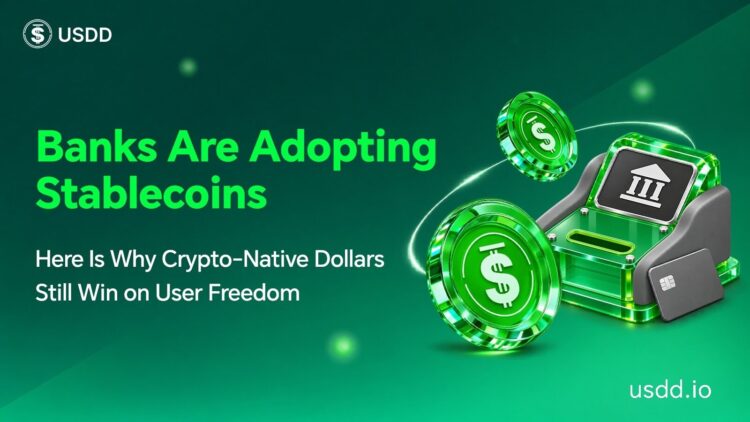
As traditional giants rush into digital dollars, USDD’s Yvonne Chia explains why 24/7 access, self-custody, and transparent yield give decentralized stablecoins an edge banks can’t replicate. 20 November – Road Town, Totorla, British Virgin Islands – Decentralized stablecoin protocol USDD is accelerating its multichain utility across TRON, Ethereum, and BNB Chain—combining automated sUSDD yield via its Smart Allocator with GasFree zero-TRX transfers—as traditional financial giants race to build competing stablecoin rails. In a recent industry interview with instant exchange partner ChangeNOW, USDD Head of Communications Yvonne Chia outlined why self-custody, 24/7 settlement, and transparent onchain reserves give decentralized digital dollars a structural advantage over bank-issued alternatives. 1. Permissionless Access vs. Gatekept Accounts For billions of people globally, opening and maintaining a traditional bank account still involves paperwork, minimum balance requirements, geographic restrictions, and approval delays. Even when banks integrate stablecoin rails behind the scenes, those services remain gated behind legacy compliance walls and intermediary control. Crypto-native stablecoins flip that model on its head. As Yvonne Chia highlighted during the interview: “Compare this to a stablecoin like USDD, where all you need is a phone, a working internet connection, you can immediately start a wallet and you have access to your funds right away.” With USDD, users can access and manage their digital dollars directly through their own wallets, without depending on traditional financial intermediaries. This represents a fundamental shift in financial access: users are no longer limited to the services, operating hours, or account structures of a single institution. Instead, they have the freedom to hold, manage, and transfer their assets on their own terms. Self-custody also gives users greater autonomy over their financial decisions. They can choose which wallets to use, where to transfer their assets, and which supported decentralized applications to interact with, without needing to route every transaction through a centralized financial institution. With USDD, users’ digital dollars can move with them across an open blockchain ecosystem, rather than remaining tied to a particular bank or service provider. 2. 24/7 Global Settlement vs. “Banking Hours” Legacy payment networks still operate on decades-old schedules: weekend cutoffs, bank holidays, and multi-day cross-border settlement delays accompanied by hefty wire fees. Blockchain networks never close. Whether it is a Sunday night or a public holiday, USDD moves globally without depending on traditional banking operating hours or settlement windows. “We are able to have transfers 24/7 and we’re not limited to any traditional banking hours. So I think that in some ways, stablecoins are not just becoming banks, but exceeding what traditional banks can offer to users.” To make everyday transfers even smoother than fintech apps, USDD introduced GasFree integration on TRON, allowing users on supported wallets to pay network fees directly in USDD without needing to hold TRX. This removes another practical barrier to stablecoin adoption: having to acquire and maintain a separate gas token just to transfer digital dollars. With GasFree, eligible users can pay approximately 0.5 USDD per transaction, compared with around 1.5 USDT for a standard USDT transfer under the referenced fee conditions. These improvements matter because the usefulness of a stablecoin is not determined by its peg alone. Low-cost transfers, straightforward wallet experiences, and around-the-clock availability are what make digital dollars practical for everyday payments and global value transfers. 3. Passing Yield Back to Users vs. Bank Spreads Perhaps the sharpest contrast between banks and decentralized stablecoins lies in how yield is distributed. In traditional banking, institutions take customer deposits, deploy them into yield-generating markets, and retain a significant portion of the returns. Everyday depositors may receive relatively low interest rates, while higher-yielding products often come with eligibility requirements, minimum deposits, or fixed maturity periods. Stablecoins introduce another way to participate in digital-dollar opportunities. Rather than keeping capital entirely within a traditional deposit account, users can access onchain yield opportunities through decentralized protocols and transparent investment mechanisms. USDD was built to return that value directly to holders. Through USDD Earn, users can deposit USDD to receive sUSDD, earning automated, competitive yield powered by our Smart Allocator system, with no fixed lock-up periods restricting access to their capital. For users, the distinction is important: USDD Earn provides access to a productive stablecoin while maintaining flexibility, rather than requiring users to commit their capital to a conventional fixed-term product. 4. Onchain Verification vs. Institutional Trust Traditional banks ask customers to trust closed-door balance sheets and periodic regulatory filings—until a crisis proves otherwise. USDD takes a different approach through its “Don’t trust, verify” ethos, emphasizing publicly accessible onchain information and independent verification. Onchain Transparency: Smart contract addresses, collateral reserves, and Smart Allocator deployments are publicly viewable, allowing users to examine relevant information directly on the blockchain. Structured Disclosures: Quarterly Treasury Reports provide additional information about reserve positions, financial performance, and operational developments. Independent Security Reviews: USDD undergoes third-party security audits to assess its smart contracts and identify potential vulnerabilities. Transparency does not eliminate financial or technical risks, but it changes how users can evaluate them. Instead of relying exclusively on an institution’s assurances, users have access to information that can be independently examined and verified. 5. Beyond a Single Network: An Open, Multichain Financial Ecosystem Financial freedom is not just about holding digital dollars. It is also about being able to use them wherever opportunities and applications exist. A stablecoin confined to a single network or limited use case cannot fully realize the potential of open blockchain finance. Following its January 2025 protocol upgrade, USDD expanded natively from TRON onto Ethereum and BNB Chain, extending its reach across multiple blockchain ecosystems. This multichain presence allows USDD to connect with different communities, liquidity environments, and decentralized applications. Its sUSDD product has also expanded into DeFi integrations, including Pendle and Morpho, giving users additional ways to access yield strategies across supported ecosystems. The bigger picture is an interconnected financial ecosystem in which users can move between holding, transferring, exchanging, and deploying their stablecoins according to their own needs. These are not isolated functions. Together, they make stablecoins more useful as everyday financial infrastructure. The Future: Interconnected, Open, and Multichain Banks will undoubtedly continue using stablecoin rails to modernize their back-end settlement. However, true financial freedom comes from open networks where assets flow freely across protocols without intermediaries. For USDD, the opportunity goes beyond offering a dollar-pegged asset. It is about making digital dollars accessible, transferable, and productive across an interconnected financial ecosystem. From self-custody and 24/7 transfers to flexible yield opportunities and multichain DeFi access, these capabilities give users more ways to put their money to work. Banks may be bringing stablecoins into traditional finance. Crypto-native protocols are showing what stablecoins can make possible beyond it.
As traditional giants rush into digital dollars, USDD’s Yvonne Chia explains why 24/7 access, self-custody, and transparent yield...

Bitcoin Price Crashes Below $62K: What Should You Do?
Bitcoin price has fallen below $62,000 for the first time since early July, extending a brutal November selloff as institutional i...
Ripple’s Stuart Alderoty argues formal crypto rules will outlast any SEC chair
Formal crypto rules ensure regulatory stability and foster innovation, reducing reliance on shifting enforcement priorities and of...

Fairmint plans tokenized stock trading venue under SEC innovation exemption
Fairmint's initiative could revolutionize stock trading by integrating blockchain technology, potentially enhancing transparency a...

Vanguard, State Street and BlackRock executives share a stage to talk ETF innovation
The collaboration of major ETF issuers highlights the potential for transformative advancements in investment strategies and marke...

XRP Price Prediction: $1 Wall Breaks, What’s Next?
XRP price has lost the $1 mark, and buyers are running out of powder to defend the breakdown. The token floats at $0.95, extending...