Tether And The City Of Lugano Presented Its “Plan B.” What Did We Learn?
The City of Lugano in Switzerland, the most important Italian-speaking city outside of Italy, is not playing around. The goal of their “Plan B” is to “make Lugano the blockchain hub for the entire Europe,” according to T...
Archive context
Older archive item. Useful for background and entity history, but not a fresh market-moving signal.

The City of Lugano in Switzerland, the most important Italian-speaking city outside of Italy, is not playing around. The goal of their “Plan B” is to “make Lugano the blockchain hub for the entire Europe,” according to Tether’s Paolo Ardoino. And it will probably succeed. The city wants to attract investment and talent, attract wealth and smart minds, and they’re putting their money where their mouth is.
Why do they have to brand their plan using bitcoin’s name, though? In NewsBTC’s previous article about the project we were very critical, and even raised the possibility of this being an affinity scam. Bitcoin name is heavily used in all promotional materials, but the protagonists talk about blockchain and crypto like there’s no tomorrow. Why would Tether Ltd. and its partners not make this a crypto project and call it a day?
We closed said article giving them the benefit of the doubt:
“And here comes the Mayor of the city of Lugano and Tether to sing bitcoin’s praises. A “blockchain not bitcoin” guy and the organization behind the most controversial stablecoin. Even though it’s suspicious, let’s give them the benefit of the doubt and hear what they have to say. They might surprise us at the March 3rd conference. Maybe Lugano has a Plan B after all.”
Do they have a Plan B? Let’s find out.
Bitcoin Legal Tender In Lugano. And USDT. And LVGAThe story’s headline is that Bitcoin, Tether, and LVGA, the city’s own cryptocurrency, will be legal tender in Lugano. Residents will be able to “pay all personal and corporate municipal taxes” in any of those cryptocurrencies. Besides that, the city’s authorities have already onboarded 200+ shops and businesses to accept them.
There’s more though. You’ll be able to use bitcoin, USDT, and LVGA to pay for: public services, parking tickets, dog taxes, ID and passport issuance fees, naturalization fees, construction permit fees, boat docking fees, tuition and meal fees, garbage taxes, signature authorization, access to public infrastructure, access to public events, rental spaces for events, and cemetery taxes.
Who Presented The News And What Did They Say?The panel consisted of:
- Michele Foletti, the city’s Mayor, who spoke in Italian.
- Jan Ludovicus van der Velde, CEO of Tether, who spoke via video.
- Pietro Poretti, economic development division for the City of Lugano.
- Paolo Ardoino, CTO of Tether
The Mayor said that “Lugano is, historically, a land of technological innovation and freedom.” He believes that “Bitcoin, blockchain, and crypto” should be “disseminated and accessible to all.” And he’s convinced “that this journey will bring benefits to all the citizens and that’s why this is our commitment.”
Jan Ludovicus van der Velde briefly recapitulated bitcoin’s history and talked about the value of open-source software. About cryptocurrencies, he said that while the adoption is wide scaled, in practice, “we lack the ability to exchange with the local bakeries and tailors. We lack the ability to pay for higher education or automobiles. We’re stuck waiting for the world to catch up to the future of financial freedom.”
About “Plan B” specifically, van der Velde said, “We envision blockchain touching every facet of this city.”
NEW: Switzerland's City of Lugano will "roll the red carpet" for #Bitcoin businesses and enthusiasts pic.twitter.com/2hujg4V4wm
— Bitcoin Magazine (@BitcoinMagazine) March 3, 2022
Paolo Ardoino stated that “with this Plan B we want to show that the tooling, the instruments, that we’re creating can be actually put to work in a local, controlled, vibrant environment like the City of Lugano.” While Pietro Poretti said that the plan was to “create the ideal conditions for companies to thrive.” They both carried the conference and announced everything else in this article.
Ardoino also explained why they chose Lugano. Among other things:
- It’s in the center of Europe.
- Switzerland is safe and secure.
- The city is near big airports.
- It has forward-looking institutions and administration.
The only mention of something bitcoin-specific goes to Paolo Ardoino, who sang the Lightning Network’s praises and expressed his wishes for Lugano to be the “first wide adopter.” We know he meant after the legendary Bitcoin Beach in El Salvador, of course.
Ardoino also announced a 100 million CHF fund “for start-ups that want to relocate here and want to put their headquarter here.” “Infrastructure partners like Polygon” made the fund possible. One of USDT’s versions runs on the Ethereum Layer 2 chain, and in this conference, we learned that LVGA, the city’s coin, also runs on Polygon rails.
Besides that fund, Lugano’s “Plan B” consists of:
- A “Start-up hub for 25+ innovative companies”
- A “space for meetups and workshops open to the public.”
- “3+ million CHF investment into practical grassroot blockchain projects”
- “500+ student grants for education in bitcoin and decentralized technologies.” According to Poretti, this whole thing isn’t possible without “synergy with academia.”
From October 26th to 28th, at Lugano’s Palazzo dei Congressi, there will be a huge conference. So far, the confirmed speakers are Blockstream’s Adam Back, bitcoin ambassador Samson Mow, and the controversial Max Keiser. More guests are to be announced.
Keep your eye on NewsBTC for following stories about the Bitcoin World Forum and Lugano’s “Plan B.”
Featured Image: Lugano's Plan B announcement, screenshot from the video | Charts by TradingViewWhy this matters
This cryptocurrency story adds another data point to the current market tape and is useful when read alongside nearby source coverage.
Original source
Read on NewsBTCRelated market context
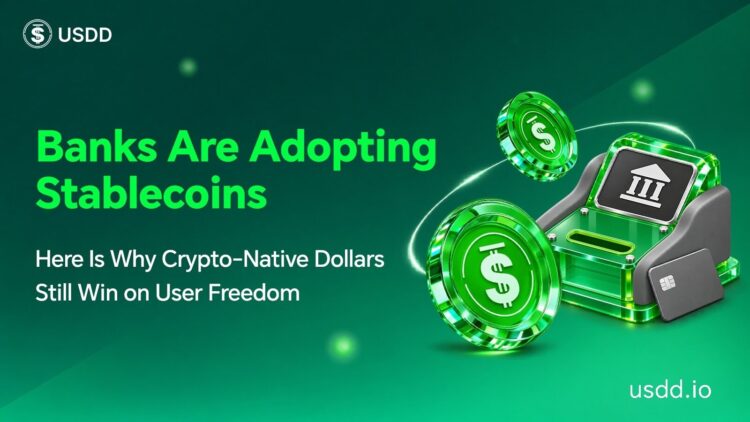
As traditional giants rush into digital dollars, USDD’s Yvonne Chia explains why 24/7 access, self-custody, and transparent yield give decentralized stablecoins an edge banks can’t replicate. 20 November – Road Town, Totorla, British Virgin Islands – Decentralized stablecoin protocol USDD is accelerating its multichain utility across TRON, Ethereum, and BNB Chain—combining automated sUSDD yield via its Smart Allocator with GasFree zero-TRX transfers—as traditional financial giants race to build competing stablecoin rails. In a recent industry interview with instant exchange partner ChangeNOW, USDD Head of Communications Yvonne Chia outlined why self-custody, 24/7 settlement, and transparent onchain reserves give decentralized digital dollars a structural advantage over bank-issued alternatives. 1. Permissionless Access vs. Gatekept Accounts For billions of people globally, opening and maintaining a traditional bank account still involves paperwork, minimum balance requirements, geographic restrictions, and approval delays. Even when banks integrate stablecoin rails behind the scenes, those services remain gated behind legacy compliance walls and intermediary control. Crypto-native stablecoins flip that model on its head. As Yvonne Chia highlighted during the interview: “Compare this to a stablecoin like USDD, where all you need is a phone, a working internet connection, you can immediately start a wallet and you have access to your funds right away.” With USDD, users can access and manage their digital dollars directly through their own wallets, without depending on traditional financial intermediaries. This represents a fundamental shift in financial access: users are no longer limited to the services, operating hours, or account structures of a single institution. Instead, they have the freedom to hold, manage, and transfer their assets on their own terms. Self-custody also gives users greater autonomy over their financial decisions. They can choose which wallets to use, where to transfer their assets, and which supported decentralized applications to interact with, without needing to route every transaction through a centralized financial institution. With USDD, users’ digital dollars can move with them across an open blockchain ecosystem, rather than remaining tied to a particular bank or service provider. 2. 24/7 Global Settlement vs. “Banking Hours” Legacy payment networks still operate on decades-old schedules: weekend cutoffs, bank holidays, and multi-day cross-border settlement delays accompanied by hefty wire fees. Blockchain networks never close. Whether it is a Sunday night or a public holiday, USDD moves globally without depending on traditional banking operating hours or settlement windows. “We are able to have transfers 24/7 and we’re not limited to any traditional banking hours. So I think that in some ways, stablecoins are not just becoming banks, but exceeding what traditional banks can offer to users.” To make everyday transfers even smoother than fintech apps, USDD introduced GasFree integration on TRON, allowing users on supported wallets to pay network fees directly in USDD without needing to hold TRX. This removes another practical barrier to stablecoin adoption: having to acquire and maintain a separate gas token just to transfer digital dollars. With GasFree, eligible users can pay approximately 0.5 USDD per transaction, compared with around 1.5 USDT for a standard USDT transfer under the referenced fee conditions. These improvements matter because the usefulness of a stablecoin is not determined by its peg alone. Low-cost transfers, straightforward wallet experiences, and around-the-clock availability are what make digital dollars practical for everyday payments and global value transfers. 3. Passing Yield Back to Users vs. Bank Spreads Perhaps the sharpest contrast between banks and decentralized stablecoins lies in how yield is distributed. In traditional banking, institutions take customer deposits, deploy them into yield-generating markets, and retain a significant portion of the returns. Everyday depositors may receive relatively low interest rates, while higher-yielding products often come with eligibility requirements, minimum deposits, or fixed maturity periods. Stablecoins introduce another way to participate in digital-dollar opportunities. Rather than keeping capital entirely within a traditional deposit account, users can access onchain yield opportunities through decentralized protocols and transparent investment mechanisms. USDD was built to return that value directly to holders. Through USDD Earn, users can deposit USDD to receive sUSDD, earning automated, competitive yield powered by our Smart Allocator system, with no fixed lock-up periods restricting access to their capital. For users, the distinction is important: USDD Earn provides access to a productive stablecoin while maintaining flexibility, rather than requiring users to commit their capital to a conventional fixed-term product. 4. Onchain Verification vs. Institutional Trust Traditional banks ask customers to trust closed-door balance sheets and periodic regulatory filings—until a crisis proves otherwise. USDD takes a different approach through its “Don’t trust, verify” ethos, emphasizing publicly accessible onchain information and independent verification. Onchain Transparency: Smart contract addresses, collateral reserves, and Smart Allocator deployments are publicly viewable, allowing users to examine relevant information directly on the blockchain. Structured Disclosures: Quarterly Treasury Reports provide additional information about reserve positions, financial performance, and operational developments. Independent Security Reviews: USDD undergoes third-party security audits to assess its smart contracts and identify potential vulnerabilities. Transparency does not eliminate financial or technical risks, but it changes how users can evaluate them. Instead of relying exclusively on an institution’s assurances, users have access to information that can be independently examined and verified. 5. Beyond a Single Network: An Open, Multichain Financial Ecosystem Financial freedom is not just about holding digital dollars. It is also about being able to use them wherever opportunities and applications exist. A stablecoin confined to a single network or limited use case cannot fully realize the potential of open blockchain finance. Following its January 2025 protocol upgrade, USDD expanded natively from TRON onto Ethereum and BNB Chain, extending its reach across multiple blockchain ecosystems. This multichain presence allows USDD to connect with different communities, liquidity environments, and decentralized applications. Its sUSDD product has also expanded into DeFi integrations, including Pendle and Morpho, giving users additional ways to access yield strategies across supported ecosystems. The bigger picture is an interconnected financial ecosystem in which users can move between holding, transferring, exchanging, and deploying their stablecoins according to their own needs. These are not isolated functions. Together, they make stablecoins more useful as everyday financial infrastructure. The Future: Interconnected, Open, and Multichain Banks will undoubtedly continue using stablecoin rails to modernize their back-end settlement. However, true financial freedom comes from open networks where assets flow freely across protocols without intermediaries. For USDD, the opportunity goes beyond offering a dollar-pegged asset. It is about making digital dollars accessible, transferable, and productive across an interconnected financial ecosystem. From self-custody and 24/7 transfers to flexible yield opportunities and multichain DeFi access, these capabilities give users more ways to put their money to work. Banks may be bringing stablecoins into traditional finance. Crypto-native protocols are showing what stablecoins can make possible beyond it.
As traditional giants rush into digital dollars, USDD’s Yvonne Chia explains why 24/7 access, self-custody, and transparent yield...
Anza’s CEO outlines plans to double Solana compute capacity and cut storage costs
Solana's expansion could revolutionize on-chain trading, challenging centralized platforms with enhanced speed and reduced costs....

XRP Price Prediction: $1 Wall Breaks, What’s Next?
XRP price has lost the $1 mark, and buyers are running out of powder to defend the breakdown. The token floats at $0.95, extending...

Coinbase Entered Prediction Markets With Kalshi. Now It Plans to Become a Rival
Coinbase Global Inc. is preparing to shift part of its prediction-market business onto its own infrastructure, to gain direct cont...

Bitcoin Price Crashes Below $62K: What Should You Do?
Bitcoin price has fallen below $62,000 for the first time since early July, extending a brutal November selloff as institutional i...

Ethereum Devs Lean Toward Shipping Glamsterdam as Is, Push Hoodi Testnet Decision to Next Week
Ethereum’s core developers leaned toward shipping Glamsterdam, the network’s next hard fork, with its contested gas repricing unch...