The crypto market values chains more than standalone applications
Opinion by: Hatu Sheikh, founder of Coin TerminalAlthough blockchains and DApps are critical, crypto industry stakeholders often prioritize applications based on adoption principles and revenue distribution. DApps won't...
Archive context
Older archive item. Useful for background and entity history, but not a fresh market-moving signal.

Opinion by: Hatu Sheikh, founder of Coin Terminal
Although blockchains and DApps are critical, crypto industry stakeholders often prioritize applications based on adoption principles and revenue distribution. DApps won't function without their underlying chains. The markets must uphold blockchains for long-term value generation.
The value perspective is wrongBlockchains and DApps should work collaboratively to coordinate their functions for better usability. Instead, analysts create a binary between chains and DApps based on Web2's structural frameworks.
In “Fat Protocols,” Joel Monegro argued that value within the internet stack comprises "thin" protocols and "fat" applications. In other words, investing in the underlying protocol technologies like TCP/IP, HTTP, and SMTP gives lower returns than applications like Google and Facebook.
Monegro further stated that the value is reversed in the "blockchain application stack." The underlying protocol layer accumulates more value than the application layer, leading to "fat" protocols and "thin" applications. He later published an updated rejoinder to clarify "application-layer success as a requirement for protocol growth" and how value capture depends on the total addressable market.
As apps become more popular, they attract users to the underlying blockchain who use the chain's token to interact with the app. Such demand pressure results in token price growth and, eventually, builds a strong network where blockchains capture maximum value.
A recent research report demonstrated how revenue generation parameters like onchain fees could flip Monegro's thesis.
In 2024, blockchains controlling 70% of the total crypto industry market cap (excluding Bitcoin and stablecoins) earned $6 billion in fees. Meanwhile, DApps, with just a 30% market share, made $3.3 billion, generating 35% of total onchain fees. The trend continues in Q1 2025 as DApps recorded $1.8 billion in total fees compared to $1.4 billion for blockchains.
According to the report, apps generate real value and user interaction, as higher fees reflect increased usage rates. Since no one logs into an app just to access a blockchain, people use apps to trade, play, invest, socialize, and spend time. Thus, apps generate value and revenue opportunities.
As apps are users' first interaction layer, they have higher demands and more growth channels. The report says: "Blockchains may have built the roads — but the apps are building the cities."
Recent: Every chain is an island: crypto’s liquidity crisis
But without “roads,'’ it's impossible to navigate and access “cities.'’ Thus, such a value lens to evaluate whether the markets prefer chains or apps is a myopic perspective.
Analysts and crypto industry veterans must understand blockchain's critical role in running the crypto industry. Consequently, the crypto markets must always support blockchains irrespective of their economic value potential.
Blockchains are fundamental to crypto marketsBlockchains are the necessary trust anchor arbitrating transactions for decentralized applications through transparent and immutable ledgers. During multiparty DApp interactions, blockchains act as a truth source for tamperproof records, making chains an integral infra layer.
The chain vs. app binary argument is false because blockchains are essentially timekeepers for dApp-generated data. Such timestamped data facilitates all onchain transactions and enables people to use DApps trustlessly.
It's irrelevant if a blockchain's value potential is based on revenue and user adoption because that's the task of gaming, social, and financial applications. Blockchains are the foundational layer for building applications and other user products that generate returns on investment capital.
Moreover, despite liquidity and integration challenges, the steady rise of modular app chains is another example of the importance of blockchain architecture. When resource-hungry apps consume network capacities, app chains solve the issue by functioning as independent blockchains to enhance performance and reduce latency.
Using app chains to solve a network's bottlenecks demonstrates that apps won't function independently and require the corresponding chain architecture. Each modular appchain thus has its own computational resources, storage capacities, and resources to prevent competing applications from slowing down performance.
These examples illustrate why crypto markets value blockchains more than standalone applications. It's because apps won't survive without blockchains.
“Value” doesn't always mean financial incentives and growth metrics. Sometimes, value also comes from the market's recognition of their cardinal role within the industry. In this market scenario, blockchains will always be much more valuable than individual applications, regardless of fees and revenue.
Opinion by: Hatu Sheikh, founder of Coin Terminal.
This article is for general information purposes and is not intended to be and should not be taken as legal or investment advice. The views, thoughts, and opinions expressed here are the author’s alone and do not necessarily reflect or represent the views and opinions of Cointelegraph.
Why this matters
This cryptocurrency story adds another data point to the current market tape and is useful when read alongside nearby source coverage.
Original source
Read on CointelegraphRelated market context

Tokenized Stocks Reach $262 Million In DeFi, But The Growth Is Not All On Base
TL;DR: Stock-linked tokens deployed in DeFi reached an estimated $262.4 million across blockchains at the end of September, up nea...

USDC Network Fees in 2026: Ethereum vs Solana vs Other Chains, Priced to the Cent
A USDC balance is the same dollar on every chain Circle issues it on. Moving it is not the same price. In October 2026 the spread...

BitTorrent Ushers in Next-Gen Web3 Infrastructure with Strategic Rebrand and Inaugural BTT Burn
The first round of BTT repurchased with decentralized service revenue has been completely burned, as BitTorrent leverages its reim...

Robinhood Chain Now Accounts For More Than Half Of Uniswap Revenue
TL;DR: Uniswap generated approximately $14.81 million in protocol revenue during September, with Robinhood Chain contributing abou...
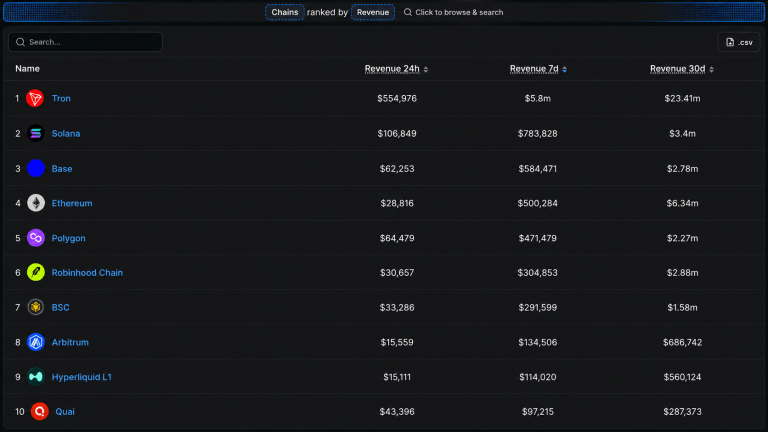
Tron Quietly Outearns Ethereum, Base, Solana and Six More Chains
Tron pulled in $23.41 million in revenue over the past 30 days, more than Ethereum, Solana, Base and six other networks earned tog...
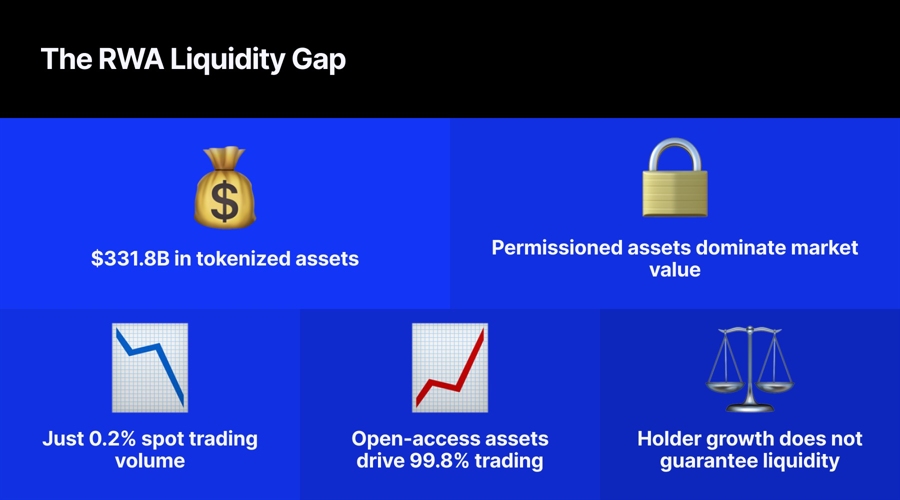
More Holders, Little Trading: The RWA Liquidity Problem Is Worse Than You Think
Let me ask you something straight. Does real-world asset trading on crypto exchanges feel like a genuine revolution, or does it fe...