Trezor and Wasabi to Implement a Coinjoin Mixing Scheme Into Hardware Wallets
This week, the hardware wallet manufacturer Trezor, and the non-custodial bitcoin wallet with a built-in Coinjoin mixer, Wasabi, revealed the two teams are working together to introduce Coinjoin mixing into hardware wall...
Archive context
Older archive item. Useful for background and entity history, but not a fresh market-moving signal.

This week, the hardware wallet manufacturer Trezor, and the non-custodial bitcoin wallet with a built-in Coinjoin mixer, Wasabi, revealed the two teams are working together to introduce Coinjoin mixing into hardware wallets. On Sunday, Wasabi tweeted “hardware wallet Coinjoins are coming next year with our friends at [Trezor].”
Trezor Says Company Is ‘Working on a Coinjoin Implementation’
According to Trezor and Wasabi, a form of Coinjoin mixing is coming to hardware wallets in the near future. Coinjoin is a privacy-enhancing process that is leveraged to anonymize transfers on a blockchain. Basically, the scheme involves a number of parties transacting together and mixing their unspent transaction outputs (UTXOs) in a pool to obfuscate the origin of all the funds.
On Sunday, Wasabi’s official Twitter account tweeted about adding the privacy-enhancing scheme to hardware wallets. In the thread, someone asked Wasabi when they would release an “album,” and Trezor replied: “Hi, we’re working on a Coinjoin implementation, not an album. Thanks for understanding.”
The news follows the U.S. government sanctioning the ethereum (ETH) mixing application Tornado Cash, which also leverages a form of Coinjoin and Zero-Knowledge Succinct Non-Interactive Argument of Knowledge (zk-SNARKs) for deposits and withdrawals. In March 2022, reports indicated that some bitcoin unspent transaction outputs (UTXOs) would be censored from Wasabi’s Coinjoin process.
Furthermore, at the end of February 2022, Chainalysis claimed it could deanonymize Wasabi transactions, after the journalist Laura Shin said she identified the infamous 2016 DAO hacker. Coinjoin applications have been known to have some weaknesses for quite some time and a few blockchain mixing schemes have leveraged zero-knowledge proofs like zk-SNARKs and combinatorial anonymity to make them stronger.
What do you think about Wasabi and Trezor working together to introduce Coinjoin mixing to hardware wallets? Let us know what you think about this subject in the comments section below.
Why this matters
This cryptocurrency story adds another data point to the current market tape and is useful when read alongside nearby source coverage.
Original source
Read on Bitcoin NewsRelated market context
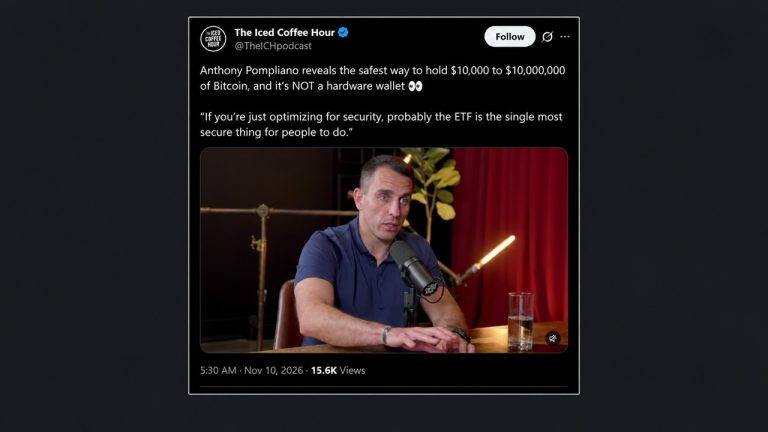
Pompliano Says a Bitcoin ETF Beats Hardware Wallets on Security
Anthony Pompliano says a spot bitcoin exchange-traded fund (ETF) is “the single most secure thing” for people holding $10,000 to $...

Binance Flags iOS Flaw That Could Expose iPhone Users’ Crypto Wallets and Private Keys
Key Takeaways: Binance warns users that iOS has a vulnerability called ‘worse_query’ that might leave other apps’ files exposed. O...

Bitcoin Wallets ‘Drop’, Telegram Wallets Rise, and Both Are Nothingburgers
Crypto asset investors looking for places to put their money now have two more data points to consider. The number of nonempty bit...

LNbits Issues Urgent v1.7.0 Security Update After Bitcoin Lightning Wallet Losses
Key Takeaways: All users of LNbits are advised to upgrade to v1.7.0 as this is an urgent security update. Ben Arc, the creator of...

Apple iOS Vulnerability Puts Crypto Wallets at Risk as Binance Issues Warning
Binance issued an urgent security warning Tuesday, Nov. 10, 2026, concerning an iOS vulnerability known as “worse_query,” which co...

Binance Warns iOS Flaw Could Expose Wallet Seed Phrases as Apple’s Latest iPhone Patch Stays Silent
Bitcoin Magazine Binance Warns iOS Flaw Could Expose Wallet Seed Phrases as Apple’s Latest iPhone Patch Stays Silent Binance warne...