Bitcoin, Ethereum Recover from China’s Latest Crypto Crackdown
Yesterday, China’s central bank declared that cryptocurrency trading and all related services, including Bitcoin mining, are illegal. In two notices published on the central bank’s site and WeChat account yesterday, the...
Archive context
Older archive item. Useful for background and entity history, but not a fresh market-moving signal.
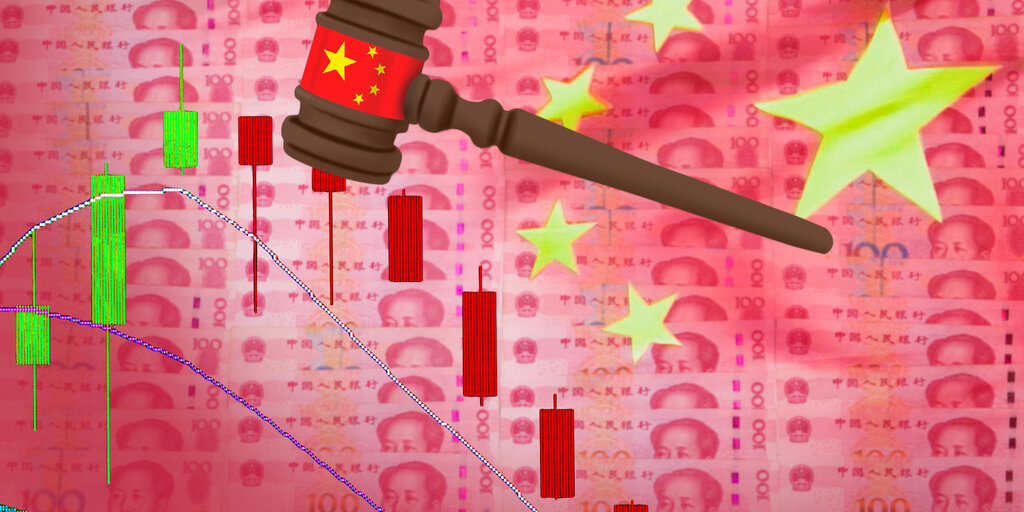
Yesterday, China’s central bank declared that cryptocurrency trading and all related services, including Bitcoin mining, are illegal.
In two notices published on the central bank’s site and WeChat account yesterday, the People’s Bank of China said that crypto breeds “illegal and criminal activities such as gambling, illegal fund-raising, fraud, pyramid schemes, and money laundering, seriously endangering the safety of people’s property.”
The crypto market crashed after the bank issued the notices. Bitcoin fell from $44,800 to around $41,000, and Ethereum fell from about $3,100 to $2,700. Other coins fell, too, and crypto’s global market cap fell from $2 trillion to $1.835 trillion.
Now the dust has settled, things are starting to recover—although the gradient is shallow so far. Today, the global market cap for cryptocurrencies increased to $1.916 trillion, Bitcoin hit highs of $43,112 and Ethereum almost punched past $3,000.
Some coins were barely affected by China’s ban. Terra (LUNA) fell from $38 to $33 after the news but is now up 11% in the past 24 hours to highs of $41. The coin’s not far off its all-time high of $44, set just 10 days ago.
Although the notices came out yesterday, the crypto ban was dated September 15 and the mining document was dated September 3.
Since the PBOC issued the notices, Huobi has reportedly prevented Chinese mainland customers from signing up for its exchange services. Huobi Token fell 18% after the news, according to Chinese blockchain journalist Colin Wu, but quickly recovered much of its losses and is down 6% in the past 24 hours, according to data from CoinGecko.
Exclusive: Huobi, the largest exchange in the Chinese region, suspends the registration of all new users in mainland China. pic.twitter.com/mkbMQPoXz3
— Wu Blockchain (@WuBlockchain) September 25, 2021
Huobi restricted Chinese mainlanders’ access to derivatives and mining pools months ago following previous statements from the Chinese government. The largest Ethereum mining pool, Spark Pool, and TokenPocket, a DeFi wallet popular in China, have also cut off mainland China residents.
Cobo, which has just completed a financing of 40 million, has announced the relocation of its headquarters from Beijing to Singapore. In fact, almost all Chinese cryptocurrency institutions are moving their headquarters to Singapore.
— Wu Blockchain (@WuBlockchain) September 24, 2021
Crypto exchange FTX has relocated from Hong Kong to the Bahamas. Sam Bankman-Fried, the founder of FTX, cited the lack of quarantine and the crypto-friendly framework as reasons. Hong Kong is a “Special Administrative Region” of China—although the lines have blurred in recent years as China snuffs out Hong Kong’s autonomy.
The last time China said that crypto was a scourge on its economy was back in May, when it effectively banned crypto mining to “prevent and control financial risks.” That wrecked the crypto economy, halving Bitcoin’s price in a little under a month.
It might seem surprising that the market has not fallen further. However, a lot of crypto trading was already illegal in China, and some people think the notices only clarify existing regulations.
Crypto exchanges vacated the country in 2017 and set up shop in Hong Kong, Singapore, elsewhere or, in the case of Binance (up until recently), nowhere at all, claiming that it was decentralized. Miners left China in May and June of this year. Additionally, markets that could have been demolished by the news, namely RMB OTC desks that service mainland Chinese users, are often opaque.
Chinese crypto-journalist Wu Blockchain said in a newsletter that the notices introduced a few new things. First, the Supreme Court and the Administration of Foreign Exchange joined in on the notice, “indicating that the crackdown and enforcement might be more intense.”
The notice on virtual currencies also specifically mentioned that Bitcoin, Ethereum, and Tether are “not legal and should not and cannot be used as currency.” The focus on Tether suggests that regulators are beginning to investigate stablecoin usage more closely, he said. In China, Tether rivals the central bank’s own digital yuan.
The views and opinions expressed by the author are for informational purposes only and do not constitute financial, investment, or other advice.Why this matters
This ethereum story adds another data point to the current market tape and is useful when read alongside nearby source coverage.
Original source
Read on DecryptRelated market context

Ethereum falls 6%, leaving $1.35 billion in long bets at risk of liquidation
Ethereum’s slide toward $2,500 has put about $1.35 billion of leveraged long positions at increasing risk of liquidation. CoinMark...

Why Abstract is killing its Ethereum L2 instead of launching a token to save it
Abstract will shut down on Dec. 15 despite onboarding more than 400,000 users, hosting 144 apps, and landing brands including Disn...

Pudgy Penguins Team to Shutter Ethereum Layer 2 Network Abstract
Another Ethereum Layer 2 chain bites the dust: Just days after the creators of the once-hyped Blast said they’re shutting down the...
Russia’s Sberbank Given Green Light to Custody Bitcoin
Bitcoin Magazine Russia’s Sberbank Given Green Light to Custody Bitcoin Russia’s largest bank has announced it is the first in the...

Bitmine's Relentless Ethereum Buying Is About to End, Tom Lee Says
Speaking at Token2049 in Singapore, the chairman said Bitmine is about 100,000 ETH—roughly six to seven weeks—from its 5% cap, set...

Tether tapped by Kazakhstan’s central bank to explore stablecoin and tokenization
The National Bank of Kazakhstan said it will study a local currency-linked stablecoin and tokenized real-world assets with Tether.