Defi Educator Says $22 Billion in ETH 2.0 Funds Won’t Be Liquid Immediately After PoS Transition
As Ethereum’s transition to proof-of-stake (PoS) gets closer and the network’s hashrate taps another all-time high, the Ethereum 2.0 contract is close to nearing 13 million ether worth $22.6 billion using today’s ether e...
Archive context
Older archive item. Useful for background and entity history, but not a fresh market-moving signal.
As Ethereum’s transition to proof-of-stake (PoS) gets closer and the network’s hashrate taps another all-time high, the Ethereum 2.0 contract is close to nearing 13 million ether worth $22.6 billion using today’s ether exchange rates. Moreover, according to a decentralized finance (defi) educator, the $22.6 billion worth of ethereum that continues to grow won’t be unlocked until another upgrade is enforced following The Merge.
Ethereum 2.0 Contract Nears 13 Million Ether Locked — Defi Educator Says The Merge Won’t Be a Negative Price Catalyst
On June 4, 2022, etherscan.io’s webpage that hosts the Ethereum 2.0 contract, indicates that there’s 12,785,941 ether locked into the contract. The Ethereum 2.0 contract holds the funds for a great number of ETH validators as it takes 32 ETH to become a validator. Every single day, a decent quantity of validators lock funds in the contract and the current value locked in the contract is worth $22.6 billion using today’s ether exchange rates. During the last 24 hours, well over two dozen deposits of 32 ether ($56,684) have been added to the contract.
The $22.6 billion in ETH is locked and not liquid and may not be for quite some time. This means once the 32 ETH is deposited, the funds will remain locked up until plans are coordinated after the PoS transition. Just recently, the decentralized finance (defi) educator Korpi published a thread about the assumption that the 12.7 million ether will immediately be unlocked and dumped after The Merge.
“I’ve noticed some people consider The Merge as a negative price catalyst due to a supposed huge [ethereum] unlock — This is wrong,” Korpi explained on Twitter. “Staked [ethereum] won’t be unlocked at The Merge. The Merge won’t enable withdrawals. This is planned for another Ethereum upgrade which may take place 6-12 months after The Merge. In other words, both staked [ethereum] and staking rewards will not enter the circulation for a long time,” Korpi added. The defi educator continued:
Unlocked [ethereum] will be released slowly. Even when withdrawals are enabled, all staked [ethereum] won’t be immediately available. There will be an exit queue which may take more than a year in the worst-case scenario or several months in a more realistic one. [The] release will be slow.
Just recently, on June 4, at block height 14,902,285, Ethereum’s hashrate tapped an all-time high at 132 petahash per second (PH/s). At the end of May, ETH transaction fees hit a 10-month low as transaction costs dropped below $3. At the recent Permissionless conference, Ethereum software developer Preston Van Loon said The Merge could happen in August. Ethereum co-founder Vitalik Buterin confirmed that The Merge may be implemented by August, however, he also eluded to delays.
Amid the recent network records, Ethereum’s Beacon chain experienced a seven-block reorganization, and these types of issues may invoke a PoS transition delay. Ethereum’s Beacon chain is the chain that runs parallel alongside the proof-of-work (PoW) Ethereum network. Ethereum developer Tim Beiko recently detailed that The Merge will likely go live by the third quarter of 2022. Beiko further stressed that he “strongly suggests” ethereum (ETH) miners do not invest in more mining rigs going forward.
The defi educator Korpi continued his Twitter thread by explaining that the Ethereum 2.0 withdrawal process will be slow. “To withdraw [ethereum], a validator must exit the active validator set but there is a limit to how many validators can exit per epoch. There are currently 395k validators (active + pending). If no new ones are set up (highly unlikely), it will take 424 days for all of them to exit. Staked [ethereum] is often a never-sell stack.” Korpi added:
Who would voluntarily lock [ethereum] for many months, not knowing when withdrawals will be even possible? [Ethereum] maxis, no doubt. Most [ethereum] stakers are long-term investors. They are not interested in selling, especially not at current prices.
What do you think about the Ethereum 2.0 contract closing in on 13 million ether? What do you think about Korpi’s statements and the slow unwinding process he explained? Let us know what you think about this subject in the comments section below.
Why this matters
This ethereum story adds another data point to the current market tape and is useful when read alongside nearby source coverage.
Original source
Read on Bitcoin NewsRelated market context
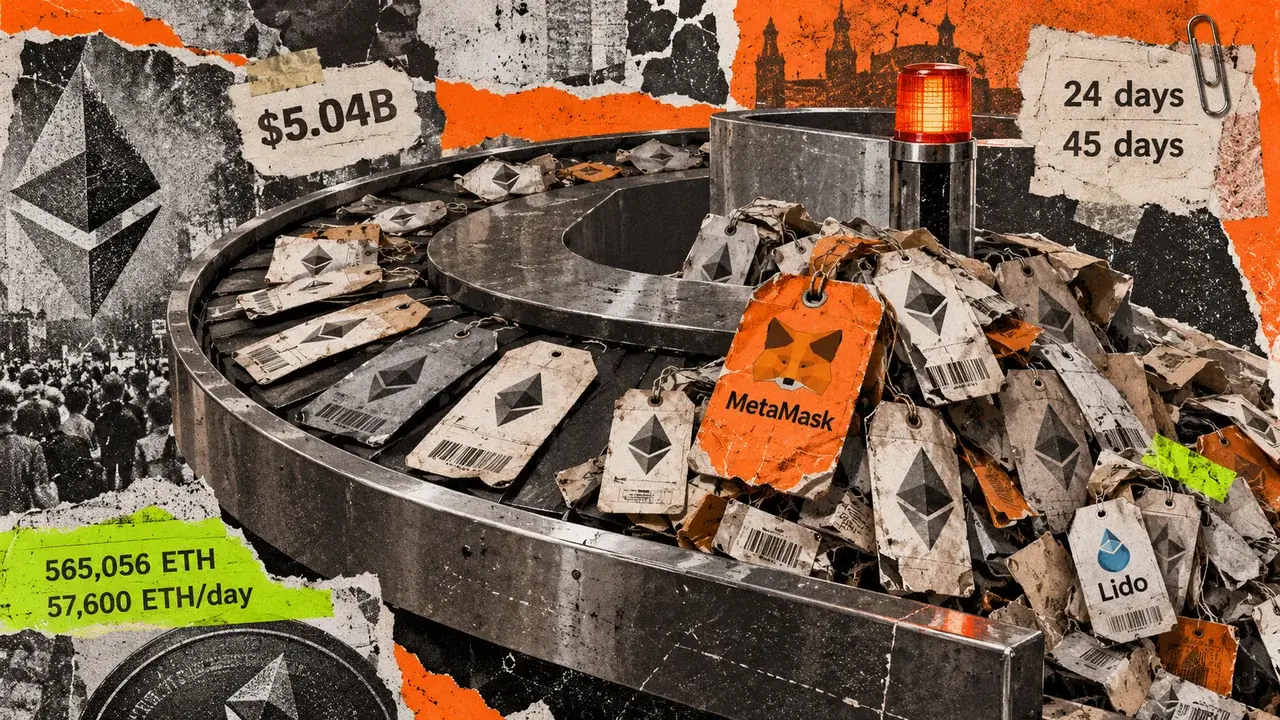
A $1,000 MetaMask incident could turn Ethereum’s staking queue into a $5 billion traffic jam
MetaMask's precautionary validator exits are turning a roughly $1,000 reward diversion into a test of Ethereum's staking capacity....

Curve Finance: Ethereum’s Glamsterdam upgrade may boost DeFi execution
The Glamsterdam upgrade could enhance DeFi efficiency, potentially boosting Ethereum's market appeal and influencing future price...

Will AI Break Crypto Encryption? Ethereum’s Vitalik Buterin Weighs In on 'Bunker Mode' Shift
Ethereum co-founder Vitalik Buterin thinks the crypto industry needs to make sure encryption is both quantum and AI-resistant.

Bitcoin ETFs suffer biggest exodus since June as Ethereum withdrawals hit nine-month high
US spot Bitcoin and Ethereum exchange-traded funds saw their steepest withdrawals in months as the cryptocurrency market continued...

Ethereum Price Prediction: Is Tom Lee’s $25K ETH Target Too Ambitious?
Tom Lee’s $10,000 Ethereum price prediction implies a 1000% move from ETH’s current price at around $2,500. BitMine’s accumulation...

Why XRP’s 63 billion circulating tokens don’t tell buyers what’s for sale
For XRP buyers, available supply depends on the price they are willing to pay. The token's roughly 63.09 billion circulating suppl...