Ethereum Fusaka Upgrade Goes Live Today: Experts Predict Potential Supply Crunch Ahead
The highly anticipated Fusaka Upgrade for Ethereum is on the verge of going live on Wednesday, heralding significant enhancements to the network’s overall functionality. Analysts contend that this pivotal development cou...
Archive context
Older archive item. Useful for background and entity history, but not a fresh market-moving signal.

The highly anticipated Fusaka Upgrade for Ethereum is on the verge of going live on Wednesday, heralding significant enhancements to the network’s overall functionality.
Analysts contend that this pivotal development could usher in a considerable supply crunch for ETH, potentially boosting its price during a challenging period for the broader cryptocurrency market.
Layer 2 Solutions To Boost ETH BurnAccording to analysts at Bull Theory, the Fusaka Upgrade integrates components from previous upgrades—Osaka, Fulu, and PeerDAS—but its most impactful feature is its resolution of one of Ethereum’s biggest challenges.
Layers 2 (L2) solutions have long utilized Ethereum’s security while contributing minimal fees back to the network. Despite L2 solutions like Base, Arbitrum, Optimism, and zkSync generating millions in fees from users, the fees recorded on Ethereum tended to diminish to nearly zero when they posted their data.
Consequently, this meant that significant L2 activity did not result in substantial ETH being burned, even though approximately 85% of Ethereum transactions now occur on these Layer 2 solutions.
The Fusaka Upgrade fundamentally changes this dynamic. A key enhancement is EIP-7918, which mandates that Layer 2 transactions pay real fees to Ethereum.
This adjustment ensures that every L2 transaction will contribute directly to the burning of ETH—something that was not previously guaranteed. The analysts assert that this feature represents one of the most significant value shifts since the introduction of EIP-1559.
Post-Fusaka ProjectionsThe upgrade is further expected to broaden the scope of ETH burn from being predominantly derived from Layer 1 (L1) transactions to encompassing all L2 activity.
Historically, most ETH burn has originated from mainnet transactions; thus, the network saw slight inflation in 2024–2025 as Layer 2s made transactions cheaper, leading to a decrease in ETH burn while staking continued to issue new ETH.
Post-Fusaka, every L2 blob will incur a minimum cost, which will be burned. As Layer 2 adoption increases, the rate at which ETH is burned will also rise, contributing to increased scarcity of ETH.
This enhancement positions Ethereum to shift back towards deflation for the first time in several years. Currently, ETH issues around 620,000 new tokens annually for stakers while burning approximately 350,000 tokens. This results in a net slight inflation.
However, projections following the Fusaka Upgrade, even with conservative estimates, suggest that the additional burn from L2 activity could range from 200,000 to 400,000 ETH per year.
Combined with existing burn rates, this could bring the total to over 600,000 ETH, leading to a net neutral or slightly deflationary state for ETH.
More bullish models predict that if L2 adoption flourishes and demand for blobs rises, burn rates could soar to between 900,000 and 1.2 million ETH annually, resulting in a supply decrease of 200,000 to 300,000 ETH each year.
Monetary Transformation For Ethereum?Another notable aspect of the Fusaka upgrade is PeerDAS, which enhances Layer 2 growth by reducing bandwidth requirements by 85%. This efficiency allows L2 solutions to publish more blobs at lower costs, resulting in increased fees and, consequently, more ETH burned.
The upgrade also increases the block gas limit from 36 million to 60 million, allowing more transactions to fit within each block. This increase means that more transactions can occur, leading to higher fees collected and a corresponding rise in burning.
Furthermore, lower fees for transactions—such as swaps, bridges, on-chain gaming, and social applications—will likely drive more usage, resulting in increased transactions and higher ETH burn.
Ultimately, the analysts believe that the Fusaka Upgrade represents a significant monetary transformation for Ethereum, indicating that the network is not only scaling but also beginning to monetize that scaling effectively.
Featured image from DALL-E, chart from TradingView.com
Why this matters
This ethereum story adds another data point to the current market tape and is useful when read alongside nearby source coverage.
Original source
Read on NewsBTCRelated market context
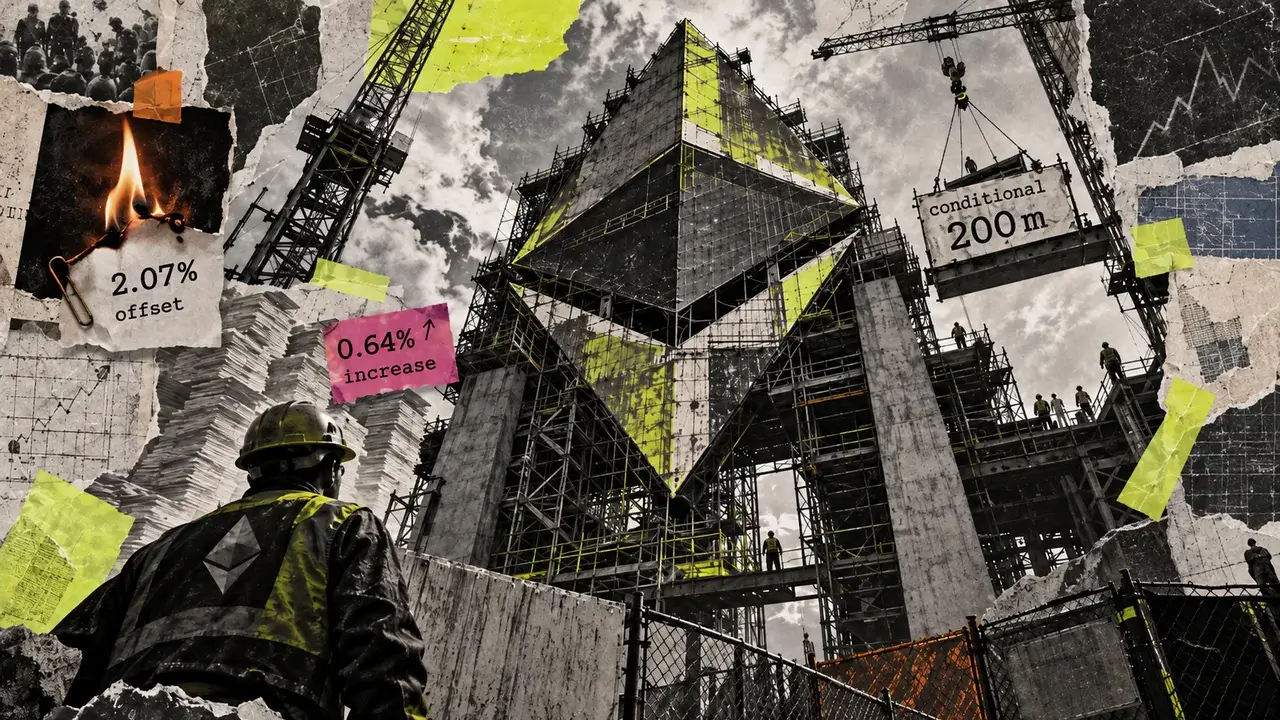
ETH fee burns cover just 2% of new coins printed in 2026
Ethereum's transaction fees have burned enough ETH to offset just 2.07% of the new coins issued in 2026, according to an Oct. 9 su...
WhiteBIT Integrates Lightning Network for Fast and Cheap Bitcoin Transactions
Bitcoin Magazine WhiteBIT Integrates Lightning Network for Fast and Cheap Bitcoin Transactions The Lightning Network continues to...

STRK rallies as Starknet weighs a move from Ethereum layer 2 to its own layer 1
Starknet's potential shift to layer 1 could redefine blockchain security priorities, challenging Ethereum's timeline and reshaping...
Curve Finance: Ethereum’s Glamsterdam upgrade may boost DeFi execution
The Glamsterdam upgrade could enhance DeFi efficiency, potentially boosting Ethereum's market appeal and influencing future price...

AI Could Weaken Ethereum Security as Cryptographic Risks Grow, Vitalik Buterin Warns
Buterin urged developers to prepare for potential AI vulnerabilities in both conventional and quantum-resistant cryptography, whil...

Ripple Custody Adds Canton Network Support, Bringing CC and CIP-56 Into One Vault
Key Takeaways: Ripple Custody 1.43 adds support for Canton Network, CC and CIP-56 tokens. Institutions can be given the same custo...