Hackless Offers Sandwich Attack Protection for BSC and Ethereum Networks
As winners of the ETH hackathon in 2021, the Hackless team is now releasing the beta version of Anti-Sandwich – a gateway to safe and efficient swapping of crypto assets, avoiding public mempools and consequently, gettin...
Archive context
Older archive item. Useful for background and entity history, but not a fresh market-moving signal.
As winners of the ETH hackathon in 2021, the Hackless team is now releasing the beta version of Anti-Sandwich – a gateway to safe and efficient swapping of crypto assets, avoiding public mempools and consequently, getting ‘sandwiched’. The solution has already proved effective for a play-to-earn platform and is now open to a wider audience.
The risks of DeFi
Financial freedom is simultaneously the biggest groundbreaker and risk of DeFi. Transition to decentralised exchanges puts users in control of their assets, but it also makes them solely responsible for ensuring the security of their funds. Given that the industry is still developing, so is its security level, resulting in quite a limited market offering. Hackless is a DeFi security provider of advanced solutions to protect projects and individual users from hacks, exploits and attacks of different kinds, as well as helps migrate funds from already hacked protocols and wallets.
A sandwich attack is a relatively new but increasingly frequent and an already well-known type of front and back running attack. According to a report published by TarLogic, between May 2020 and April 2022, there were a total of 457,691 sandwich attacks detected with an average ROI above 4%. The most profitable attack ever was spotted in May 2021 having taken 56 ETH worth of $200,000 at that time. It was achieved in just two transactions executed within the second.
Sandwich attacks explained
Sandwich attacks include both front-running and back-running tactics applied over buy transactions sent to DEX. To do this, attackers watch a mempool – for suitable transactions and once an opportunity arises, they buy the same token first and sell it after the transaction has been executed.
When breaking down a sandwich attack, three clear stages are seen:
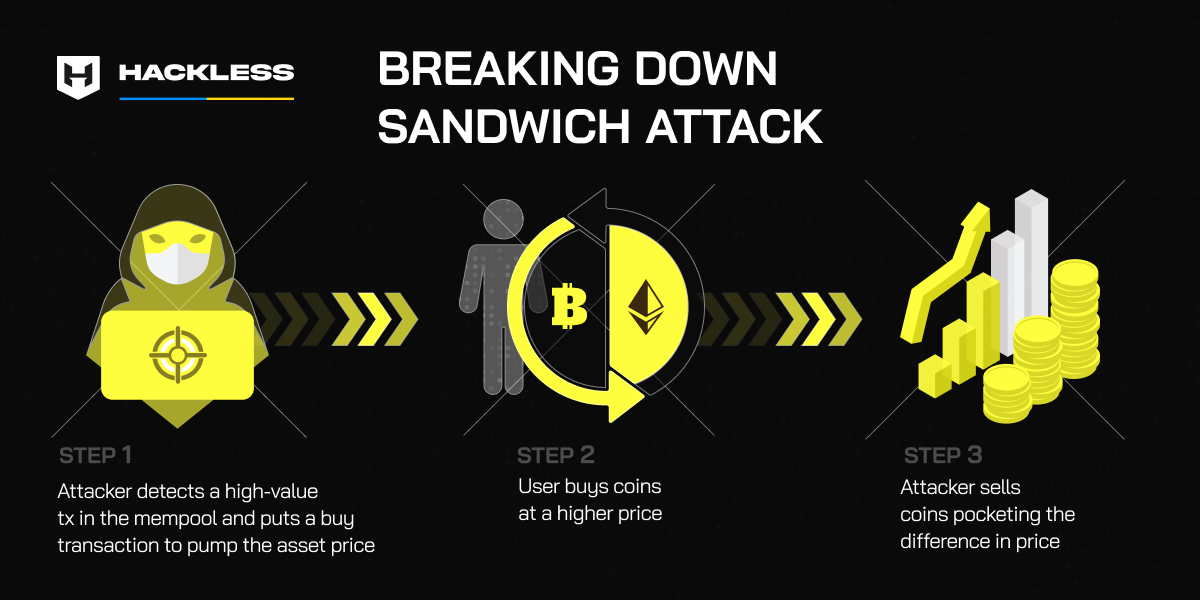
- An attacker detects a high-value transaction in the mempool and puts a buy transaction to pump the asset price.
- A user buys coins at a higher price.
- The attacker sells coins pocketing the difference in price.
Choose the best Anti-Sandwich protection for you
Hackless enables each and every DeFi user to swap assets, avoiding public mempools. This means that you send your transactions directly to miners, making them invisible to exploiters.
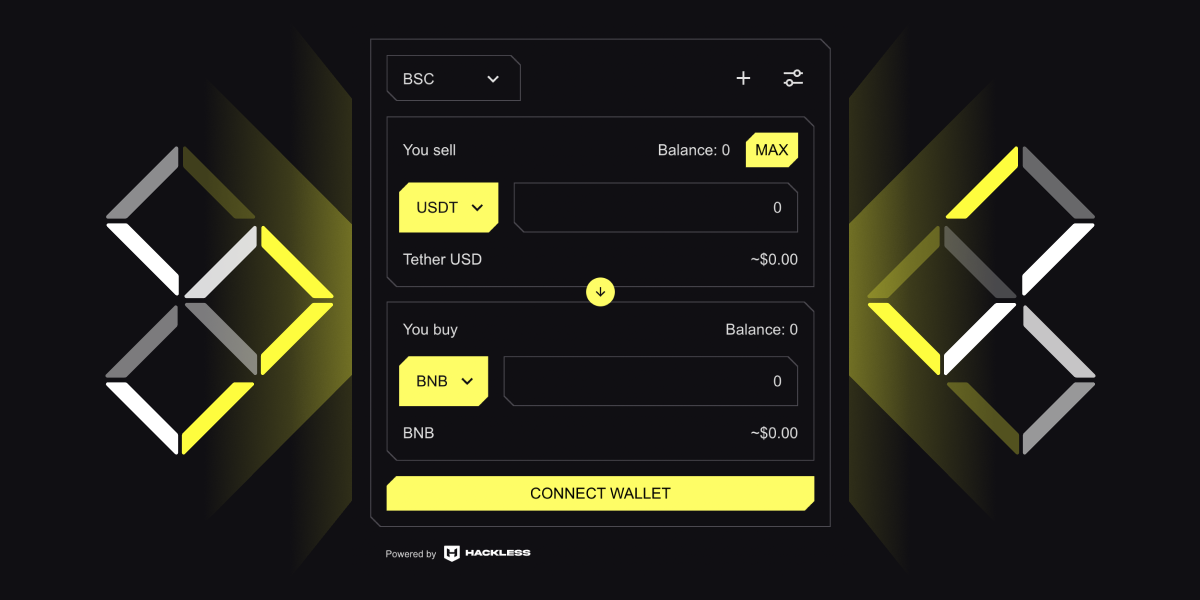
The service is available on the Hackless website via an intuitive and easy to use widget. All you need to do is to connect your Metamask, select the network and token and sign the transaction, which will be submitted to private miners automatically.
Anti-Sandwich for business
According to the REKT Database, DeFi protocols have lost $6 billion in total, due to scams, hacks, and exploits of different kinds, sandwich attacks included. Hackless is now introducing a solution for those DeFi companies that wish to offer extra protection, as well as a better product experience, to their users.
Anti-Sandwich by Hackless is the best fit for blockchain projects in need of a fast and secure swapping widget. The solution is now available on Ethereum and Binance Smart Chain networks with further expansion to other chains.
With the Anti-Sandwich widget on the client’s website, users can easily swap project tokens without ever leaving the website. This makes the user experience smoother and also safer, while averting potential sandwich attacks and confusion with any other tokens. The widget is easily pluggable to any website via the NPM library, as well as customizable to brand design and feel.
10,000 $HKLS airdrop pool for early adopters
While the best perk is actually avoiding getting ‘sandwiched’ and losing your money, Hackless also encourages the most security conscious teams and folks by airdropping 10,000 HKLS tokens, giving referral bonuses and more.
Early adopters are the luckiest for sure – not only do they have a chance to try out the service free of charge, but also participate in the dedicated airdrop activity via Gleam.
To learn more about Hackless and how it can boost DeFi security, visit the project’s site, and make sure to join the community on Discord and Telegram.
This is a sponsored post. Learn how to reach our audience here. Read disclaimer below.
Why this matters
This ethereum story adds another data point to the current market tape and is useful when read alongside nearby source coverage.
Original source
Read on Bitcoin NewsRelated market context

AI Could Weaken Ethereum Security as Cryptographic Risks Grow, Vitalik Buterin Warns
Buterin urged developers to prepare for potential AI vulnerabilities in both conventional and quantum-resistant cryptography, whil...

XRPL’s $1.34 billion stablecoin base doesn’t tell us how much XRP users need
Tracked stablecoins on the XRP Ledger totaled $1.338 billion on Oct. 7. For XRP holders, the critical question is how much activit...

Stealing $1.5B in crypto is easy, cashing out is the trap
North Korean hackers stole around $1.5 billion from Bybit in February 2025. While the hack itself has been widely covered and anal...

Sui’s Hashi Launches With $500M to Turn Bitcoin Into Productive DeFi Collateral Markets
Key Takeaways: With more than $500 million in locked-in tokens, Hashi will launch its phased mainnet launch. The protocol enables...

Aave MCP now connects with MetaMask Agent Wallet for AI-driven DeFi actions
AI-driven DeFi integration enhances automation and security, empowering users with greater control and developers with streamlined...
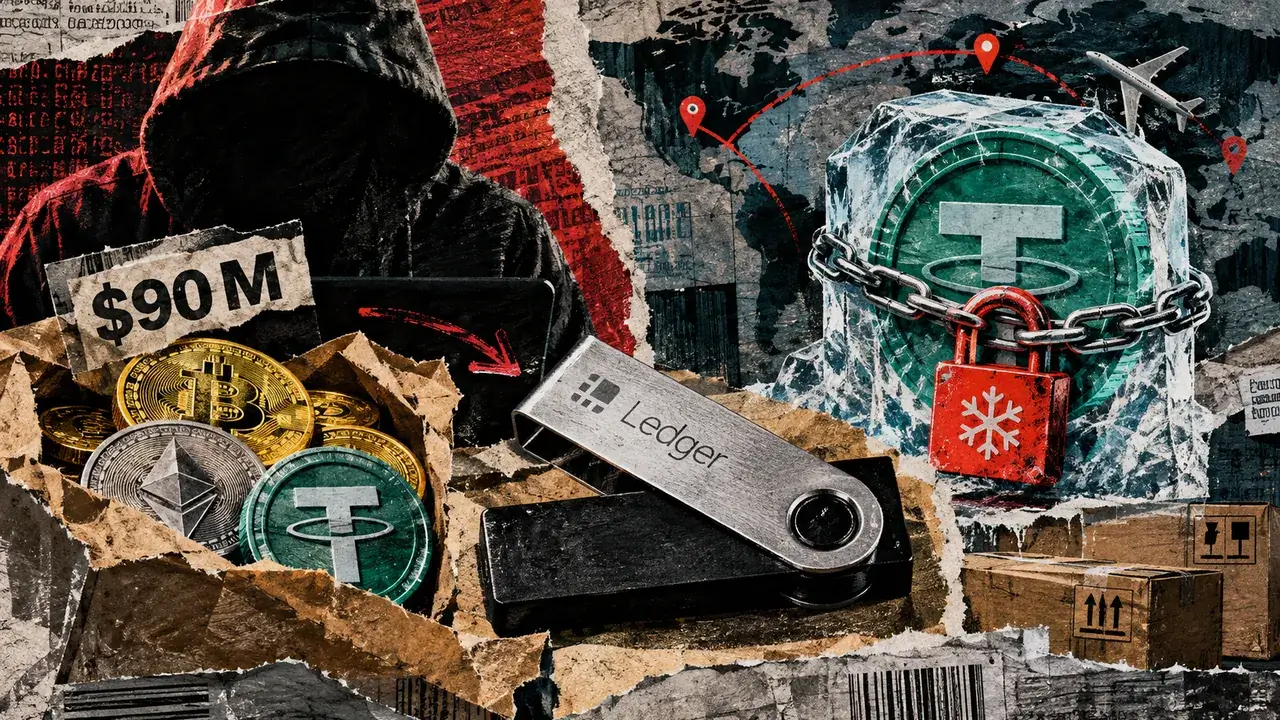
Ledger hack scare nears $90 million as Tether moves to freeze stolen USDT
Suspected Ledger wallet thefts are approaching $90 million as Tether freezes USDT stablecoin linked to the incident, according to...