Qubic Overtakes Monero’s Hash Rate in Live “51% Takeover Demo,” Showcasing Real-World Power of Useful Proof of Work
Led by Qubic founder Come-from-Beyond (CFB), the demo harnessed Qubic’s Useful Proof of Work (uPoW) framework to exceed Monero’s global hash rate, signaling the arrival of a new era in verifiable decentralized compute. C...
Archive context
Older archive item. Useful for background and entity history, but not a fresh market-moving signal.
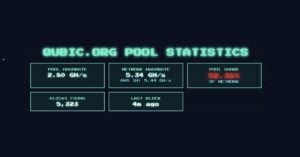
Led by Qubic founder Come-from-Beyond (CFB), the demo harnessed Qubic’s Useful Proof of Work (uPoW) framework to exceed Monero’s global hash rate, signaling the arrival of a new era in verifiable decentralized compute.
Come-from-Beyond (@c___f___b)
Question: Why do you think $XMR price won’t decline after 51% attack?
Answer: Because #Monero is unique, those valuing anonymity have no alternative to migrate to.
The demo was performed live and is being independently verified, with performance metrics showing Qubic’s compute outpacing Monero’s average network hash rate over a sustained window. This time, the approach was “Selfish Mining,” a tactic that allows a mining pool with significant hashrate, as low as 33-40%, to gain a disproportionate share of the block rewards.
Instead of engaging in a direct hashrate war, Qubic withheld newly found blocks from the public. When the rest of the network was still trying to solve the previous block, Qubic was already working on the next one. By revealing their chain of withheld blocks at strategic moments, they would orphan the blocks found by other miners, essentially making their work worthless.
After several hours of this new strategy, orphaned blocks began to appear on the Monero network. An orphaned block is a valid block that is not part of the main, longest chain. When a miner solves a block and broadcasts it, other miners accept it and begin working on the next block. If a different miner solves a block at nearly the same time, two competing chains can form. The network ultimately accepts the longer chain, and any blocks on the shorter chain become “orphaned.”
Qubic’s approach turns AI compute tasks into globally distributed workloads that are rewarded and validated via a novel consensus mechanism based on usefulness, rather than arbitrary cryptographic puzzles.
Why This Is ImportantThis historic event is a profound wake-up call for the entire crypto industry, fundamentally challenging long-held assumptions about blockchain security.
The successful takeover demonstration by a smaller, $300 million market cap protocol over a $6 billion privacy giant proves that market size alone does not guarantee security. People should care because this wasn’t a malicious attack but a strategic validation of the theory that economic incentives, not just technical prowess, are the ultimate arbiter of power in any Proof of Work system.
The experiment provides a new blueprint for how protocols can interact, showing that compute power can be repurposed for useful tasks, and it forces the entire industry to re-evaluate what truly secures a decentralized network in a competitive landscape driven by profitability.
Chart of Monero network reorganization after Selfish Mining
About Qubic
Qubic is a high-performance Layer 1 blockchain, verified by CertiK as the Fastest Blockchain in the World. Designed for real-time decentralized compute, Qubic is powered by Useful Proof of Work and a tick-based consensus mechanism, enabling zero-fee transactions, instant finality, and unmatched throughput. Qubic unlocks scalable infrastructure for the next wave of innovation across AI, DePIN, DeFi, and AGI-level applications.
Want to learn more about Qubic? Start here.
Why this matters
This mining story adds another data point to the current market tape and is useful when read alongside nearby source coverage.
Original source
Read on Brave New CoinRelated market context

Sui’s Hashi Bitcoin collateral network lines up more than $500M ahead of mainnet
Sui's Hashi network could redefine Bitcoin's utility, potentially increasing institutional adoption and liquidity in decentralized...

Glamsterdam Upgrade: Sepolia Blocks Leave Most of Ethereum’s New Gas Capacity Unused
Ethereum’s Glamsterdam upgrade has raised Sepolia’s block-gas limit from about 60 million to nearly 200 million, giving developers...

Polygon Open Money Stack Expands to TRON, Extending Network Access to Regulated U.S. Payment Rails
Dubai, UAE – October 8, 2026 – Polygon Labs today announced that Polygon Open Money Stack now supports the TRON network, giving fi...
Solana Foundation says the network is secure against quantum threats
Solana's proactive quantum threat measures could set a precedent for blockchain security, influencing industry standards and user...

NextBlock invests $3 million in Soda Labs blockchain privacy startup
Soda Labs' funding boost could accelerate privacy tech adoption in blockchain, potentially reshaping financial transactions and da...

UK sanctions crypto platforms suspected of supporting Russian financial networks
The UK sanctioned Cryptomus, Heleket and TokenSpot in a Russia sanctions package, with TRM Labs identifying links to Grinex and Ga...