California’s Dormant Crypto Law: Is Your Digital Fortune at Risk? The Unsettling Truth Behind AB 1052
A legislative wave is brewing in California that could redefine how you manage your digital assets. While the headlines might sound benign – “unclaimed property laws updated for crypto” – the reality of Assembly Bill 105...
Archive context
Older archive item. Useful for background and entity history, but not a fresh market-moving signal.

A legislative wave is brewing in California that could redefine how you manage your digital assets. While the headlines might sound benign – “unclaimed property laws updated for crypto” – the reality of Assembly Bill 1052 (AB 1052) is sparking debate and raising questions for cryptocurrency holders. Dry legal jargon aside, the real question is could your carefully hoarded crypto vanish into the state’s coffers, just because you’re quietly HODLing?
The Three-Year Time Bomb: Are You Really “Engaging” with Your Assets?
At its core, AB 1052 states that if crypto assets held in a custodial account (think your Coinbase or Kraken account) show no “act of ownership interest” for a period of three years, they could be transferred to the state as unclaimed property. This isn’t an outright “seizure” in the conventional sense, as the state intends to hold the assets in-kind (Bitcoin remains Bitcoin) and allows for reclamation.
But consider this: are you actively logging into your exchange account every few years? Are you making minor transactions just to prove you’re there? For the long-term holder, the “set it and forget it” investor, or even someone who just wants to ride out a bear market without daily interaction, this law introduces an unsettling new layer of diligence. Are you certain your current passive approach meets California’s definition of “ownership interest”? If not, are you prepared for the potential hassle and uncertainty of reclaiming assets from a state bureaucracy?
The Hidden Risks of Centralized Trust: Why This Law Matters
While traditional unclaimed property laws have long applied to dormant bank accounts, extending them to crypto strikes a nerve for a fundamental reason: it highlights the inherent tension between centralized control and decentralized freedom. When you leave your crypto on an exchange, you’re trusting that third party to safeguard your assets and act on your behalf. AB 1052 essentially grants the state the power to step into that relationship if you appear “absent.”
Critics are quick to point out the chilling effect this could have on crypto adoption, particularly for those seeking an alternative to traditional financial systems. If a government can classify your “dormant” digital wealth as public property, how secure is it truly within a centralized framework? This isn’t just about California; it’s a potential precedent for other states, reshaping the regulatory landscape of digital assets across the nation.
Your Action Plan: Don’t Let Your Crypto Become “Unclaimed”
This isn’t a moment for passive observation. It’s a call to action.
- Review Your Custodial Holdings: If you have significant crypto on exchanges, now is the time to understand their terms of service regarding dormancy and how they intend to comply with AB 1052 (should it pass).
- Prioritize Self-Custody: For many, this law underscores the compelling argument for taking control of your own private keys. Hardware wallets and decentralized solutions offer a pathway to truly owning your crypto, beyond the reach of third-party intermediaries and, by extension, state unclaimed property laws. Are you ready to make the leap to true self-sovereignty?
- Stay Informed, Stay Engaged: This legislation is still in progress, heading to the Senate. Its final form could still change. Understanding the nuances and potential impacts is crucial for protecting your digital wealth.
What’s the End Game For ‘Unclaimed’ Crypto?
So what happens if your dormant Bitcoin or Ethereum is transferred to the state and you, or your heirs, never come forward to reclaim it? While the state acts as the perpetual custodian, not the owner, meaning your right to claim never truly expires, California’s Unclaimed Property Law allows these assets (or the value derived from traditional property) to be placed into the state’s General Fund. For crypto specifically under AB 1052, the mandate is to hold the assets in-kind rather than liquidating them.
This means the state theoretically becomes a permanent, albeit reluctant, HODLer of your digital fortune, safeguarding it indefinitely. The “end game” for California isn’t a windfall from your crypto, but rather a long-term custodial responsibility that continues until the rightful owner, or perhaps a distant descendant, eventually remembers to claim it.
Why this matters
This research story adds another data point to the current market tape and is useful when read alongside nearby source coverage.
Original source
Read on Brave New CoinRelated market context

Bitcoin Claws Back $2,500 Overnight After a $771 Million Crypto Liquidation Wave
Bitcoin traded near $83,700 early Tuesday, up from a low of about $81,200 at 00:50 UTC, CoinGecko prices show. The recovery came w...

Bybit Brings 1,000+ US Stocks and ETFs Into Crypto Trading Accounts
Eligible Bybit users can now trade U.S. equities in the accounts they already use for cryptocurrency trading. The service connects...

A $5 billion Bitcoin fortune is at stake, but UK court says being defrauded isn’t enough to claim it
A London judge rejected Chinese fraud victims' bid to use English law to claim more than 61,000 seized Bitcoin. In an Oct. 12 ruli...

Starknet launches Shadow Accounts to keep DeFi wallets unlinkable
Starknet's Shadow Accounts enhance DeFi privacy, potentially reshaping user anonymity and security, while balancing compliance nee...
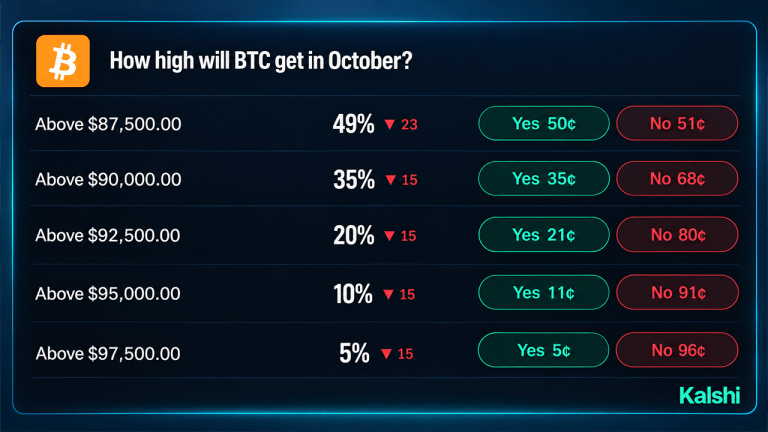
Bitcoin Price Odds on Prediction Markets Give $100K Just 27%
Bitcoin’s return to $100,000 is looking increasingly doubtful before 2027, at least in the eyes of prediction market traders. Poly...

Dormant Bitcoin Whale Shifts $378 Million in BTC After Six Years of Silence
A six-year dormant Bitcoin wallet moved 4,582 BTC worth $377.6 million to five new addresses. No exchange deposits confirmed, but...