Luxembourg Labels Crypto Firms High Risk for Money Laundering in 2025 Risk Report
Luxembourg has officially labeled cryptocurrency firms, particularly Virtual Asset Service Providers (VASPs), as “high-risk” entities for money laundering in its 2025 National Risk Assessment (NRA). According to the repo...
Archive context
Older archive item. Useful for background and entity history, but not a fresh market-moving signal.
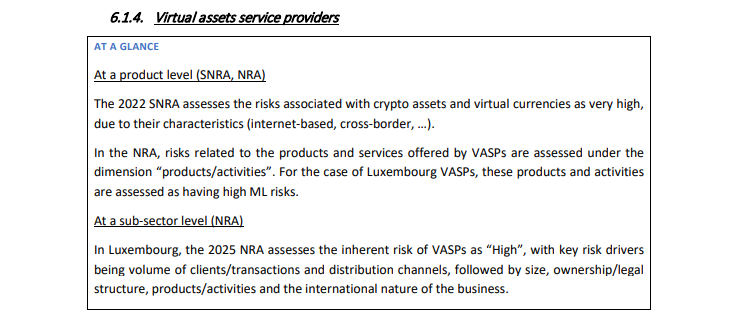
Luxembourg has officially labeled cryptocurrency firms, particularly Virtual Asset Service Providers (VASPs), as “high-risk” entities for money laundering in its 2025 National Risk Assessment (NRA).
According to the report, VASPs are considered inherently susceptible to misuse due to several risk factors.
These factors include the high volume of transactions they process, the global reach of their clientele, the use of complex legal structures, and the decentralized, internet-based nature of operations.
Report Cited Weak Compliance and Regulatory GapsThe report indicates that VASPs often operate in a decentralized environment, which impedes adequate supervision and complicates the identification of illicit financial flows.
Source: 2025 National Risk Assessment of Money LaunderingA key vulnerability noted is the ease with which digital assets can be transferred across jurisdictions with minimal regulatory oversight.
This makes the sector attractive for money laundering operations, especially involving proceeds from cybercrime, fraud, tax offenses, and corruption.
The report also cites cases where some VASPs in Luxembourg were registered without adequate understanding or application of AML rules.
In other instances, firms failed to meet essential compliance obligations such as customer due diligence, ongoing transaction monitoring, and reporting suspicious transactions.
Regulatory authorities, including the Commission de Surveillance du Secteur Financier (CSSF), have undertaken oversight efforts.
However, the report warns of capacity constraints and the need for improved supervisory tools tailored to the fast-evolving crypto industry.
Notably, the 2025 assessment builds upon Luxembourg’s previous efforts to strengthen its anti-money laundering (AML) framework.
These efforts were accelerated following the FATF’s 2023 evaluation, which showed the weaknesses in enforcement and risk-based supervision.
Classifying crypto firms as high-risk is expected to shape Luxembourg’s policy priorities and resource allocation in the fight against financial crime.
It may also influence how the country implements the upcoming EU-level Markets in Crypto Assets (MiCA) regulation in late 2025.
While the report does not accuse specific firms of wrongdoing, it signals a warning to domestic and foreign VASPs operating in or through Luxembourg.
Enhanced monitoring, more stringent compliance checks, and targeted guidance will likely follow as authorities respond to the sector’s elevated risk profile.
Luxembourg Adopts Cautious Path in MiCA ImplementationAs of May 2025, Luxembourg has not published official figures on the number of Crypto-Asset Service Providers (CASPs) authorized under the European Union’s MiCA regulation.
The country has opted for a cautious, methodical rollout, taking full advantage of MiCA’s 18-month transitional period, which extends from December 30, 2024, to July 1, 2026.
This transition period allows existing Virtual Asset Service Providers (VASPs) to continue operations while gradually adapting to MiCA’s new compliance standards.
Despite the absence of a published registry of authorized CASPs, key developments indicate regulatory momentum. On May 16, 2025, Bitstamp became one of the first major exchanges to secure its CASP license under MiCA from Luxembourg’s financial regulator, the Commission de Surveillance du Secteur Financier (CSSF).
https://twitter.com/cryptonews/status/1923374509349806531?s=46As one of the world’s longest-operating crypto exchanges, Bitstamp’s approval marks a critical milestone in Luxembourg’s phased adoption of the regulation.
In a similar move, UK-based banking giant Standard Chartered announced in January 2025 its intention to establish a crypto and digital asset custody hub in Luxembourg.
https://twitter.com/cryptonews/status/1877395970658562232?s=46The bank cited MiCA’s harmonized legal framework as a strategic advantage and named Luxembourg as its operational base for crypto services within the European Union.
Meanwhile, global platforms such as Kraken and Crypto.com have secured regulatory approvals under MiCA in various EU jurisdictions, signaling that the regulation is already reshaping the European crypto landscape.
The post Luxembourg Labels Crypto Firms High Risk for Money Laundering in 2025 Risk Report appeared first on Cryptonews.
Why this matters
This research story adds another data point to the current market tape and is useful when read alongside nearby source coverage.
Original source
Read on CryptonewsRelated market context

EU targets MiCA loophole that lets crypto exchanges serve 27 countries with one license
EU finance ministers agreed to shift oversight of major crypto companies to a central watchdog, reshaping supervision under MiCA....

Crypto Regulation: UK Lands £3.8Bn Bitcoin Seizure as Korea Blocks KuCoin and MEXC
In recent crypto regulation news, The High Court in London has strengthened the UK authorities’ position in a dispute over roughly...

France’s tax proposal would tax Bitcoin-to-USDC swaps before investors cash out
France’s proposed crypto tax changes would make a move from Bitcoin or Ether into certain stablecoins a taxable disposal, even if...

Lithuania tightens crypto tax reporting rules under EU’s DAC8 directive
Lithuania's stricter crypto tax reporting rules enhance transparency and compliance, potentially influencing EU-wide regulatory st...

State of TRON Q3 2026 Report Highlights $2.21 Trillion in Stablecoin Settlement Amid Network Activity Growth
Geneva, Switzerland, October 12, 2026 — TRON DAO, the community-governed DAO dedicated to accelerating the decentralization of the...

Financial Stability Board warns of untested stablecoin risks in crises
The FSB's warning highlights the urgent need for robust global regulatory frameworks to manage stablecoin risks and ensure financi...