Shifting $576M of forced sales off public order books saved Hyperliquid from a systemic crash
Hyperliquid, an on-chain perpetual futures venue, sent most of the forced selling in the worst minute of the October 2025 crypto crash to the Hyperliquid backstop rather than its public order book, according to a new res...
Archive context
Older archive item. Useful for background and entity history, but not a fresh market-moving signal.
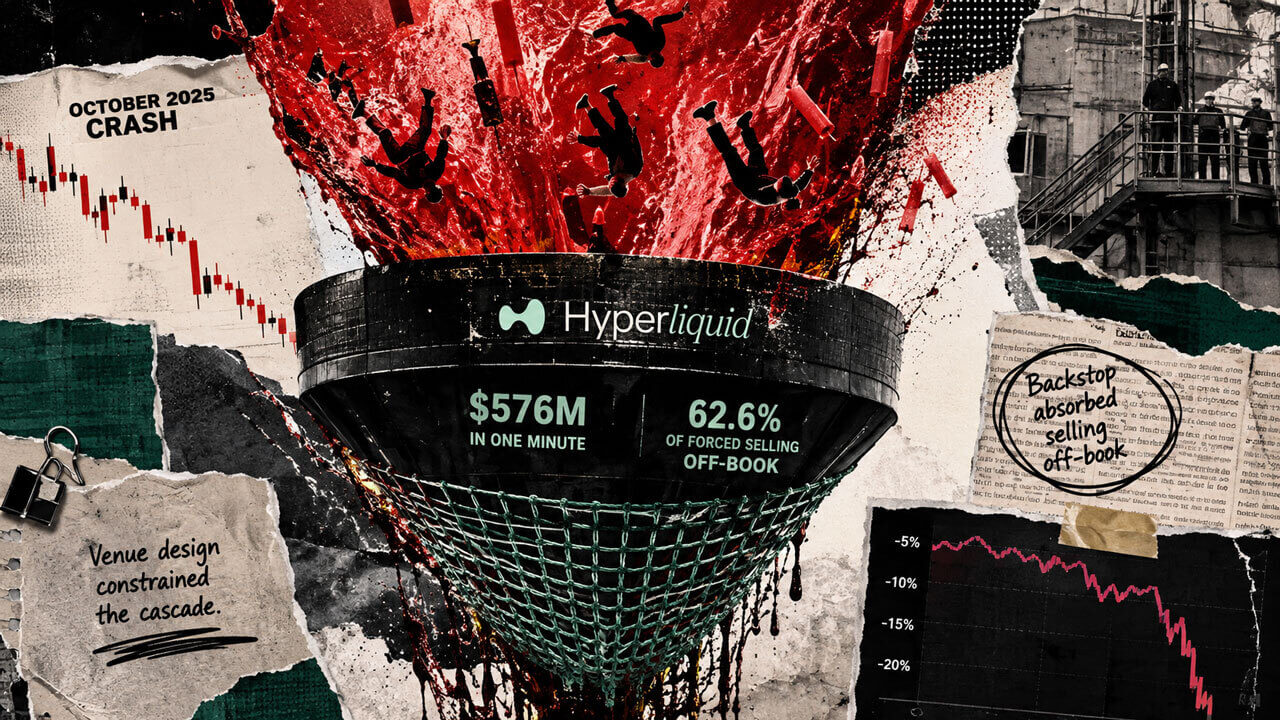
Hyperliquid, an on-chain perpetual futures venue, sent most of the forced selling in the worst minute of the October 2025 crypto crash to the Hyperliquid backstop rather than its public order book, according to a new research preprint.
About $641 million was force-sold on Hyperliquid at 21:19 UTC on Oct. 10, the paper found. Roughly $576 million went to the Hyperliquid backstop, while about $64 million reached the order book.
Related Reading Weekend ‘Crypto Black Friday' liquidation cascade: What actually happened? A data-first post-mortem on liquidations, funding, and ETF dip-buyers. Oct 14, 2025 · Gino MatosThe split is relevant because a thinning public order book can push prices lower and force more leveraged positions to close. The Hyperliquid backstop can interrupt that feedback by absorbing orders inside the venue. The preprint has not completed peer review, and its direct measurement covers Hyperliquid rather than the wider market.
Hyperliquid’s liquidation rules first try to close a position through market orders. Under specified conditions, a liquidator vault can take over the position instead. That vault is a component strategy within the Hyperliquidity Provider (HLP) protocol vault.
Related Reading How $150 billion was liquidated from crypto market in 2025 driving Bitcoin crash The $150 billion in liquidations revealed the vulnerabilities of a leverage-heavy crypto market dominated by derivatives. Dec 26, 2025 · Oluwapelumi AdejumoThe study found that the backstop absorbed 62.6% of forced-sale value off-book after onset. The event was also highly compressed: 87.8% of forced selling after onset occurred within 30 minutes and 96.5% within one hour.
The paper tracked $733 million of book-directed forced-sale value across its 15.7-hour post-onset window, including $644 million during the initial nucleation phase. It reported the 62.6% backstop share as a separate off-book series, so the figures describe different parts of its measurement rather than a single combined liquidation total.
How the Hyperliquid backstop damped liquidation feedbackThe paper modeled the cascade with a branching ratio, or the average number of additional liquidations associated with each forced sale. A ratio approaching 1 would indicate a self-sustaining chain inside the venue.
Hyperliquid’s structural estimate remained below 0.2 in every measured regime. It reached 0.195 during nucleation and eased to 0.140 at the peak, while a separate amplification calculation implied a ratio of 0.122.
The authors interpret the Hyperliquid backstop as damping feedback inside the venue at the climax. The finding applies only within the venue; shared prices across exchanges may still have amplified liquidations across the broader market.
Related Reading Something broke for crypto in October, data shows how the market changed Major exchanges are suffering from a "drought" in order book depth, creating a volatility trap where even modest selling triggers massive price swings. Dec 23, 2025 · Liam 'Akiba' WrightThe study places the Hyperliquid backstop in the context of seven major Bitcoin perpetual futures cascades from 2022 through 2025. Its Part I companion, previously covered by CryptoSlate, found no event-invariant early-warning variable across those episodes. Part II shifts from warning signals to the mechanism operating during a cascade.
Hyperliquid’s fill-log archive begins on May 25, 2025, making the October 2025 event the paper’s only in-flight case study. The authors frame higher realized branching on venues without a comparable backstop as a hypothesis for future cross-venue testing.
The post Shifting $576M of forced sales off public order books saved Hyperliquid from a systemic crash appeared first on CryptoSlate.
Why this matters
Hyperliquid is showing up inside the Market Structure theme, so this story is worth tracking for follow-through rather than treating it as a one-off headline.
Original source
Read on CryptoSlateRelated market context

Bitcoin drops to $84k sees $143 million in liquidations as ETF inflows turn positive
Bitcoin’s October 7 morning market readings showed roughly $143 million in Bitcoin futures positions liquidated over the preceding...

XRP Whales Dominate Exchange Outflows as Bitcoin Shorts Rise on Hyperliquid
The contrasting flows highlight a market where some large investors are moving XRP away from exchanges even as leveraged traders p...

Crypto liquidations hit $608 million as Ether longs unwind, with a $26.64 million hit on Binance
The liquidation event highlights the volatility and risk in crypto markets, emphasizing the need for cautious leverage management...

‘Every single exchange’ will have to adopt public blockchain infrastructure to compete, Hyperliquid Policy Center CEO says
Chervinsky says that beyond regulated perps, onchain markets need to enter the U.S. regulatory perimeter, a step he expects will h...

Bitcoin briefly slides below $84,000 as crypto long liquidations reach $487 million
Crypto liquidations amounted to $555.6 million over the past 24 hours, including $487.2 million in long positions, according to Co...

Bitcoin Drops Under $84,000 as $487 Million in Leveraged Longs Get Liquidated in 24 Hours
Bitcoin fell below $84,000 late Tuesday as traders holding leveraged long positions were forced out of their trades. Coinbase exch...