OpenAI’s math breakthrough exposes the next weak link in crypto security
OpenAI’s latest mathematics breakthrough could bring automated theorem proving closer to smart-contract security workflows. On Sept. 8, the AI company said that roughly 10,000 concurrent AI agents produced a solution add...
Archive context
Older archive item. Useful for background and entity history, but not a fresh market-moving signal.
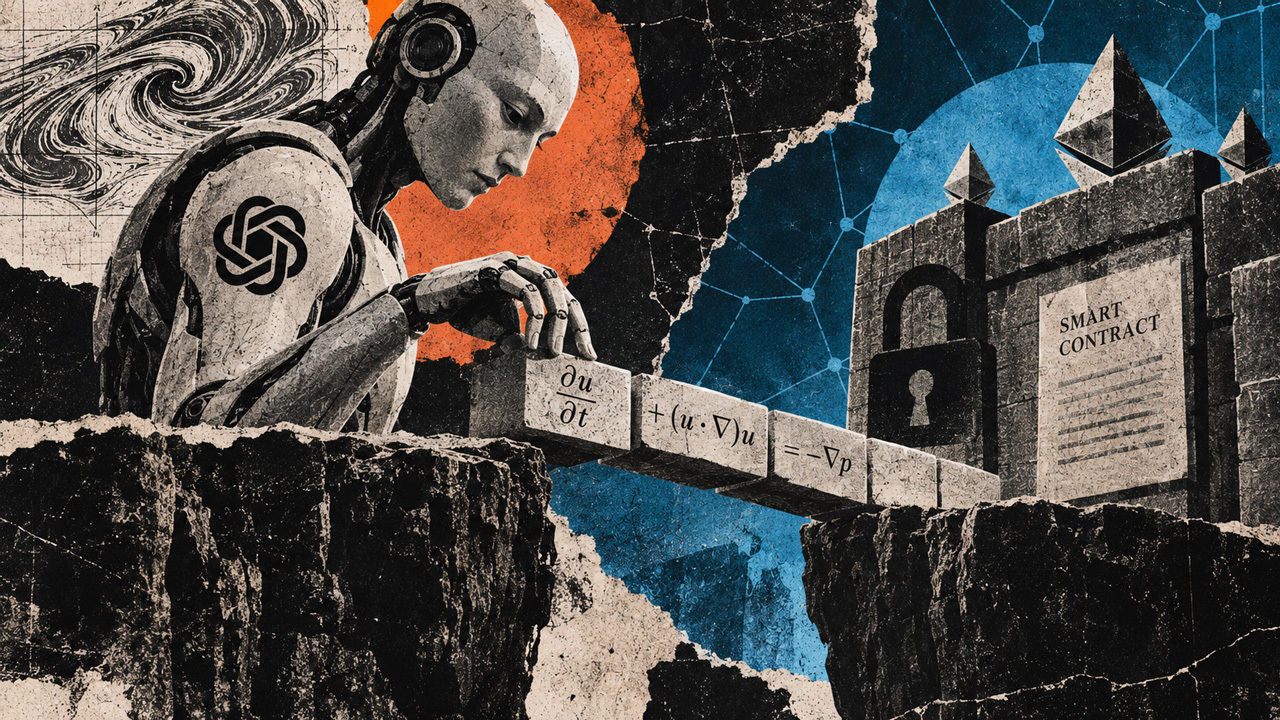
OpenAI’s latest mathematics breakthrough could bring automated theorem proving closer to smart-contract security workflows.
On Sept. 8, the AI company said that roughly 10,000 concurrent AI agents produced a solution addressing the Navier-Stokes fluid-motion problem after about 88 hours. Formalization and verification in Lean, a software proof assistant, required another 17 hours using GPT-6 Astra.
The system generated an analytical proof showing that an initially smooth fluid can develop a singularity in finite time while retaining finite energy, establishing cases C and D of the Millennium Prize formulation. OpenAI released both the proof and its Lean formalization for independent scrutiny.
Related Reading OpenAI just showed why one of its former researchers thinks AI could kill everyoneFor crypto developers, the more immediate implication lies in the process. Formal verification uses mathematical specifications and theorem proving to establish whether smart-contract code behaves as intended, an area where human guidance can make verification costly and labor-intensive.
AI could move the security bottleneck upstreamThe scale of OpenAI’s experiment closely resembles a scenario mathematician Terence Tao described five days before the announcement.
Tao warned that autonomous AI systems backed by enormous computing resources could eventually generate complex Navier-Stokes solutions and formally verify them in systems such as Lean while keeping much of the iterative discovery process out of public view.
His concern centered on what researchers might lose along the way. Failed approaches and intermediate discoveries often produce insights that outlive the final proof, while a largely autonomous system could deliver a correct result without transferring the same depth of understanding to humans.
That concern carries into smart-contract security as theorem proving becomes more automated.
Ethereum documentation says formal verification establishes whether a contract satisfies properties developers have specified in advance. Poorly written or incomplete specifications can allow vulnerabilities to escape detection even when verification succeeds.
More capable AI systems could therefore reduce the work required to construct proofs while increasing the importance of deciding what those proofs should cover. Access controls, withdrawal conditions, accounting invariants and privileged functions still have to be expressed accurately before a prover can test them.
That could reshape the economics of formal verification for DeFi protocols, bridges and tokenized-asset platforms, where manual effort has limited how widely the technique is deployed.
The next test is whether systems capable of handling research mathematics can be adapted to production software and produce proofs developers and auditors can meaningfully inspect.
Firms that can combine automated theorem proving with rigorous specification design could verify more contracts before deployment while concentrating human expertise on defining the failures that must never occur.
The post OpenAI’s math breakthrough exposes the next weak link in crypto security appeared first on CryptoSlate.
Why this matters
Ethereum is a tracked market entity in the DigitalMoneyBox archive, making this useful context for readers monitoring repeated mentions and follow-up coverage.
Original source
Read on CryptoSlateRelated market context

Ethereum ETFs Lose $201.9 Million As Bitcoin Funds Return To Inflows
TL;DR: US spot Ethereum ETFs recorded $201.9 million in net outflows on October 6, according to Farside Investors. Bitcoin ETFs mo...
Ethereum Tests 200 Million Gas Limit On Sepolia As Glamsterdam Moves Forward
TL;DR: Ethereum’s Sepolia testnet is testing a 200 million block gas limit as part of work around the Glamsterdam upgrade. The exp...

Ethereum (ETH) Price Prediction: ETH Eyes Recovery From $2,600 as $2,666-$2,689 Becomes Resistance
Ethereum price is holding around $2,618 as buyers attempt to preserve the latest recovery, but the market is approaching a decisiv...

Ethereum Price Prediction: Layer-2 Trouble Deepens as Another Network Shuts Down
Blast’s decision to close its Layer-2 network sharpens the question of Ethereum price and prediction: does activity ultimately con...

BlackRock Says AI Agents Could Be the Next Big Driver of Crypto Demand
Bitcoin Magazine BlackRock Says AI Agents Could Be the Next Big Driver of Crypto Demand Artificial intelligence and digital assets...

Cybersecurity consultant found guilty of stealing $55M in crypto from Uranium Finance
The conviction highlights the vulnerabilities in DeFi systems and underscores the effectiveness of blockchain forensics in tracing...