LND Tests A Guardrail Against Extreme External Bitcoin Fee Estimates
LND’s October 22 release candidate brings attention to a quiet source of wallet risk: outside fee estimates that software treats too generously. The 0.21.5 development notes describe a ceiling for values received through...
Watchlist
Published in the last two hours. A tracked entity is involved.

LND’s October 22 release candidate brings attention to a quiet source of wallet risk: outside fee estimates that software treats too generously. The 0.21.5 development notes describe a ceiling for values received through an external fee API, alongside fixes to other node operations.
TL;DR- The published build is v0.21.5-beta.rc1, a pre-release.
- The fee change limits extreme estimates supplied by an external service.
- Release verification and application testing answer different questions.
The release notes say external estimates previously had a lower bound without the corresponding upper bound. The documented repair limits the estimate before it can flow into fee-sensitive wallet operations.
The associated change applies a ceiling of 10,000 satoshis per virtual byte and also bounds the API’s minimum-relay estimate. That ceiling is an extreme-value guardrail. It is not a statement that such a fee is normal, economical or required by current network conditions.
A fee estimate is an input to a decision, not an instruction that must be obeyed at any cost. A service can return an unusable value because of an error, a changed data format or a compromised dependency. Bounding the input limits one way that an upstream problem can influence a wallet.
The larger operational issue connects with Bitcoin Core’s revised disclosure process: software that handles money needs both a method for finding problems and a path for getting repairs into use.
A candidate build still needs evidence from its deployment settingThe GitHub release page identifies the build as a pre-release and says it requires no database migration. It provides signature and binary-verification instructions. Those details support checking what was downloaded; they do not demonstrate how it will behave in every node configuration.
The notes also describe a native SQL connection-pool deadlock fix. That matters because node reliability depends on storage behavior as well as network communication. A process that remains running while requests stop completing can still fail the applications depending on it.
Testing a candidate therefore needs to cover the service’s actual work: receiving requests, accessing storage, handling failures and restarting cleanly. The absence of a database migration removes one category of change, but it does not prove that every interaction with existing data is unchanged.
For payment providers, that is distinct from the custody controls explored in shared-key Bitcoin lending. Keeping signing authority secure and keeping a payment node functioning are separate responsibilities.
The same distinction explains why custody and recovery arrangements cannot replace software maintenance. This candidate offers specific changes to evaluate. The final release decision and an operator’s deployment decision remain additional steps.
Written by the News Desk and edited by Samuel Rae.
Why this matters
Bitcoin is showing up inside the Market Structure theme, so this story is worth tracking for follow-through rather than treating it as a one-off headline.
Original source
Read on NewsBTCRelated market context

Binance Founder CZ Makes Shocking Claim About AI Hacking: “No Crypto Wallet Is 100% Safe”
The comments followed two X posts in which CZ discussed the limits of digital security and AI risks, highlighting phishing and soc...

Electrum Fixes Bitcoin Wallet Flaw That Could Turn A Fee Bump Into Theft
Electrum disclosed a wallet flaw on October 24 that could turn a Bitcoin fee adjustment into an unintended payment. Its advisory e...
Aave Opens Its First Externally Curated V4 Markets With Sentora
Aave’s first externally curated V4 markets are live on Ethereum, according to Sentora’s October 22 launch explanation. The curator...

Phantom Starts a Staged US Launch of In-Wallet Prediction Markets
US users of Phantom can now trade prediction markets in the wallet, under a staged launch that began Friday and runs through Kalsh...
CoinDCX Confirms $15.99M USDT Loss After Failed Sweep Hit Old Crypto Wallets
Key Takeaways: CoinDCX announced a $15.99M USDT loss from the old wallet infrastructure in the last contaminated security event im...
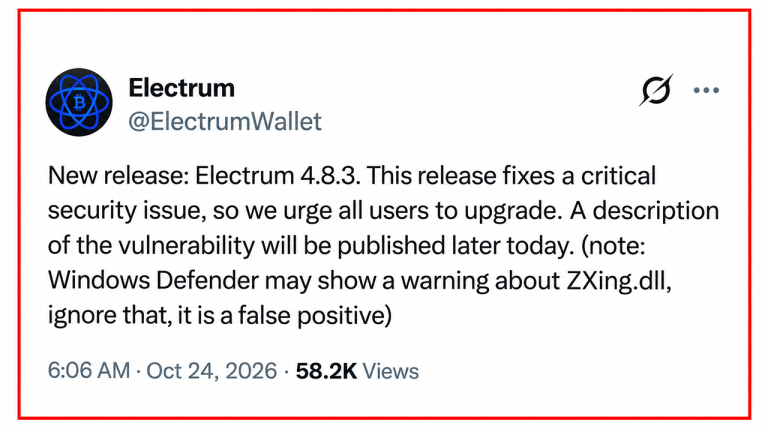
Electrum Wallet Attack Hid Bitcoin Theft Behind a Fee Increase
A malicious bitcoin wallet server could quietly swap a legitimate payment for a thief’s transaction, then wait for its owner to ap...