Pareto launches synthetic dollar backed by private credit
Private credit marketplace Pareto has introduced a new synthetic dollar aimed at linking institutional investors with decentralized finance (DeFi) opportunities — a move that highlights the expanding role of stablecoins...
Archive context
Older archive item. Useful for background and entity history, but not a fresh market-moving signal.

Private credit marketplace Pareto has introduced a new synthetic dollar aimed at linking institutional investors with decentralized finance (DeFi) opportunities — a move that highlights the expanding role of stablecoins in global finance.
The newly launched USP synthetic dollar is fully backed by real-world private credit, Pareto told Cointelegraph on May 15. To mint USP, users must deposit stablecoins such as USDC (USDC) and USDS, which are then held as collateral.
The deposited funds are placed into Pareto’s credit vaults and lent to what the company describes as “vetted institutional borrowers,” generating yields for participants, Pareto co-founder Matteo Pandolfi told Cointelegraph in a written statement.
To maintain its peg to the US dollar, Pareto uses what it calls a “native backing” process. Each USP token is minted only when an equivalent amount of USDC or USDS is deposited, ensuring full collateralization when the token is created. An arbitrage mechanism also supports the dollar peg’s ongoing stability.
In addition, Pareto has set up a protocol-funded stability reserve to act as a buffer in case of borrower defaults.
Related: Coinbase invests in Canadian stablecoin issuer
Institutional entry into RWA credit marketThe company said the synthetic dollar gives institutional investors a regulated onchain entry point into real-world asset (RWA) credit markets — a segment of the tokenization industry that has expanded rapidly over the past year.
Recent examples of private credit tokenization include Tradable’s portfolio of 30 credit positions and Apollo’s Diversified Credit Securitize Fund.
When asked about the potential risks of connecting DeFi to the often opaque private credit sector, Pareto acknowledged the concern but emphasized its approach to risk management.
“That’s a fair concern, but Pareto was specifically built to address the inefficiencies and opacity that have historically plagued traditional credit markets,” Pandolfi said, adding:
“By bringing private credit onchain, we enable real-time transparency, programmable risk management, and automated settlement while reducing counterparty risk and operational friction.”A chart highlighting the growth of the tokenized credit market. Source: RWA.xyzRelated: VanEck to launch its first RWA tokenization fund
Stablecoins: From crypto niche to the mainstreamAlthough synthetic dollars account for a small fraction of the total stablecoin market, they are driving innovation by introducing new methods for creating and managing fiat-pegged assets.
Ethena, the largest synthetic dollar network by market capitalization, offers Staked USDe (sUSDe) tokenholders an annual percentage yield of 10%. Roughly 368,000 investors were earning yield as of January, Cointelegraph reported.
Despite the success of synthetic variants, collateralized stablecoins continue to dominate the market — a position US regulators are keen to preserve through proposed legislation like the GENIUS Act and STABLE Act.
Under President Donald Trump, the US government has recognized the role of stablecoins as a “way to support the dollar’s worldwide use as a reserve currency,” Komodo Platform’s chief technology officer, Kadan Stadelmann, told Cointelegraph in a written statement.
“Stablecoins are the second-most adopted blockchain use case behind Bitcoin — more than NFTs and DeFi,” he said. “US dollar-pegged stablecoins account for a mind-boggling 1% of the M2 money supply.”
The total stablecoin market is approaching $250 billion, with Tether accounting for roughly $150 billion. Source: DefiLlamaSergey Gorbunov, CEO of Interop Labs and co-founder of Axelar Protocol, told Cointelegraph that US regulators have prioritized stablecoin legislation because they know there’s more at stake than just crypto.
“This is about setting the conditions for regulated US financial firms to lead on stablecoins and preserve the primacy of the US dollar, globally,” he said.
Related: SEC approves first yield-bearing stablecoin security
Why this matters
This cryptocurrency story adds another data point to the current market tape and is useful when read alongside nearby source coverage.
Original source
Read on CointelegraphRelated market context

Morgan Stanley Builds Crypto Lab to Test Stablecoins, Tokenization and DeFi at Scale
Key Takeaways: Morgan Stanley has opened a Digital Asset Lab dedicated to blockchain technologies. The test is to be applied to th...
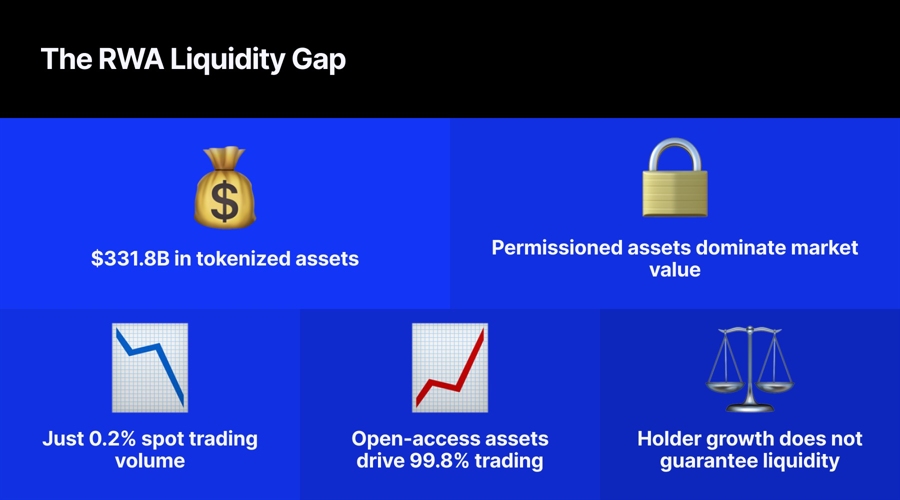
More Holders, Little Trading: The RWA Liquidity Problem Is Worse Than You Think
Let me ask you something straight. Does real-world asset trading on crypto exchanges feel like a genuine revolution, or does it fe...

Grayscale Opens DeFi And AI Crypto Funds To Investors With Just $2,500
TL;DR: Grayscale and investment platform Republic are offering three specialised crypto funds with minimum commitments starting at...

Grayscale Opens 3 Crypto Funds on Republic With $2,500 Minimum for Eligible Investors
Key Takeaways: Grayscale has introduced three crypto-investment products to Republic. A minimum investment of $2,500 is required f...

Circle Says 59 Cents of Each Revenue Dollar Went to USDC Partners and Transaction Costs
Circle said it paid about $819 million of its roughly $1.4 billion in first-half 2026 revenue to USDC distribution partners and tr...
Stablecoin Growth Cooled as Deposit Rates Rose, With USDC Most Exposed, Working Paper Says
When U.S. banks paid savers more, stablecoins grew more slowly, according to a Bank for International Settlements working paper pu...