Prime Staked: Liquid Restaking
Why you should listen Origin has a stablecoin, the Origin Dollar (OUSD) to support users as they passively earn yield on OUSD held in wallets – as opposed to being staked or locked up in a protocol. Ethereum restaking ha...
Archive context
Older archive item. Useful for background and entity history, but not a fresh market-moving signal.

Origin has a stablecoin, the Origin Dollar (OUSD) to support users as they passively earn yield on OUSD held in wallets – as opposed to being staked or locked up in a protocol.
Ethereum restaking has become one of 2024’s most disruptive narratives. The thriving sector is teeming with innovation, offering new opportunities for builders and users alike.
Matt says he learned that if you want to remain at the forefront, you need to constantly evolve along with the space. This principle allowed him to take liquid staking by the horns with Origin Ether. In a few months, they brought a product to market that continues to deliver value for users. Today, Origin Ether is approaching $100M of TVL while delivering higher risk-adjusted yields than the top liquid staking tokens like stETH, rETH, and frxETH.
His new product is Prime Staked ETH (primeETH), a liquid restaked token (LRT) that provides liquidity for assets that have been deposited into EigenLayer. By converting staked ETH into primeETH, users can stack ETH staking yield, EigenLayer points, and primeETH XP points all while remaining liquid.
primeETH is a reward-bearing token that works similarly to cTokens. primeETH tokens are not rebasing like stETH or OETH. Instead, the underlying rewards accrued by restaking positions are reflected in the price of primeETH over time as it increases in value.
primeETH was developed by Matt and the Origin Protocol team that have launched multiple DeFi products with $100M+ in TVL. Prime Staked is a fork of Kelp which has been battle-tested with hundreds of millions of funds and has been audited by sigmaPrime and code4arena. The primary change to the codebase was the addition of new LSTs and configuring their associated oracles. Each of the newly added assets have been carefully reviewed to make sure they don’t introduce new reentrancy vectors or unexpected behaviors.
Supporting linksBitget VIP Link with BONUS 1000 USDT
If you enjoyed the show please subscribe to the Crypto Conversation and give us a 5-star rating and a positive review in whatever podcast app you are using.
ADVERTISEMENT
Advertise with BNC
Why this matters
This research story adds another data point to the current market tape and is useful when read alongside nearby source coverage.
Original source
Read on Brave New CoinRelated market context

Bitcoin hedge funds face a liquidation trap when their collateral is split across markets
Here's a hypothetical situation: a hedge fund is making money, but one of its exchanges is about to liquidate its position anyway....
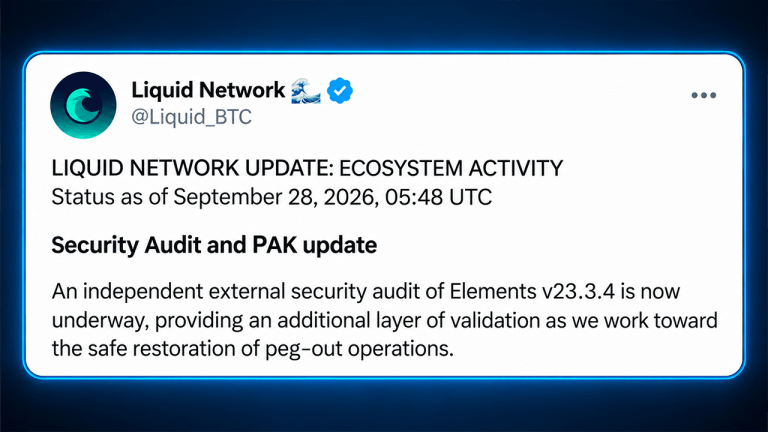
Liquid Network at 86% Backing as Bitcoin Redemption Freeze Drags On
It has been 35 days since an attacker exploited a vulnerability in the Liquid Network’s Elements software, draining nearly 4,000 B...

Locked liquidity did not stop this $14 million crypto pool drain
The PancakeSwap pool for 79AU, 79thVault’s token, lost $14.35 million in USDT on Oct. 7 through two selling wallets, according to...

Liquid Bitcoin Redemptions Remain Frozen With 85.8% Reserve Coverage
The reserve gap is about 603 BTC. Liquid says peg-outs require full backing and completed security reviews before they can restart...

Sui’s Hashi Launches With $500M to Turn Bitcoin Into Productive DeFi Collateral Markets
Key Takeaways: With more than $500 million in locked-in tokens, Hashi will launch its phased mainnet launch. The protocol enables...

Bitcoin tops $84,000 and liquidates nearly $83 million in short bets
Bitcoin's surge highlights the volatility and risk in leveraged trading, emphasizing the need for cautious market strategies and r...