Cardano finally cleared the SEC shortcut for a spot ETF, but its last remaining sponsor quit two days too early
Grayscale withdrew its registration for the Cardano Trust ETF on Aug. 7, telling the SEC only that it “does not intend to proceed with the planned distribution.” The move was voluntary and came along with parallel regist...
Archive context
Older archive item. Useful for background and entity history, but not a fresh market-moving signal.
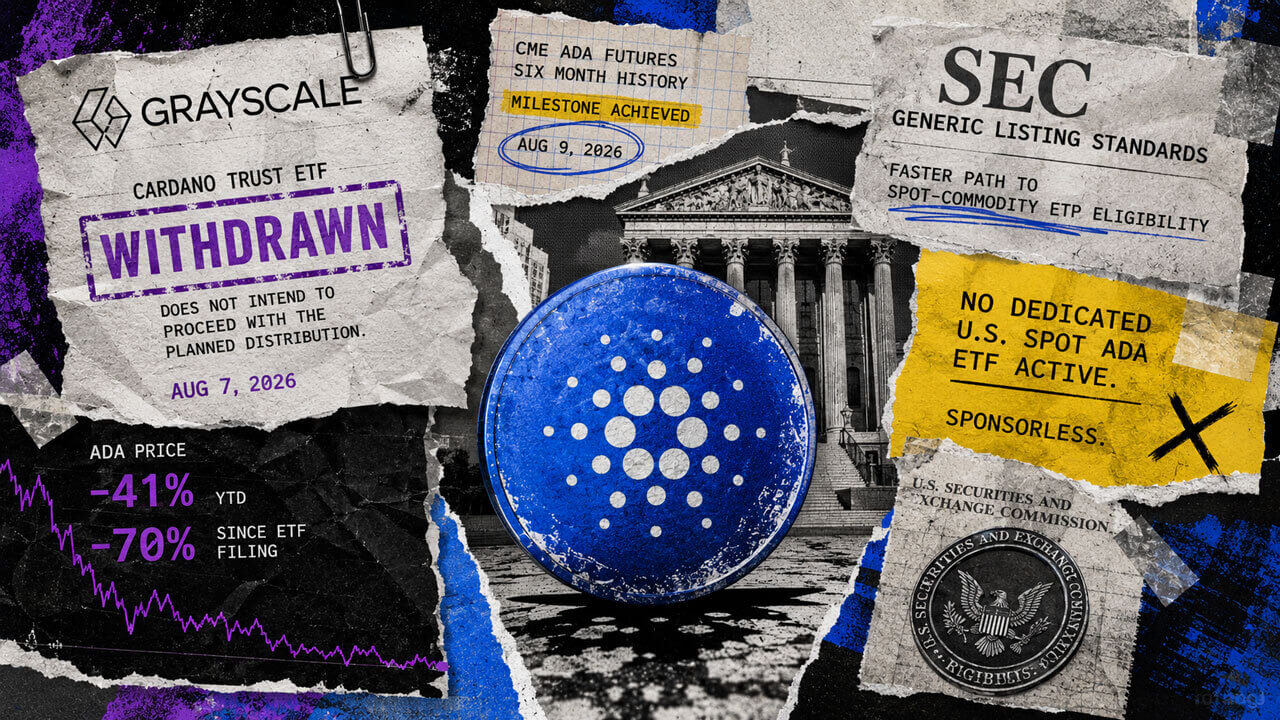
Grayscale withdrew its registration for the Cardano Trust ETF on Aug. 7, telling the SEC only that it “does not intend to proceed with the planned distribution.”
The move was voluntary and came along with parallel registrations for Hedera and Polkadot, within about three minutes of each other that same afternoon.
Two days later, ADA crossed a regulatory threshold that could have made its case for a spot ETF considerably easier. CME's regulated ADA futures had traded for six months as of Aug. 9, the track record the SEC's generic listing framework accepts as one path to spot-commodity ETP eligibility.
Cardano's only dedicated spot applicant walked away right before the rule that could have helped it took effect.
Date Event Why it matters for ADA Feb. 9, 2026 CME ADA futures begin trading Starts the six-month regulated futures clock Aug. 7, 2026 Grayscale withdraws Cardano Trust ETF registration Removes the only dedicated U.S. spot ADA ETF filing Aug. 7, 2026 Grayscale also withdraws HBAR and DOT filings Suggests broader product-priority decision, not necessarily an ADA-specific issue Aug. 9, 2026 ADA reaches six months of CME futures history ADA crosses a key eligibility route under generic listing standards After Aug. 9 No other dedicated U.S. spot ADA filing appears active ADA becomes eligible-looking but sponsorless What is fact and what is inferenceOther Grayscale altcoin registrations, including Bittensor, Aave, BNB, NEAR, and Zcash, remained active and preliminary the next day. That pattern points to a portfolio-level product decision, though Grayscale has not confirmed why it walked away.
ADA has also fallen more than 41% year-to-date and roughly 70% since Grayscale's original ETF filing. That decline fits a broader story about shrinking appetite for altcoin products, but it does not confirm what Grayscale was weighing when it pulled the filing.
The registration of the Grayscale Cardano Trust ETF never became effective, and the filing states plainly that no securities were issued or sold under it. There was no operating fund holding ADA, so there was nothing to unwind.
The only dedicated US spot ETF application built to hold ADA itself is gone. A vehicle like that would have allowed brokerage and institutional demand to convert directly into ADA purchases every time new shares were created.
With Grayscale gone and no other single-asset spot filing currently on record, ADA is missing that specific demand channel until a new sponsor steps in.
Why futures funds and baskets fall shortVolatility Shares runs a Cardano ETF built primarily on CME ADA futures, and its prospectus states that the fund does not invest directly in ADA.
Its combined net assets across both the standard and leveraged versions totaled roughly $1.26 million as of July, a small amount relative to ADA's roughly $7.1 billion market cap.
Grayscale's CoinDesk Crypto 5 ETF dropped ADA in its January rebalance, replacing it with BNB once the underlying index reselected its five components. Franklin Templeton's Crypto Index ETF still holds ADA, but at just 0.69% of net assets, about $70,709 worth as of the end of last year. Neither structure lets ADA demand flow in on its own terms.
Investment wrapper Holds ADA directly? Let's ADA demand stand alone? Investment-instrument takeaway Dedicated spot ADA ETF Yes Yes Would convert fund demand into direct ADA exposure ADA futures ETF No Partly Brokerable exposure, but demand flows through futures, not spot ADA Leveraged ADA futures ETF No Partly Trading product, not a long-term spot allocation wrapper Multi-crypto index ETF Sometimes No ADA can be included, reduced, or removed by index rules Direct ADA ownership Yes Yes Pure exposure, but outside the ETF/brokerage wrapper thesisA $25 million ADA ETF would represent about 0.35% of ADA's current market cap; a $100 million fund would reach roughly 1.4%; a $250 million fund would approach 3.5%, and a $500 million fund would cross 7%, enough to make ADA a visible allocation product on its own.
Creations, hedging, and secondary trading all complicate the relationship, but they show the size of the demand channel that just went quiet.
Under the SEC's generic listing standards, qualifying commodity-based trust shares can list without the exchange first filing a separate Section 19(b) proposed rule change for that individual product.
That removes the bespoke 19b-4 review track, which under Exchange Act Section 19(b)(2) can run from an initial 45-day review period to as long as 240 days if proceedings are instituted and extended.
Cardano's six-month futures history put ADA in a position to use that faster path.
The bull case has another issuer filing on the strength of ADA's now-qualifying futures history, using the same six-month CME track record Grayscale had access to.
A new spot application inherits a faster review window and does not have to rebuild the regulatory case from zero. Grayscale's exit becomes a handoff between sponsors, and ADA regains a path toward the demand channel a dedicated ETF represents.
The bear case has issuers directing their attention toward tokens with clearer demand, Solana, XRP, Dogecoin, and BNB among them, leaving Cardano without a sponsor willing to file.
Hypothetical spot ADA ETF size Share of ADA’s ~$7.1B market cap What it would signal $25M ~0.35% Small but visible institutional wrapper $100M ~1.4% Meaningful standalone ADA allocation product $250M ~3.5% Clear evidence of institutional/brokerage appetite $500M ~7.0% ADA becomes a visible ETF allocation categoryFutures wrappers stay near their current size, multi-asset baskets keep ADA at a small weight or drop it entirely, and the market starts reading the missing spot filing as a signal about ADA's institutional standing.
Cardano cleared the regulatory bar built to make a spot ETF possible. Whether ADA becomes an easier asset to invest in now depends on whether anyone else decides that bar is worth clearing.
The post Cardano finally cleared the SEC shortcut for a spot ETF, but its last remaining sponsor quit two days too early appeared first on CryptoSlate.
Why this matters
Cardano is showing up inside the Regulation theme, so this story is worth tracking for follow-through rather than treating it as a one-off headline.
Original source
Read on CryptoSlateRelated market context

Dogecoin prepares for upgrade with DogeOS testnet launch
DogeOS's testnet launch could transform Dogecoin's role in DeFi, enhancing utility and demand for DOGE, but security and timing re...

Samsung Wallet Brings USDC to 82M Galaxy Devices With Coinbase, Solana and Sui Support
Key Takeaways: Samsung Wallet will support 82 million U.S. Galaxy to add transfers on USDC. Coinbase will keep USDC in their Coinb...
Securitize Puts 12 U.S. Stocks on Solana With 1:1 Backing and 24/7 Trading Plans
Key Takeaways: Securitize has already launched tokenized U.S. stocks on Solana, including NVIDIA, Tesla and Apple. Each token repr...

Circle mints 250M USDC on Solana, boosting liquidity and network potential
Increased USDC supply on Solana may enhance network activity and adoption, but market caution persists regarding significant price...

LiquidAcre selects Uphold to power tokenized real estate infrastructure
The partnership could accelerate the adoption of tokenized real estate, potentially transforming property investment and ownership...

Citrini Research favors AAVE, UNI, ETHFI, PENDLE, and ONDO in tokenization bet
Citrini's focus on infrastructure over headline assets suggests a shift towards sustainable growth in crypto through tokenization...