Cardano Vies With Ethereum for Most Active Developers: Report
The developers behind Cardano, a proof-of-stake blockchain that aims to compete with Ethereum as a playground for decentralized applications and NFTs, is getting ready for its much anticipated Alonzo update this weekend....
Archive context
Older archive item. Useful for background and entity history, but not a fresh market-moving signal.
The developers behind Cardano, a proof-of-stake blockchain that aims to compete with Ethereum as a playground for decentralized applications and NFTs, is getting ready for its much anticipated Alonzo update this weekend.
They've been hard at work, according to numbers from crypto investment group Outlier Ventures.
Outlier's most recent Blockchain Development Trends report, which analyzed the top 50 blockchains by their native assets' market caps from July 2020 through June 2021, found that Cardano had the most commits per month on GitHub code repositories, with 701. That was 24% higher than its commits from the previous year. Ethereum came in second with 447, IOTA ranked third with 394, Filecoin fourth with 368, and NFT-centric blockchain Flow rounded out the top five 305.
Ethereum and Cardano ranked first and second in terms of monthly active developers, with 168 and 165 per month, respectively. Additionally, other protocols—including Avalanche, Ocean, Terra, and Cosmos came on strong in the last year with triple-digit-percentage growth over the previous year.
Github commits is a proxy indicator of a blockchain community's underlying health, though an imperfect one. Nonetheless, glancing at last year's report is instructive in determining how seriously to take these numbers.
Outlier Ventures' Q2 2020 report found a "substantial rise in developer activity" for Polkadot and Cosmos. A few months later, Polkadot's DOT came "from nowhere" to land in the top 10 by market capitalization. Cosmos' price, meanwhile, has risen 438% in the last year, according to data from CoinGecko.
The same report identified EOS, Bitcoin Cash, and TRON as seeing large drops in developer activity. Indeed, while the coins for all three blockchains have seen considerable gains over the past year, the networks themselves have largely fallen out of the public discourse as platforms that have emphasized DeFi applications and NFTs have taken the spotlight. (EOS and TRON both have decentralized applications but have not gained much traction, per data from DeFi Llama.)
Decentralized finance applications, which let people trade, borrow, and lend crypto assets on a peer-to-peer basis without going through financial intermediaries, exploded in popularity during last year's DeFi summer. That wave was quickly followed by a rush for NFTs, blockchain-based tokens that are used to indicate ownership in a digital or real-world asset.
Both DeFi and NFTs originated years ago on Ethereum before making their way to other platforms, such as Solana and, soon, Cardano. And both are made possible by smart contracts, pieces of code that automate blockchain transactions and remove the need for third parties.
Cardano Plunges as Critics Take Aim at Smart Contract LaunchBut Cardano's smart contract rollout ran into preemptive criticism from Ethereum developers and others this week when the first decentralized application built atop Cardano, a decentralized exchange known as Minswap, shut down its testnet due to a "concurrency" issue. Essentially, there's one transaction per block—a hindrance to transaction-heavy DeFi applications that rely on blockchain-based smart contracts for every asset swap, crypto loan, or other function. Cardano argues that its smart contract design is a feature, not a bug, as it improves security and lessens the likelihood of unexpected fees, and that concurrency issues like these can be avoided.
Regardless, we know one thing for sure: They're working on it.
Why this matters
This altcoin story adds another data point to the current market tape and is useful when read alongside nearby source coverage.
Original source
Read on DecryptRelated market context

Cardano’s DeFi has shrunk by more than half and RealFi is betting credit can revive it
Cardano’s “bank the unbanked” push went live with RealFi, putting real-world credit behind a new dollar-token system. On Oct. 1, R...
Ethereum Layer 2 Blast Is Shutting Down, Saying Costs Now Exceed What the Chain Earns
Blast, the Ethereum layer 2 network created by Blur founder Tieshun “Pacman” Roquerre, is shutting down, its team announced on X o...

Authors Withdraw Ethereum Staking Reward Burn Plan From Hegota Upgrade, Seek Separate Process
A proposal to burn a growing share of Ethereum staking rewards will not be part of the network’s Hegota upgrade. Ethereum France p...

SEC Commissioner Hester Peirce exits after eight years as crypto’s most prominent regulatory ally
Peirce's departure may slow crypto regulation progress, impacting SEC's ability to swiftly implement clear digital asset guideline...
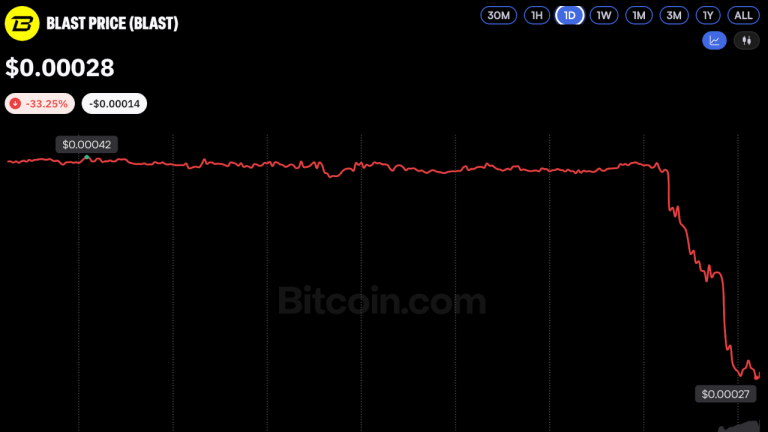
Ethereum Layer 2 Network Blast to Shut Down After Revenue Collapse
Blast, a once-buzzy Ethereum Layer 2 network, is set to shut down later this month after a dramatic decline in activity left the s...

Once a $2 billion Ethereum layer-2, Blast is shutting down after assets plunge 98%
Once home to more than $2 billion in crypto assets, Blast is shutting down as activity fades, costs rise, and bigger platforms lik...