Circle’s Next Step: Hyperliquid (HYPE) Integration As The Catalyst For Real Supply-Share Gain
Bankless has been looking past the usual “partnership announcement” narrative and instead focused on what the new Hyperliquid (HYPE), Coinbase (COIN), and Circle (CRCL) deal could realistically change for USDC. In its la...
Archive context
Older archive item. Useful for background and entity history, but not a fresh market-moving signal.

Bankless has been looking past the usual “partnership announcement” narrative and instead focused on what the new Hyperliquid (HYPE), Coinbase (COIN), and Circle (CRCL) deal could realistically change for USDC.
In its latest write-up, the outlet argues the collaboration is more than public relations, especially at a time when stablecoin momentum has started to pick up but the deeper numbers have not shifted as quickly as some investors might expect.
Bankless frames USDC’s moment as meaningful, but also incomplete—while positioning Hyperliquid as the missing platform that could help Circle’s stablecoin translate momentum into real market share.
The USDC DealAs reported by Bitcoinist last week, Coinbase said it is expanding its role by becoming the official treasury deployer of USDC on Hyperliquid.
In the plan, Coinbase treats USDC as an Aligned Quote Asset (AQA), while Hyperliquid’s USDH token is expected to be phased out gradually.
Bankless says that with this latest move, improvements are concrete: a significantly better revenue split—roughly double what Hyperliquid was earning with USDH—plus additional regulatory and institutional “firepower” that comes from aligning with what it describes as crypto’s largest voice in Washington, D.C.
The report also emphasizes user experience benefits, especially because USDC is a trusted stablecoin already built into the exchange experience for many traders.
Bankless adds that USDC is predominantly used in Hyperliquid’s HIP-3 markets, the segment that has driven much of Hyperliquid’s visibility over roughly the past six months.
From there, the argument becomes more strategic. Bankless contends that the Coinbase and Circle deal is more than “PR” because USDC already has momentum following the GENIUS Act approval, but its supply share has not meaningfully changed.
It presents Hyperliquid as the fix for that mismatch—an added distribution channel that could allow stablecoin growth to compound rather than merely coexist with the existing dominant currency dynamic.
Binance Reinforces USDT DominanceTo support the “supply share isn’t moving” claim, Bankless points to stablecoin market composition. In April 2025, it says Tether’s USDT stablecoin held 67% of stablecoin supply while USDC held 27.6%.
A year later, USDT sits at 67.3% and USDC at 28.1%. It notes that USDC transaction volume is accelerating, but the structural picture remains basically unchanged, which it describes as the central problem. The report argues that this is happening for a reason. USDC is strongest in the United States, but competition is concentrating precisely there.
Outside the US, the report says, USDT still functions as the default dollar for saving, investing, and trading—meaning USDC faces a tougher environment when it comes to establishing base currency status across global trading venues.
That is why distribution is presented as the priority, and perpetuals are framed as the natural battleground. Stablecoins are the quote asset that perpetuals are built around, and the ecosystem that dominates the largest exchange tends to reinforce itself.
On Binance, Bankless notes, USDT is the standard against which many of the biggest markets trade. In practice, that means traders are frequently transacting against USDT, which strengthens USDT’s supply, liquidity, deposits, withdrawals, and on-chain activity.
Hyperliquid May Fix ThatHyperliquid, in Bankless’s telling, offers USDC a way to fight that cycle. The report includes a set of market indicators meant to show that Hyperliquid’s share in the perp ecosystem isn’t theoretical.
It claims Hyperliquid holds 30% of onchain perp market share, commands 46% of onchain open interest, and operates at about 50% of Bybit’s volume, around 30% of OKX’s volume, roughly 79% of Coinbase International’s, and about 13% of Binance.
While Hyperliquid is still smaller than Binance overall, Bankless suggests the direction is clear—toward perpetuals becoming an environment where USDC can gain more consistent exposure.
The conclusion is that Coinbase and Circle can let Hyperliquid carry the reach while USDC benefits from being the stablecoin underneath the trading activity.
Featured image created with OpenArt, chart from TradingView.com
Why this matters
Hyperliquid is showing up inside the Stablecoins theme, so this story is worth tracking for follow-through rather than treating it as a one-off headline.
Original source
Read on NewsBTCRelated market context
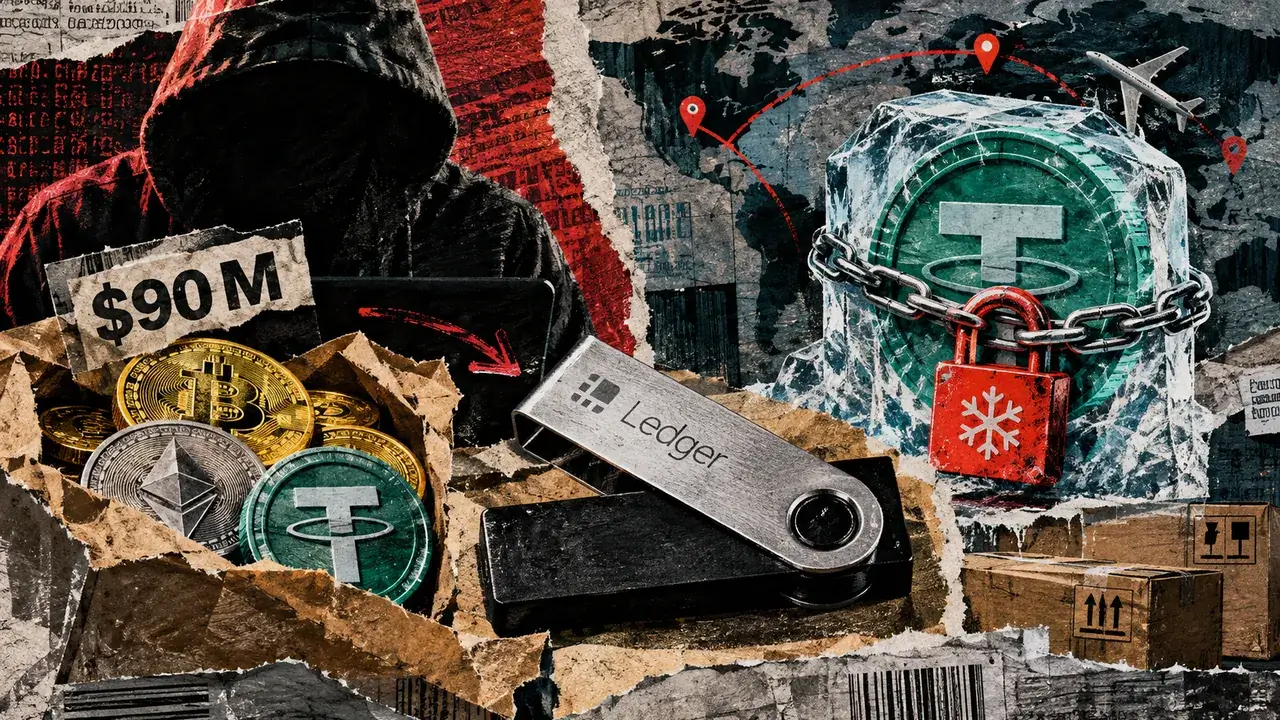
Ledger hack scare nears $90 million as Tether moves to freeze stolen USDT
Suspected Ledger wallet thefts are approaching $90 million as Tether freezes USDT stablecoin linked to the incident, according to...
Circle Brings USDC and EURC Into SAP Workflows Powering 84% of Global Commerce
Key Takeaways: Circle and Tereina are introducing USDC and EURC to the SAP payment flow. USDC will process eligible dollars while...
Tether Freezes $1.45M in THORChain USDT Vaults, Then Reverses Blacklist Hours Later
Key Takeaways: The amount of about $1.45 million in USDT was temporarily frozen in THORChain vault addresses. According to THORCha...

Circle mints 250M USDC on Solana, boosting liquidity and network potential
Increased USDC supply on Solana may enhance network activity and adoption, but market caution persists regarding significant price...
Ledger theft-linked funds shift from USDT to USDD to dodge Tether freezes
The shift from USDT to USDD underscores vulnerabilities in stablecoin freeze mechanisms, prompting scrutiny on regulatory and secu...
Coinbase and Gennius plan ONED USD stablecoin access through Latin American banks
Coinbase's partnership with Gennius could reshape Latin American banking by integrating stablecoins, enhancing financial inclusion...