Ethereum Validator Slashing Puts Cardano’s Resilience In Focus – Here’s Why
A recent slashing of Ethereum from different validators has reignited the debate around staking models, with many pointing to Cardano’s more resilient structure as a key differentiator. While Ethereum’s system penalizes...
Archive context
Older archive item. Useful for background and entity history, but not a fresh market-moving signal.

A recent slashing of Ethereum from different validators has reignited the debate around staking models, with many pointing to Cardano’s more resilient structure as a key differentiator. While Ethereum’s system penalizes validators for downtime or misbehavior, Cardano’s staking approach avoids such risks, offering delegators security without the fear of losing funds.
Why Simplicity And Resilience Are Cardano’s Key AdvantagesOn September 10, a slashing of 11.7 ETH from 39 Ethereum validators highlights the advantages of Cardano’s staking structure. Crypto analyst Dori has highlighted on X the fundamental differences in staking requirements and risks between the two networks. On Ethereum, it is structurally impossible to stake 0.1 ETH directly on ETH, but an individual must stake a minimum of 32 ETH and operate a validator node themselves.
However, platforms have been built on Ethereum to allow staking with as little as 0.1 ETH, and liquid tokens are issued. The critical difference is that, due to the slashing mechanism, Ethereum’s structure carries the risk of a cascading collapse. This has given rise to platforms like Ankr and Lido Finance, which pool ETH from many users, run validators, and issue liquid staking tokens such as ankrETH and stETH to solve the problem of locked-up funds.
In this incident, an operational mistake by the operators of 39 validators led to a slashing penalty of 11.7 ETH, which is worth approximately $52,000. If a larger slashing event were to occur, it could lead to the de-pegging of the liquid staking tokens, potentially triggering a cascading collapse as DeFi ecosystem protocols built upon them.
On Ethereum, iquid staking platforms were developed to remove obstacles to staking, and liquid tokens were distributed to address the issue of lock-ups. In contrast, Cardana’s staking model allows anyone to stake as little as 10 ADA in a stake pool without worrying about slashing. There are no lock-up periods, and a user’s staked funds are never at risk of being lost, even if their chosen stake pool misbehaves.
Fundamentally Different Approaches To StakingCardanians (CRDN) also stated that a critical flaw in Ethereum’s staking model has been exposed, highlighting the fundamental advantages of Cardano’s design. The data shows that the Ethereum staking exit queue has hit an all-time high, forcing users who unstake their ETH to wait an estimated 46 days to get their funds back.
However, Cardano’s ADA staking model offers a fundamentally different experience, with liquid staking and no entry or exit queues. When a user stakes their ADA, the funds remain in their wallet and are always available for use or transfer, and earn rewards without being locked up. “The design is fundamentally better,” the expert noted.
Why this matters
This altcoin story adds another data point to the current market tape and is useful when read alongside nearby source coverage.
Original source
Read on NewsBTCRelated market context
SEC’s Crypto Custody Proposal Could Change How Funds Hold Digital Assets
TL;DR: The SEC has proposed a tailored crypto custody framework for advisers and regulated funds, but the changes are not yet fina...

How Solana Supports Fast Crypto Payments in Digital Gaming
Picture a SOL holder on a quiet evening, watching the token tick sideways on a chart that hasn’t done much all week. Rather than r...

Kraken wins Fintech Company of the Year – Established at the National Fintech Awards 2026
TL;DR Kraken was named Fintech Company of the Year – Established at the Business Post’s National Fintech Awards 2026 in Dublin. Th...
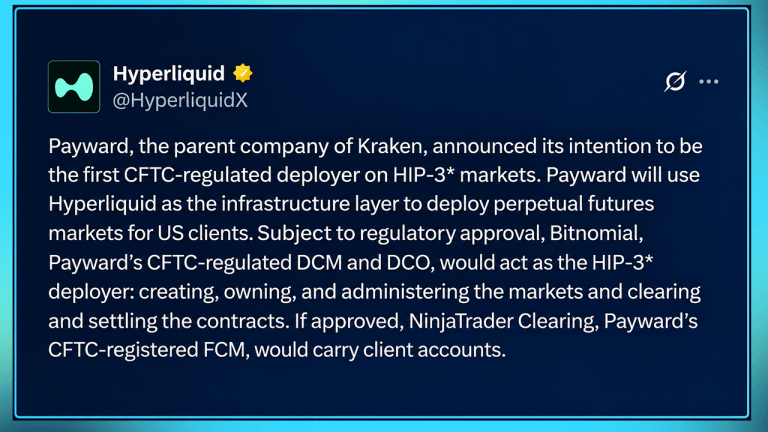
Kraken Parent Payward Eyes First CFTC-Regulated Hyperliquid Futures Market
Kraken parent Payward plans to become the first Commodity Futures Trading Commission (CFTC)-regulated operator to deploy perpetual...

Anthropic’s Claude AI Predicts a Huge Move for Solana by 2027
Something potentially significant could happen for Solana by January 1, 2027, as Anthropic’s Claude AI predicts that SOL could be...

BNB New Layer 1 Puts CZ’s Ecosystem Strategy in Focus as ASTER Builds Its Own Chain
Changpeng Zhao’s vision for a multi-chain crypto ecosystem is coming into sharper focus as BNB Chain develops a new Layer 1 blockc...