Hyperliquid tests allowlists that let operators restrict access to their own markets
In a Sept. 3 developer update, Hyperliquid API Announcements said the onchain derivatives exchange was adding optional wallet allowlists to builder-run perpetual markets. The testnet-only extension, called HIP-3*, would...
Archive context
Older archive item. Useful for background and entity history, but not a fresh market-moving signal.
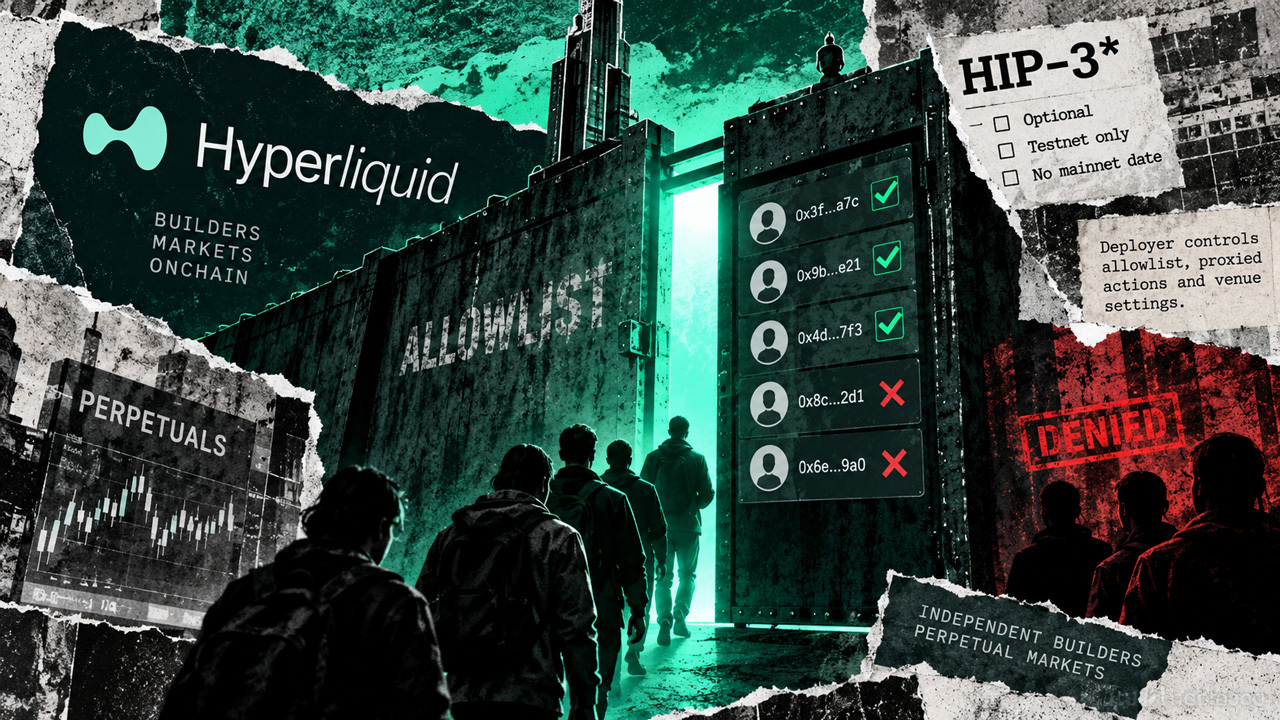
In a Sept. 3 developer update, Hyperliquid API Announcements said the onchain derivatives exchange was adding optional wallet allowlists to builder-run perpetual markets. The testnet-only extension, called HIP-3*, would let a market deployer decide which wallets may trade on its venue without imposing the same access policy across Hyperliquid.
HIP-3 is Hyperliquid's framework for perpetual markets deployed by independent builders. The current API reference says a new venue can be designated HIP-3* when it is created, enabling an onchain allowlist and proxied user actions. Hyperliquid described the feature as optional and strictly additive, with existing markets unchanged. The specification is preliminary, available only on testnet and has no announced mainnet date.
Related Reading Anyone can now create Hyperliquid perp contracts with $20M: Is DeFi about to break? How HIP-3* wallet allowlists workA HIP-3* deployer can act for a user in five defined ways: add or remove allowlist approval, cancel specified resting orders, cancel all of the user's resting orders and time-weighted average price orders on the venue, place reduce-only orders, and move collateral to another account on the same venue.
Each power is limited by the venue boundary. The documented bulk-cancellation tool leaves orders on other DEXs untouched, the collateral-transfer function is venue-scoped, and every proxied order must be reduce-only. That last restriction allows an operator to reduce a position but not increase one through the proxy function.
A deployer may use all five tools itself or delegate them one by one to approved sub-deployers. One address could administer the allowlist while another handles cancellations, without receiving every available permission.
The reference does not enumerate every action a wallet outside the allowlist may still perform on its own. HIP-3* should therefore be understood as access control and operator powers for one newly created venue, not as a wallet freeze across Hyperliquid.
The design could give firms with customer or jurisdiction restrictions a technical way to build gated perpetual markets while other deployers continue using ordinary HIP-3. It does not amount to regulatory approval, protocol-wide know-your-customer checks or evidence that an institution has adopted HIP-3*. Hyperliquid said the tools are intended to help independent deployers operate under requirements applicable to them, leaving legal and operational choices with each deployer.
Related Reading Wall Street’s fight with Hyperliquid could decide who controls 24/7 marketsThat separation also leaves the economic responsibility with the market operator. Under the existing HIP-3 specification, deployers define contracts, maintain oracles, set leverage limits and settle markets. Each deployer DEX has independent margining, order books and settings.
Related Reading Inside the brutal 2-minute flash crash sending a $400M South Korean market plunging on HyperliquidA mainnet HIP-3 deployer must currently maintain 500,000 HYPE in stake. Validators can slash that stake for irregular inputs that jeopardize protocol correctness, uptime or performance. HIP-3* adds access controls to that operator model; it does not shift responsibility for a restricted venue to Hyperliquid or alter permissionless markets elsewhere on the network.
The post Hyperliquid tests allowlists that let operators restrict access to their own markets appeared first on CryptoSlate.
Why this matters
Hyperliquid is showing up inside the DeFi theme, so this story is worth tracking for follow-through rather than treating it as a one-off headline.
Original source
Read on CryptoSlateRelated market context

Kain Warwick warns Hyperliquid’s HYPE token offers holders no investor protections
The lack of investor protections for HYPE token holders highlights the risks in DeFi, emphasizing reliance on code over legal safe...

Sui’s Hashi Launches With $500M to Turn Bitcoin Into Productive DeFi Collateral Markets
Key Takeaways: With more than $500 million in locked-in tokens, Hashi will launch its phased mainnet launch. The protocol enables...
Aave MCP now connects with MetaMask Agent Wallet for AI-driven DeFi actions
AI-driven DeFi integration enhances automation and security, empowering users with greater control and developers with streamlined...

Samsung Wallet Brings USDC to 82M Galaxy Devices With Coinbase, Solana and Sui Support
Key Takeaways: Samsung Wallet will support 82 million U.S. Galaxy to add transfers on USDC. Coinbase will keep USDC in their Coinb...

LiquidAcre Selects Uphold to Power Digital Asset Infrastructure and Future Tokenized Real Estate Offerings
LiquidAcre, a financial technology company building a platform designed to expand access to real-world assets and digital financia...

Bitcoin miners escape months of distress as daily revenue surges by 78%
Bitcoin miners are emerging from months of financial pressure as rising BTC prices lift daily industry revenue by 78%. According t...