Kraken tips Solana’s razor-thin inflation vote
A highly contentious proposal to alter the inflation rate of SOL, a vote called SGP-0002, has passed with precisely 67% ayes. Official rules require two-thirds of participating stake to pass, so the proposal cleared the...
Archive context
Older archive item. Useful for background and entity history, but not a fresh market-moving signal.

A highly contentious proposal to alter the inflation rate of SOL, a vote called SGP-0002, has passed with precisely 67% ayes. Official rules require two-thirds of participating stake to pass, so the proposal cleared the bar by barely 0.33 percentage points.
As a result of the vote, SOL’s so-called “disinflation rate” will double from 15% to 30%.
SGP-0002 instructs the network to continue creating new SOL but shrink the inflation rate twice as fast.
After switching its vote at the eleventh hour, holders of staked SOL at crypto exchange Kraken tipped the voting outcome. Its 8.9 million SOL validator, labeled “Kraken 2,” cast 90.34% of its stake in favor of the measure.
Had Kraken’s votes cast No instead of Yes, SGP-0002 would have failed at approximately 63.9%, i.e. below the 66.66% threshold.
Passed. LFG
— The White Whale (@WhiteWhaleLabs) August 28, 2026Helius CEO Mert Mumtaz celebrated Kraken changing its earlier No indication to a Yes during the final whipsaw.
Contributors from Mumtaz’s firm wrote many of the technical proposals for SGP-0002.
Kraken was mathematically decisive but not uniquely responsible. Galaxy and other late voters also moved the tally.
Still, the exchange supplied enough Yes votes to secure a winning margin and was widely credited on social media with flipping the vote.
Solana kept quiet about Alpenglow upgrade breakagesRead more: First US-listed Solana treasury firm moves and protects executives
Doubling Solana’s disinflation rate doesn’t end inflationSolana is still inflationary. The change doesn’t flip the rate of new SOL entering the market negative.
To be clear, SOL will always remain inflationary at a positive rate, the only matter of debate was how positive the rate would be.
Solana validators voted to cut future SOL issuance by roughly 18.9 million tokens over six years, but over the long haul, those tokens will still enter the market eventually.
Technical specifications for the change keep terminal (a.k.a. “long tail”) inflation at 1.5%, but estimates reaching that terminal rate 2.8 years after activation instead of 5.7 years.
It’s the first Solana governance proposal to pass under the network’s new binding, on-chain voting system. A prior attempt at similar territory, SIMD-0228, failed in March 2025 with about 61% support.
Developers now project approximately 18.9 million fewer SOL created over the next six years.
Under the old 15% annual reduction, SOL wasn’t due to hit the 1.5% floor until around 2032. Doubling that rate to 30% moves the date to roughly 2029.
Developers must still re-anchor the supply curve, test the change, and activate its feature gate. In other words, the vote creates no instantaneous supply shock.
The vote temporarily improves SOL’s scarcity pitch over the next few years. If demand for SOL persists, fewer coins entering the market should provide less supply overhang.
Solana splits votes on two other proposalsThe disinflation vote was the most consequential, but the combined vote also included two other proposals, SGP-0001 and SGP-0003.
Stakeholders approved SGP-0001, the “Solana Constitution,” with 85.97% support. It formalized governance processes that accompanied today’s cliffhanger.
Over the past few years, governance of the Solana network has mostly occurred off-blockchain, and this new constitution aims to bring more democratic processes on-chain.
Voters rejected SGP-0003 with 53.90% support, below the two-thirds threshold.
This Solana inflation-related proposal sought to burn a usage-based resource charge while paying block leaders a fixed inclusion fee.
Got a tip? Send us an email securely via Protos Leaks. For more informed news and investigations, follow us on X, Bluesky, and Google News, or subscribe to our YouTube channel.
The post Kraken tips Solana’s razor-thin inflation vote appeared first on Protos.
Why this matters
Solana is showing up inside the Market Structure theme, so this story is worth tracking for follow-through rather than treating it as a one-off headline.
Original source
Read on ProtosRelated market context

Circle minted another 750 million USDC on Solana in the last 24 hours
Increased USDC liquidity on Solana may boost SOL demand, but its market impact depends on active circulation and broader crypto tr...

Samsung Wallet Brings USDC to 82M Galaxy Devices With Coinbase, Solana and Sui Support
Key Takeaways: Samsung Wallet will support 82 million U.S. Galaxy to add transfers on USDC. Coinbase will keep USDC in their Coinb...
Securitize Puts 12 U.S. Stocks on Solana With 1:1 Backing and 24/7 Trading Plans
Key Takeaways: Securitize has already launched tokenized U.S. stocks on Solana, including NVIDIA, Tesla and Apple. Each token repr...

Stealing $1.5B in crypto is easy, cashing out is the trap
North Korean hackers stole around $1.5 billion from Bybit in February 2025. While the hack itself has been widely covered and anal...
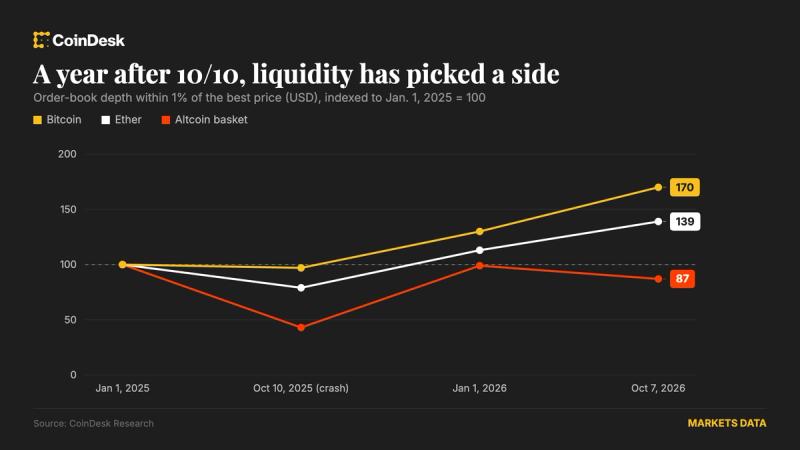
One year after 10/10, bitcoin and ether liquidity have rebuilt, but other altcoins still face risks
Bitcoin and ether order books are deeper than before the crash, while altcoin liquidity keeps eroding and spot trading remains wel...

Too Big to Supervise at Home: EU Limits Direct ESMA Rule to Crypto Giants
EU member states have rejected plans to put every digital-asset firm under direct ESMA supervision, drawing a line that leaves mos...