New Memecoin CASHCAT Put Robinhood Chain Ahead of Hyperliquid in DEX Volume
Robinhood Chain recorded between $560 million and $570 million in 24-hour DEX volume on July 8, 2026, seven days after its mainnet went live, overtaking Hyperliquid as the top decentralized exchange by that metric. The d...
Watchlist
Archive context. The story has cross-source confirmation.

Robinhood Chain recorded between $560 million and $570 million in 24-hour DEX volume on July 8, 2026, seven days after its mainnet went live, overtaking Hyperliquid as the top decentralized exchange by that metric.
The displacement is not a minor statistical quirk: Hyperliquid had posted $492.7 billion in quarterly volume and a record ~$161 million in net revenue in Q1 2026, the highest single-quarter figure ever recorded by a DeFi protocol, making it the benchmark every new chain was being measured against.
What actually drove the surge forces an immediate qualification. The catalyst was not a blue-chip lending market, a novel perpetuals mechanism, or an institutional RWA product.
It was a memecoin called CASHCAT, a cat token that emerged organically on the new chain and alone accounted for roughly $98 million of the $560–$570 million total.
Discover: The Best Token Presales
A Cat Token Drives a Record-Breaking DEX DayRobinhood Chain launched on July 1 as a permissionless Ethereum Layer-2 network built on the Arbitrum stack, integrating Uniswap for trading, Chainlink for price oracles, and Morpho for lending.
Because the chain is fully permissionless, anyone can deploy a token and spin up a trading pair, which is precisely how CASHCAT appeared, trading against WETH on Uniswap pairs with no corporate announcement behind it.
CASHCAT hit an all-time high above $0.17, with its market cap ballooning to somewhere between $100 million and $170 million in a single session.
Source: DexScreenerThe token’s price action generated approximately $98 million in 24-hour volume on its own, about 17% of Robinhood Chain’s entire daily DEX figure. Strip that out, and the chain’s number drops significantly, though the remainder still represents substantial activity for a seven-day-old network.
Daily active addresses on Robinhood Chain approached 200,000 on July 8, with more than 140,000 of those being first-time users. That onboarding rate signals genuine demand pull, not just existing DeFi participants rotating between chains. Whether those users stay once the memecoin cycle fades is the operative question.
Discover: The Best Crypto to Diversify Your Portfolio
TVL Composition Is the More Durable SignalThe chain’s TVL crossed $100 million within its first week, and the primary driver was Morpho lending activity, not speculative token positions.
That distinction matters. Lending TVL reflects users deploying capital for yield under structured terms, which carries different retention characteristics than liquidity posted purely to support a memecoin trading pair. It does not confirm long-term DeFi adoption, but it is a structurally different signal than raw trading volume.
Source: Robinhood Chain TVL / DefiLlamaTrading volumes have already begun stabilizing below the July 8 peak, according to the primary source. That is expected behavior after a memecoin-driven spike – the question is what the floor looks like once CASHCAT volatility normalizes.
The lending TVL figure suggests at least some portion of the user base arrived with yield-seeking intent rather than pure speculation, which gives Robinhood Chain a non-trivial base to build from.
For context on the scale of what Robinhood Chain briefly displaced: Hyperliquid had accumulated $330.8 billion in combined spot and perpetual trading volume by July 2025 and entered the top 10 global derivatives exchanges by volume, a first for any DEX.
Robinhood’s own crypto trading arm had sat at $237.8 billion over the same period, meaning Hyperliquid had been outpacing Robinhood’s crypto business for months before the chain launched. The reversal, even if partly memecoin-driven, is not a trivial data point.
Don’t Miss Out on Our $1,000 USDT Airdrop on ByBit
The post New Memecoin CASHCAT Put Robinhood Chain Ahead of Hyperliquid in DEX Volume appeared first on Cryptonews.
Why this matters
Hyperliquid is showing up inside the DeFi theme, so this story is worth tracking for follow-through rather than treating it as a one-off headline.
Original source
Read on CryptonewsRelated market context

Ethereum Layer 2 Blast Is Shutting Down, Saying Costs Now Exceed What the Chain Earns
Blast, the Ethereum layer 2 network created by Blur founder Tieshun “Pacman” Roquerre, is shutting down, its team announced on X o...

Hyperliquid receives first $15M USDC for HYPE buybacks via AQAv2 protocol
The USDC infusion into Hyperliquid's buyback strategy may enhance HYPE token liquidity, potentially boosting market confidence and...

Hyperliquid perpetual contracts now available on Bloomberg Terminal
The integration of Hyperliquid on Bloomberg Terminal signals a pivotal shift towards institutional acceptance of decentralized fin...

Hyperliquid receives $15M USDC for HYPE token buybacks
The financial backing for HYPE buybacks may boost investor confidence, potentially driving long-term value and market interest in...

Hyperliquid lines up roughly $15M in USDC yield for HYPE buybacks
Hyperliquid's new yield-based buyback strategy diversifies revenue streams, potentially stabilizing HYPE's value amid trading fluc...
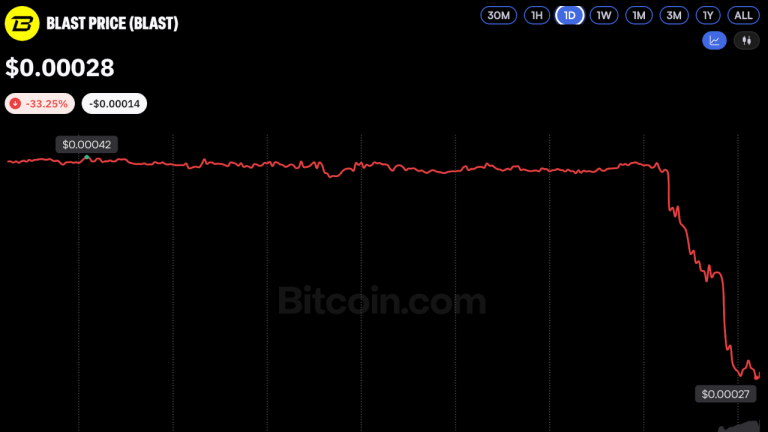
Ethereum Layer 2 Network Blast to Shut Down After Revenue Collapse
Blast, a once-buzzy Ethereum Layer 2 network, is set to shut down later this month after a dramatic decline in activity left the s...