Ripple’s $12.5 Trillion Claim: How Does XRP Fit Into 13,000 Banks?
Ripple and XRP are now tied to a sweeping claim of 13,000 banking connections and $12.5 trillion in payment activity. The scale draws immediate attention and prompts closer examination of how XRP fits within a network th...
Archive context
Older archive item. Useful for background and entity history, but not a fresh market-moving signal.
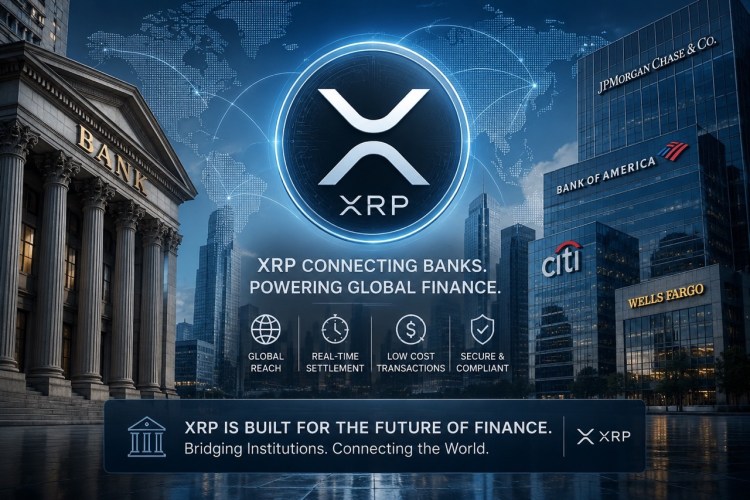
Ripple and XRP are now tied to a sweeping claim of 13,000 banking connections and $12.5 trillion in payment activity. The scale draws immediate attention and prompts closer examination of how XRP fits within a network this large and operates across such an extensive financial system.
XRP And Ripple’s 13,000-Bank Reach: What Connects Them?The scale of 13,000 connected banks begins with how Ripple links financial institutions without requiring them to abandon existing systems. Instead of replacing banking infrastructure, the company built a framework that integrates with it. This approach allows thousands of banks to operate within a shared network while still relying on their established processes.
At the center of this structure is Ripple’s treasury platform, which unifies payment flows and liquidity tracking in one environment. It delivers a consolidated view of cash positions, giving institutions the ability to monitor and manage funds across borders in real time. Such visibility becomes essential when transaction volumes extend into the trillions.
A key step in expanding this capability came with the $1 billion acquisition of GTreasury in 2025. This added established treasury management tools widely used in corporate finance, strengthening Ripple’s ability to coordinate large-scale financial activity. By integrating tested technology rather than building entirely new systems, the network expanded more efficiently while maintaining compatibility with existing operations.
This structure clarifies the 13,000-bank figure. It reflects connectivity through a unified system rather than a complete shift into new infrastructure. The network functions as a bridge across institutions, enabling interaction within a shared financial layer while preserving internal systems.
XRP’s Role Inside The $12.5 Trillion Payment FlowThe next focus is on volume, and this is where XRP’s role becomes more defined. Within a system handling $12.5 trillion in payments, efficiency in moving value across borders becomes essential. Positioned within Ripple’s infrastructure, XRP functions as a liquidity tool designed to support faster and more flexible value transfer across currencies.
Traditional cross-border payments often depend on pre-funded accounts in multiple currencies, which ties up capital and slows transactions. XRP offers an alternative by acting as an intermediary asset, allowing value to move between currencies without requiring those reserves. This function aligns with the demands of a system processing large-scale payment flows.
Still, the reported $12.5 trillion does not imply that every transaction runs through XRP. Ripple’s platform supports multiple payment methods, giving institutions flexibility depending on regulatory requirements and operational preferences. XRP is used in specific scenarios where speed, cost efficiency, and liquidity access are priorities.
The figures shared by BSCNews point to a broader infrastructure rather than a single-channel system. XRP operates within that structure as a targeted solution, not the sole mechanism behind the entire volume. Its role becomes clearer when viewed in context: part of a larger financial network designed to move value efficiently across thousands of connected institutions.
Why this matters
XRP is showing up inside the Institutional Adoption theme, so this story is worth tracking for follow-through rather than treating it as a one-off headline.
Original source
Read on NewsBTCRelated market context
Chainlink And LG CNS Target South Korean Banks With Digital Asset Infrastructure Deal
TL;DR: Chainlink and LG CNS are partnering on oracle and cross-chain infrastructure aimed at South Korea’s financial institutions;...
Ripple and Arf Bring $10B PayFi Settlement Liquidity to XRP Ledger With RLUSD
Key Takeaways: For licensed payment companies on the XRP Ledger, Arf is rolling out settlement financing using RLUSD. About $10 bi...

Centrifuge opens production tokenization infrastructure to institutions
Centrifuge's infrastructure could revolutionize asset management by simplifying blockchain fund tokenization, reducing costs, and...

JPMorgan Solana Push Brings MONY and JLTXX Into Tokenized Finance
JPMorgan Asset Management brings two Solana tokenized money market funds, MONY and JLTXX, to the blockchain, opening another route...

Critical PHP Fixes Put Crypto Checkout Infrastructure In Focus
TL;DR: PHP released fixes for two critical flaws on October 21 and urged immediate updates. Crypto businesses using PHP-based web...
Tether Invests In Bolivian Fintech Peso To Expand USDT Payments
TL;DR: Tether says it led Peso’s pre-seed round to expand USDT payment infrastructure in Latin America. The announcement emphasize...