Solana DEX volume spike hides circular trades, and automated bots are blamed
Bitquery flagged $117.7 billion in Solana DEX trades in a 30-day sample, where repeated round trips supplied much of the recorded turnover. The blockchain data company's Sept. 24 reconstruction challenges using gross vol...
Archive context
Older archive item. Useful for background and entity history, but not a fresh market-moving signal.
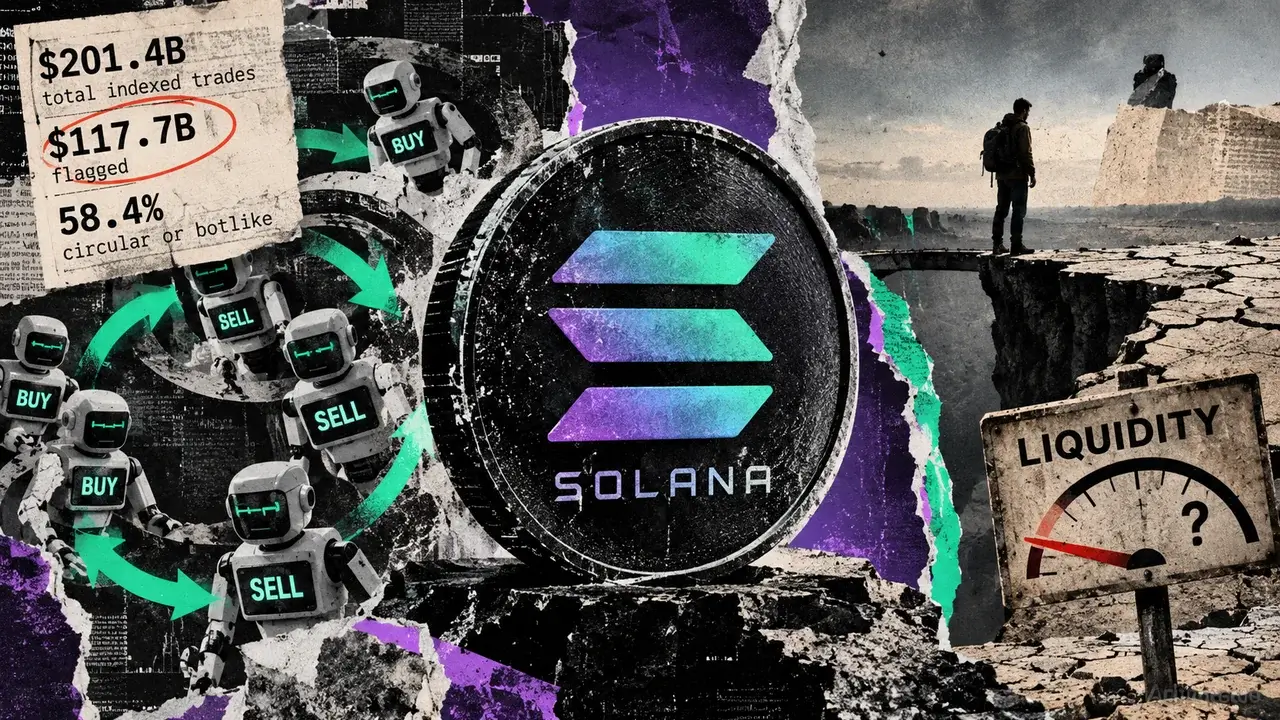
Bitquery flagged $117.7 billion in Solana DEX trades in a 30-day sample, where repeated round trips supplied much of the recorded turnover. The blockchain data company's Sept. 24 reconstruction challenges using gross volume as a stand-in for demand from independent traders.
It leaves a question of how much an outside user could actually trade at a useful price in the same pools.
From Aug. 24 through Sept. 22, Bitquery examined $201.4 billion in trades it could value in dollars across Solana pools it indexes. Its rules classified 58.4% of that sample as circular or botlike, and about $111.6 billion of the flagged amount (95%) involved buying and selling the same token through the same pool inside one transaction, according to its Solana analysis.
One Sept. 14 example shows how the number can grow. A wallet bought a token named Claude from a PumpSwap pool, while a second wallet sold nearly as many units back to that pool inside the same transaction.
Bitquery found that both signed it, and the two pool trades recorded about $2,000 of volume. The token name does not indicate a connection to Anthropic.
Bitquery also identified two groups of 20 and 50 wallets with strikingly similar trading records. Together they accounted for $26.3 billion of the flagged amount. The firm grouped wallets by their volumes and token counts, without tracing their funding.
Related Reading A tiny cluster of Solana bots unlocked a 3x trading advantage by routing through one proprietary protocolBitquery counted trades priced in SOL, USDC or USDT in pools covered by its index. Other quote assets and some routed venues fell outside the sample, and the firm says fewer of its checks could run on Solana than on the other chains it studied.
Its figure reflects the activity its rules flagged in one window, not a rate for all Solana DEX trading.
Bitquery flagged $117.7 billion of $201.4 billion in priced Solana DEX trades, mostly involving same-pool buys and sells.A Sept. 24 snapshot of DefiLlama's Solana DEX dashboard showed $75.9 billion in rolling 30-day volume. Bitquery's window ended two days earlier.
Subtracting Bitquery's flagged dollars from that dashboard total would combine different dates and different pools.
Bitquery also made a same-date comparison, saying $83.7 billion of its indexed Solana trades were outside its flagged category, while DefiLlama counted $78.8 billion across the chain for Aug. 24 through Sept. 22.
Bitquery described the close totals as partly coincidental: DefiLlama includes venues Bitquery misses and excludes pools Bitquery keeps. The $83.7 billion is a remainder under Bitquery's rules, with its independent-user share still unknown.
On PumpSwap, DefiLlama's published method counts pools with specified quote tokens, at least $5,000 in total value locked, and at least 50 unique traders. Its adapter code implements those thresholds.
Bitquery screens transactions and wallet behavior instead. A pool balance and a count of trading addresses alone cannot show whether those addresses represent separate users.
This is why the competitive signal changes after screening. A venue may lead a turnover table while a portion of its recorded activity comes from wallets repeatedly crossing the same pool.
Equally, trades left outside Bitquery's screen remain unclassified by that test. Neither dashboard gives a matched measure of orders an independent trader could execute without substantial price movement.
Solana's pool history is not its depthThe exact Claude/SOL pool in Bitquery's transaction example displayed effectively empty reserves and $0 liquidity in a GeckoTerminal snapshot retrieved Sept. 24.
Its prior trading record could still be large while a new trader faced no meaningful liquidity there at the time of that snapshot.
The relevant execution test needs a token pair, trade size, and timestamp. Jupiter's swap documentation describes a quoted expected output followed by an actual execution result, with prices able to move before a quote is used.
To estimate the liquidity available after repeated round trips are set aside, historical reserves, comparable routes, and realized fills for flagged and unflagged pools are needed. Bitquery's volume total alone supplies none of those measurements.
The token pools in this investigation also sit beside distinct Solana markets. Jump Crypto's April publication examined March fills in SOL/stablecoin markets run through proprietary automated market makers.
Jump participates in that market, and those results cannot describe execution in the PumpSwap token pools Bitquery flagged. One segment's results should not determine the chain's liquidity standing.
Fees offer another incomplete shortcut. DefiLlama's chain-fee table tracks a separate measure from PumpSwap's liquidity-provider, protocol, and creator fees. Neither recorded turnover nor any of those fee totals tells a trader the price impact of a particular order.
Bitquery's new screen shows why Solana's reported DEX activity needs a closer look at who generates it and where.
The $117.7 billion figure applies to indexed pools and rules, while the spendable depth left for independent users remains unmeasured. Solana's competitive position on execution will depend on pair- and size-specific fills across comparable venues.
The post Solana DEX volume spike hides circular trades, and automated bots are blamed appeared first on CryptoSlate.
Why this matters
Solana is showing up inside the Stablecoins theme, so this story is worth tracking for follow-through rather than treating it as a one-off headline.
Original source
Read on CryptoSlateRelated market context
EU Banking Regulator Takes Over Key Oversight of Circle’s USDC Stablecoin
The European Banking Authority (EBA) classified Circle's USDC as a significant e-money token under the Markets in Crypto-Assets Re...

Samsung Wallet adds USDC transfers on Solana for US Galaxy users
Samsung's integration of USDC on Solana into its Wallet app could accelerate mainstream crypto adoption by simplifying cross-borde...
Bitmex Faces $26 Million Claim Over 1,053 Losing Bitcoin Trades
A British software engineer wants 324.8 BTC back from Bitmex, claiming the cryptocurrency exchange had no legal authority to offer...

SEC Crypto: What do the Coinbase and MARA Binary Options Mean?
In SEC crypto news, the commission has reportedly approved standardized binary options that pay a predetermined cash amount if a s...

Bitcoin Price Prediction: Can BTC Rebound After a Brutal Sell-off?
Bitcoin is trading at $81,100, down 2.5% over 24 hours. The larger move has been rougher as it briefly slid toward $80,000 as soon...
Nearly $1 billion in crypto bets liquidated as bitcoin, ether and XRP slide
Ether accounted for nearly 60% of the forced closures across the two largest cryptocurrencies, falling roughly twice as much as bi...