This blockchain just voted to shut itself down for a Solana-powered AI pivot
ZetaChain's on-chain governance has approved retiring the network’s standalone blockchain and moving ZETA to Solana as the project pivots toward private AI. Proposal 68 passed after voting ended Sept. 20, with about 99.4...
Archive context
Older archive item. Useful for background and entity history, but not a fresh market-moving signal.
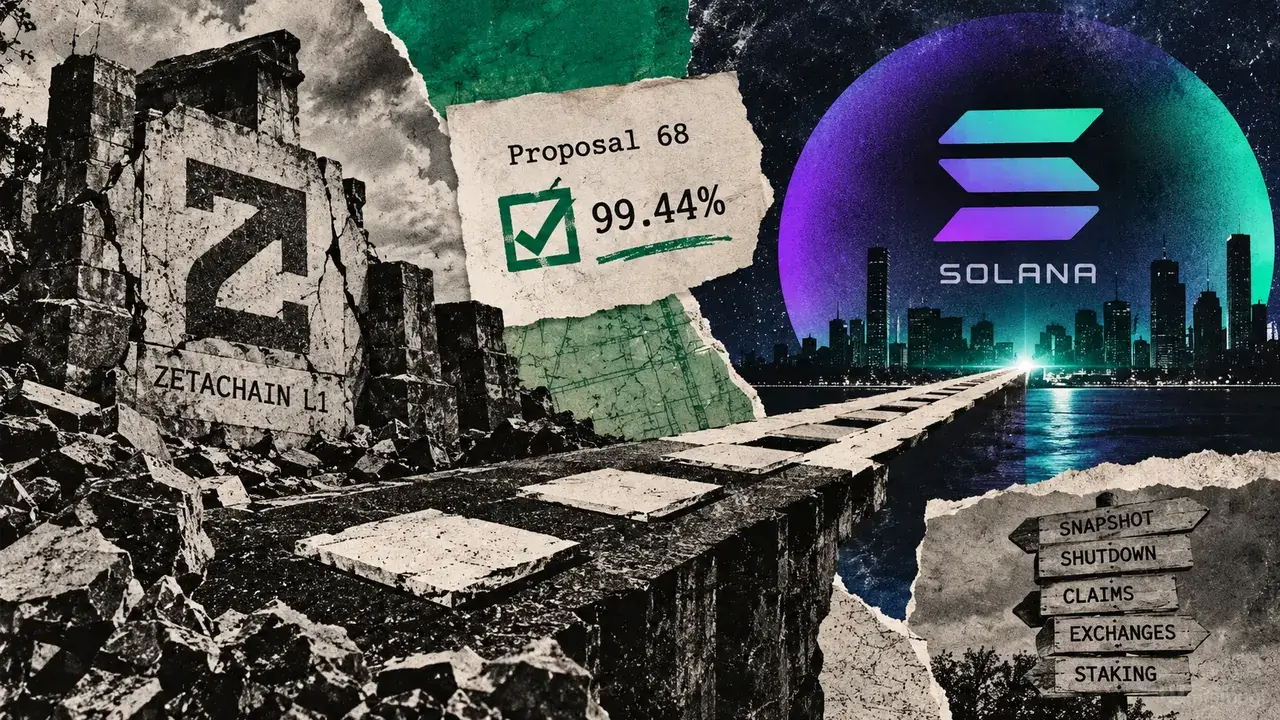
ZetaChain's on-chain governance has approved retiring the network’s standalone blockchain and moving ZETA to Solana as the project pivots toward private AI.
Proposal 68 passed after voting ended Sept. 20, with about 99.44% of ballots supporting the plan. The on-chain tally showed 263.65 million ZETA voting in favor, 744,658 voting against, and 752,300 abstaining, giving core contributors a mandate to prepare the migration.
The vote does not immediately move tokens or shut down the network.
ZetaChain says its own L1 no longer fitsThe planned shutdown marks a sharp strategic shift for a project founded in 2021 to connect otherwise separate blockchains.
ZetaChain spent years building a Cosmos SDK-based layer-1 designed to let applications interact with assets and contracts across networks including Bitcoin, Ethereum and Solana. Earlier this year, however, the project began concentrating resources on Anuma, a private multi-model AI application built around what it calls a Private Memory Layer.
ZetaChain now says maintaining its own blockchain no longer helps that effort. In Proposal 68, the project said operating a Cosmos-based network requires coordinating upstream security advisories and patches across dozens of independent validators, an operational burden it expects to increase as AI tools make vulnerabilities easier to find.
Moving to Solana would replace that validator infrastructure and let contributors focus on Anuma and the AI application layer. ZetaChain said “every contributor hour” would shift toward ZETA, Anuma and development on Solana.
Related Reading Helium community votes to migrate to Solana, scores new T-Mobile partnershipThe project says Anuma has attracted more than 300,000 users since February and processed more than 1 million requests across 35 AI models. Each Anuma account also includes a wallet, meaning the migration could bring those users into the Solana ecosystem alongside the token.
ZetaChain argues Solana offers the transaction speed, low fees, liquidity, and emerging agent-payment infrastructure needed for AI applications that may make frequent payments or model calls. It cited confirmations of about 400 milliseconds, more than $15 billion of stablecoins on the network and roughly $70 billion in monthly decentralized-exchange volume.
ZETA shifts from securing a chain to accessing AIThe imminent token migration would also change ZETA's economic role within the project's ecosystem.
Native balances on ZetaChain would convert 1:1 into a Solana-native SPL token under the same ticker. Total supply would remain unchanged, and no additional tokens would be created. Once the migration is completed, the Solana token would become the canonical version of ZETA and ZetaChain’s own L1 would wind down.
The company is positioning ZETA as an access token for its AI products rather than primarily as the asset underpinning an independent proof-of-stake network.
Anuma already lets users lock ZETA in exchange for credits they can spend on AI usage, removing those tokens from circulating supply. ZetaChain wants other AI applications and agents on Solana to use the same system.
That strategy depends on whether Anuma can convert its early user growth into sustained demand and whether outside developers adopt ZetaChain’s memory layer.
The migration would give the token access to Solana’s larger trading and payments ecosystem, but it also removes the independent blockchain that previously formed the center of ZETA’s utility.
ZETA held on Ethereum and BNB Chain is outside Proposal 68, while existing vesting schedules would remain unchanged. Native balances moving from ZetaChain will shift from 18 decimal places to Solana’s nine and be rounded down, though the first proposal does not specify how fractional remainders will ultimately be treated.
Exchanges now hold part of the timetableThe next step depends heavily on centralized exchanges that list ZETA.
Core contributors said they will submit the second governance proposal only after those venues confirm how they intend to support the swap. Major exchanges require advance notice for token migrations, leaving the shutdown timetable dependent on those negotiations rather than a predetermined date.
That follow-up proposal is expected to establish the withdrawal window for assets still connected to ZetaChain, the snapshot and halt heights, when Solana claims begin, and how exchange-held balances convert. It will also spell out holder protections and the validator wind-down process.
The future of staking remains unresolved. Rewards will continue until the L1 shuts down, while ZetaChain says it is still exploring what staking could become after ZETA moves to Solana.
Until exchanges agree on those mechanics and token holders approve them, ZetaChain will continue operating the infrastructure it has voted to retire.
The post This blockchain just voted to shut itself down for a Solana-powered AI pivot appeared first on CryptoSlate.
Why this matters
Solana is showing up inside the DeFi theme, so this story is worth tracking for follow-through rather than treating it as a one-off headline.
Original source
Read on CryptoSlateRelated market context

Blur NFT Marketplace to Shut Down Next Month as Trading Slows
Blur announced that its website will close on November 12, 2026, while its Ethereum NFT marketplace contracts remain operational....
Once-largest Ethereum NFT marketplace Blur is shutting down after volumes collapse 99%
Blur will close its website on Nov. 12 after monthly trading fell from about $1.43 billion at its 2023 peak to under $7 million, t...

China’s top leadership calls for a national blockchain network, minus the tokens
China's blockchain push, sans tokens, may bolster state control over digital infrastructure, impacting global blockchain innovatio...

XRP Price Prediction: Ripple Token Outperforms Tech Stocks as Asian Markets Turn Red
XRP price fell to $1.38, losing up 2.5% over 24 hours, while Asian risk assets were under pressure, and South Korea’s KOSPI fell m...

Solana tops crypto mindshare, outpacing Bitcoin and Ethereum
Solana's rising mindshare could reshape crypto market dynamics, influencing investor sentiment and potentially altering future pri...

Solana reclaims top spot in tokenized equities DEX volume after 13 weeks
Solana's resurgence in tokenized equities DEX volume may drive increased market confidence and influence its valuation and adoptio...